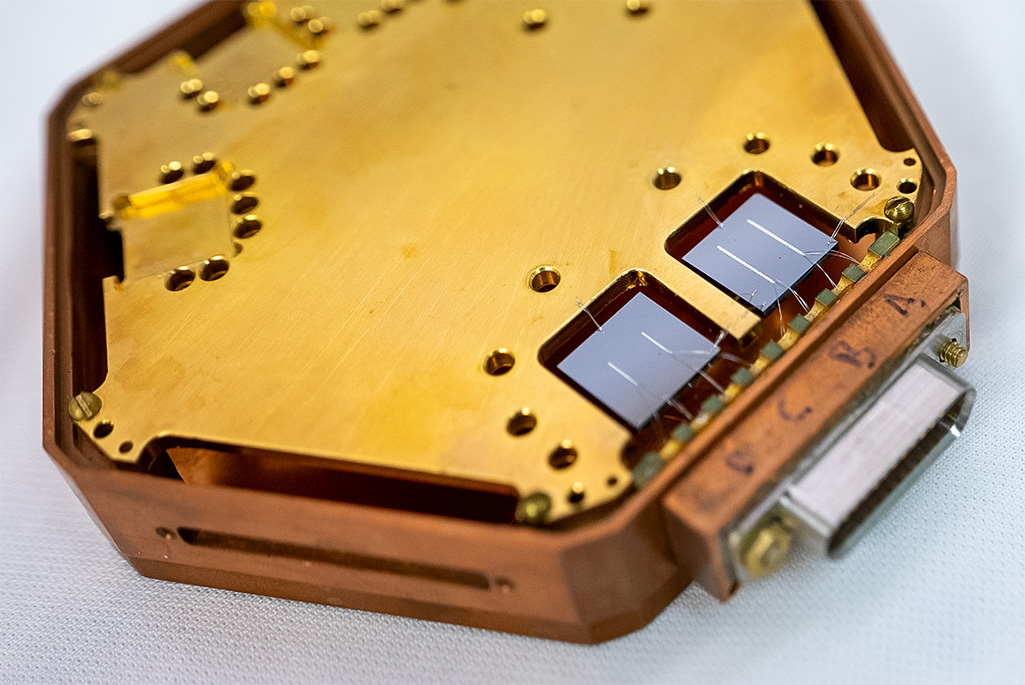
A new high-speed integrated circuit has been designed to reliably transmit large amounts of data from the Large Hadron Collider. Physicists at Southern Methodist University developed this “link-on-chip,” or LOC serializer circuit, for use in ATLAS, which is the largest particle detector at the LHC.
The LOC serializer was designed for the LHC’s high-radiation environment, and boasts high-data bandwidth, low-power dissipation, extremely high reliability and the ability to operate at cryogenic temperatures. It has a data transmission rate of 5.8 billion bits per second, a feature that will be even more important when the LHC ramps up the LHC’s luminosity.
“SMU’s LOC serializer is the fastest in our field for the moment,” said Jingbo Ye, associate professor of physics who led development of SMU’s LOC serializer. “In the next few years, we hope to increase the total speed by a factor of 62 more than what is installed in ATLAS.”
Ye and his team developed and perfected the LOC serializer over the past three years. It is made of complementary metal-oxide-semiconductor transistors in silicon-on-sapphire.