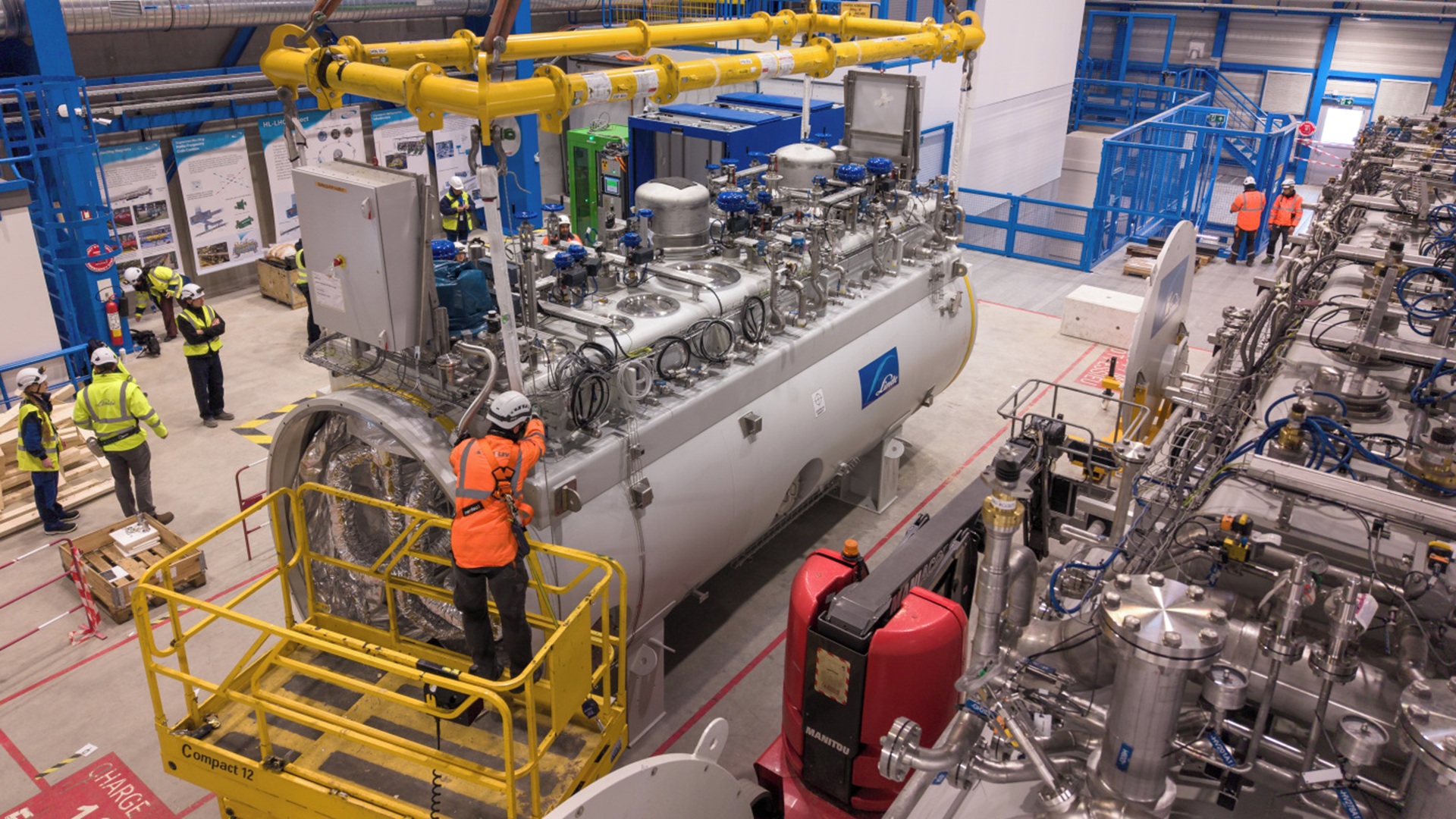
Cryomodule is a term that is most commonly used to refer to cryostats that contain superconducting radio frequency (SRF) cavities. Such cavities are used to accelerate charged particle beams and are a major component of modern particle accelerators.

Using the term cryomodule to refer to cryostats containing SRF cavities appears to stem from the original Continuous Beam Accelerator Electron Facility (now Jefferson Lab) machine design in the early 1990s in which cryomodules were defined as cryostats that contained four cryo-units (each with two SRF cavities) and two end cans. Since then, cryomodule has been used more generally to refer to the basic building block of SRF based accelerators that contains the cavities.
There is a wide range of accelerators that use cryomodules. These include: ISAC II at the TRIUMF lab in Canada, the 12 GeV Upgrade project at Jefferson Lab, the ATLAS machine at Argonne National Lab, the FLASH machine at DESY lab in Germany, and the ReA3 machine at Michigan State University. Proposed or under design accelerators using cryomodules include: Project X at Fermilab, XFEL at DESY, ERL at Cornell and FRIB at Michigan State University. The largest potential application of cryomodules will be in the proposed International Linear Collider which will contain roughly 2,000 cryomodules.

The design requirements for cryomodules can frequently be quite extensive.Cryomodules must keep the SRF cavities at their operating temperature (typically 2K) and provide connections for the RF power, cryogenic fluids, particle beam, the mechanism for adjusting the cavity resonant frequency and instrumentation.
Cryomodules also frequently contain superconducting magnets for beam steering and focusing. In order to permit proper functioning of the SRF cavities, cryomodules typically have strict requirements on both alignment and vibration. Designing cryomodules that meet these requirements while still being cost effective and reliable is a significant challenge and is an area of cryogenic engineering that has seen significant development since 1990.
Cryomodules are custom designed to meet the accelerator requirements. Design solutions vary greatly and depend upon such factors as the shape of the SRF cavity and its resonant frequency, the number of cryomodules in the accelerator, the presence of superconducting magnets, the level of ionizing radiation and magnetic fields present and the physical layout of the accelerator enclosure.

Figures 1-3 show examples of recent cryomodule designs.
Recent examples of cryomodules are given in: “Assembly, Installation, and Commissioning of the Atlas Upgrade Cryomodule”, J. Fuerst et al.; “The Injector Upgrade for the Superconducting Electron Accelerator S-DALINAC,” T. Kruerzeder et al.; both in Advances in Cryogenic Engineering Vol. 55A; and:
“Installation and Commissioning of the Superconducting RF Linac Cryomodules for the ERLP,” A.R. Goulden et al. in Adv. Cryo. Engr. Vol. 53B; “Commissioning of the ATLAS Upgrade Cryomodule,” P.N. Ostroumov et al., Proceedings 11th International Conference on Heavy Ion Accelerator Technology and “The TESLA Test Facility (TTF) Cryomodule: A Summary of Work to Date”, J.G. Weisend II et al. in Adv. Cryo. Engr. Vol. 39.