by Scott Courts, Applications Scientist at Lake Shore Cryotronics, scourts@lakeshore.com
In a recent study of cryogenic sensor users conducted by Lake Shore Cryotronics, CSA CSM, applications varied widely, from standard lab environment monitoring and control to applications like these:
• Measuring the temperature of samples and controlling the temperature of a dilution refrigerator
• Controlling laser target temperatures and controlling room-temperature structures for stable positioning
• Determining and controlling sample environment equipment in neutron scattering experiments
• Measuring temperature of liquid hydrogen targets for nuclear and particle experiments
For cryogenic applications, the most common types of temperature sensors are resistors, diodes and thermocouples. Choosing a sensor depends on application, response time and response range, sensitivity, stability, ease of use, packaging and optimum cost. Environmental factors are also critical to sensor selection as environmental effects, including ionizing radiation and magnetic fields, can impact accuracy. Mounting needs can suggest particular packaging.
Resistive Elements
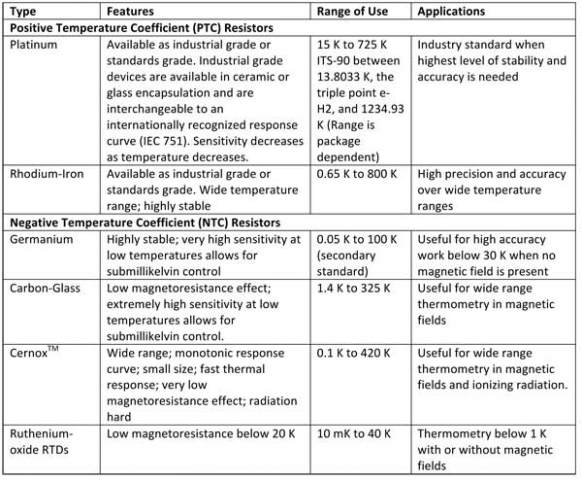 The most popular and widely available temperature sensor for low temperatures is a resistor. There are two main resistor classifications: Positive Temperature Coefficient (PTC) and Negative Temperature Coeffi-cient (NTC). PTC resistors are typically a pure metal, such as platinum, copper, or nickel, or a pure metal with small impurities, such as rhodium-iron or less common platinum-cobalt. Semiconductors such as germanium have NTC behavior.
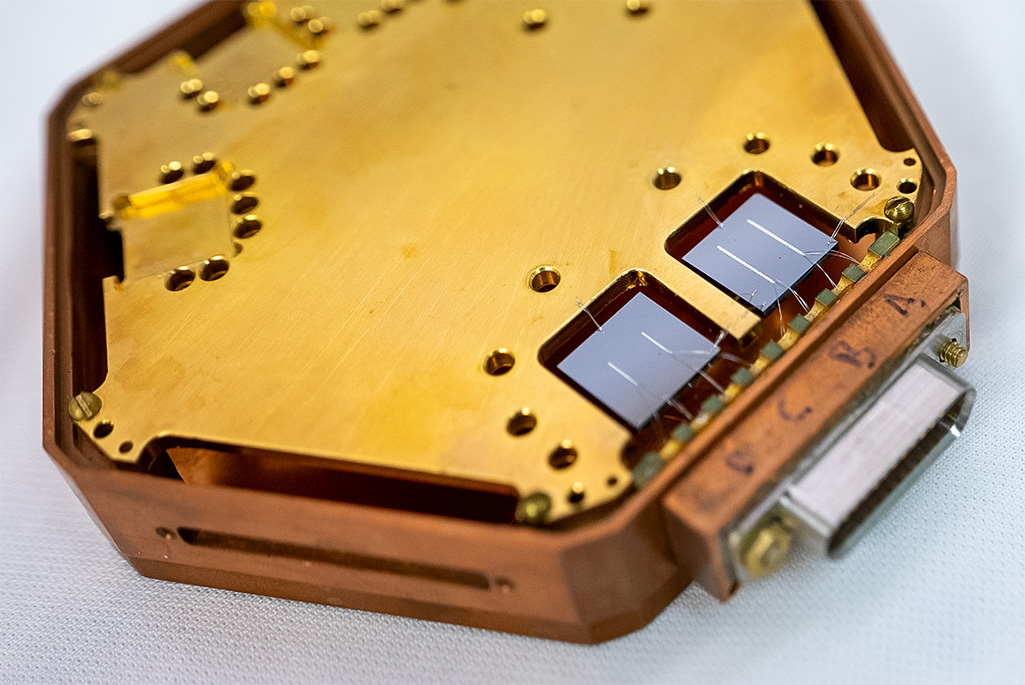
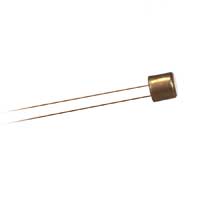
The most commonly used sensors at 0.2K and below are Cernox™ RTDs. These zirconium oxynitride sensors have a monotonic response curve and are useful from temperatures of 0.1K to 420K, and they typically have a sensitivity similar to a platinum RTD at room temperature. For lower temperatures, the dimensionless sensitivity can increase by a factor of 4. For applications needing small size and fast thermal response, a single bare chip (0.75 mm wide × 1 mm long × 0.2 mm thick) is available. The bare chip time constant at 4.2K is on the order of 1 millisecond.
Studies on Cernox RTDs in fields up to 32 Tesla and for temperatures down to 2K show that they have a low magnetic field induced temperature error. It is nearly an order of magnitude better than carbon-glass for T > 2K. Below 2K, the magnetoresistance increases sharply and the overall behavior in the magnetic field is more complex than for carbon-glass. Cernox sensors exhibit excellent stability when exposed to ionizing radiation.

Depending on the model and manufacturer, they can have low magnetoresistance below 20K. These devices have the lowest magnetoresistance below 1K of any commercially available RTD. To ensure stability, these sensors must be thermally shocked up to 60 times prior to calibration. The material does thermally anneal, and exposure to temperatures slightly above room temperature can require repeating the thermal cycling and calibration processes.
Diodes
Silicon diodes’ ease of use, high signal, large sensitivity, straightforward instrumentation, and interchangeability account for their appeal in many applications for temperatures from 1K to 500K. Because of their relatively high power dissipation, self-heating concerns limit their use at the lowest temperature. The temperature dependence of the forward voltage drop in a p-n junction biased at constant current is the operating principal for diode thermometry.
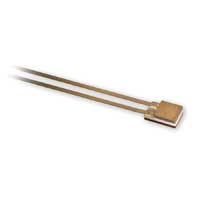
Magnetic fields strongly affect silicon diodes. Below 40K they are extremely sensitive to magnetic fields and the diode’s orientation in the field. However, a diode sensor made from GaAs or GaAlAs can be used for higher fields. GaAs and GaAlAs diodes have higher signal and sensitivities than silicon diodes, but these sensors are not interchangeable and must be individually calibrated.
Thermocouples
Thermocouples, based on the Seebeck effect, are most useful where low mass or differential temperature measurements are required. They must be calibrated in situ because the entire length of the wire contributes to the output voltage if it traverses a temperature gradient. Variations in wire composition, homogeneity, or even mechanical strain can affect the temperature readings. Many types of thermocouples are available for low temperature use. Common types are copper versus constantan (Type T), nickel-10% chromium versus constantan (Type E), nickel-10% chromium versus nickel-5% aluminum and silicon (Type K), chromel versus Au-0.07% Fe, chromel versus Au-0.03% Fe and chromel versus Cu-0.15% Fe. Type E thermocouples are recommended for use in the temperature range from 3 to 1144K in oxidizing or inert atmospheres. Au-Fe thermocouples are most commonly used for measurements below 10K.
All common thermocouple types except Types E and K have one leg of a high thermal conductivity material, requiring small wire diameters, small temperature gradients, or heat sinking to prevent the measurement from being affected by heat conducted along the wire. While only requiring a voltmeter for measurement, the requirement for a temperature reference junction is a disadvantage for many cryogenic temperature measurements, and the accuracy of the reading can be no greater than the accuracy of the reference junction temperature measurement.
Thermocouples are very difficult to use as low temperature thermometers in the presence of magnetic fields as the thermo-
electric power depends on both the temperature and magnetic field. Zero magnetic field effect is possible if thermocouple exposure to the magnetic field is isothermal, but that’s difficult to achieve in practice. Type E thermocouples have reproducible and relatively small magnetic field dependence, but only marginal temperature sensitivity below 10K.
Other Cryogenic Sensors
For aerospace and certain industrial applications, other sensors like fiber optic sensors offer advantages. For temperatures below 1K, thermometers have predominantly been resistive devices like germanium RTDs or carbon resistors. However, for temperatures below 50 mK the resistance can become extremely large, and even a low AC excitation can cause significant Joule heating in the sensor.
For thermometry below 20 mK, other temperature sensors are used. The most common is paramagnetic thermometry, which utilizes the Curie-Weiss law for magnetic susceptibility. The paramagnetic susceptibility, χ, increases inversely with temperature. The susceptibility is measured with a mutual inductance technique and can be used with a SQUID (Superconducting Quantum Interference Device) for maximum sensitivity. This type of thermometry is not limited to ultra-low temperatures. Currently, this technique is used for high-resolution thermometry at higher temperatures. Resolution on the order of 0.1 nK Hz-1/2 has been achieved near 2K. The most commonly used paramagnetic thermometer has been made using cerium magnesium nitrate (CMN) or lanthanum-diluted CMN.
The temperature dependence of the melting pressure in helium-3 is the basis for the He-3 melting pressure thermometer. A melting pressure thermometer contains both liquid and solid phases in a constant volume. The pressure changes due to temperature are measured by a capacitive sensor. The He-3 melting pressure thermometer has intrinsic fixed points and it was used to define the Provisional Low Temperature Scale of 2000 (PLTS-2000).
A nuclear orientation thermometer (NOT) is based upon the anisotropic emission of gamma radiation from radioactive material in a slightly magnetized host matrix. NOT has the advantage of being a primary thermometer, and proper implementation yields a direct measure of the temperature. Many radioactive isotopes have been used, but the most common is cobalt-60 covering roughly a 1 mK to 50 mK temperature range. Other radioactive isotopes may be used to cover higher temperature ranges. The achievable uncertainty is typically 1% of temperature with care, but it depends upon the source strength, temperature and counting times for the radiation intensity.
Capacitors are sometimes used for temperature measurement, but the largest application is in temperature control in high magnetic fields due to their magnetic field insensitivity. The capacitance is usually measured with an AC capacitance bridge. Some temperature controllers are designed to use a resistance temperature sensor to control temperature in zero magnetic field and then maintain the temperature in field with a capacitance sensor. The time response of capacitance sensors is usually limited by the physical size and low thermal diffusivity of the dielectric material. SrTiO3 capacitance temperature sensors are not detectably affected by magnetic fields, but they commonly experience calibration shifts after thermal cycling, and are known to drift with time while at low temperatures. Other commercially available capacitors have been investigated for use as cryogenic thermometers, but their use is not well established.
More details on all sensor types can be found on the Lake Shore website, www.lakeshore.com.