By Georgina Jedikovska
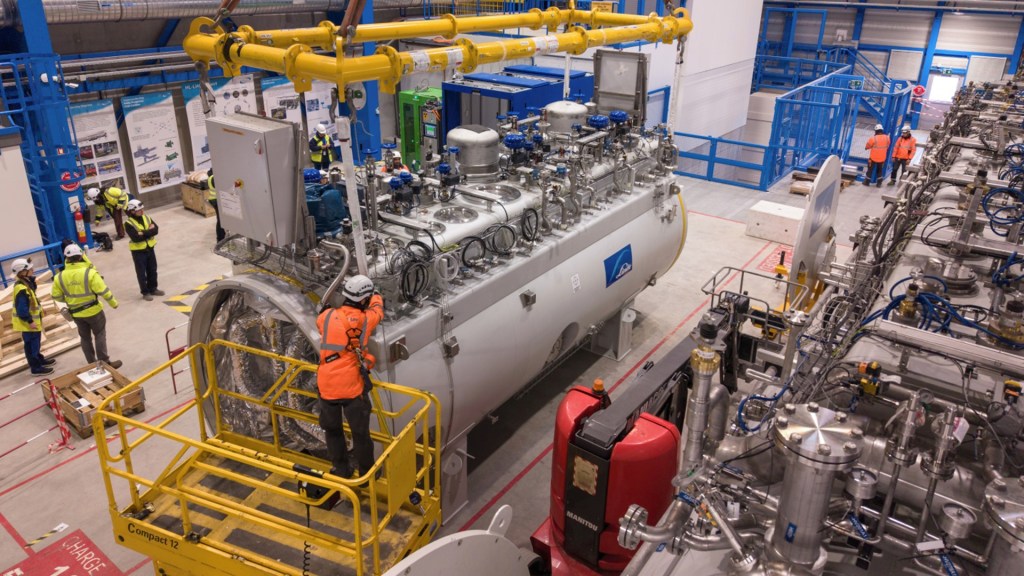
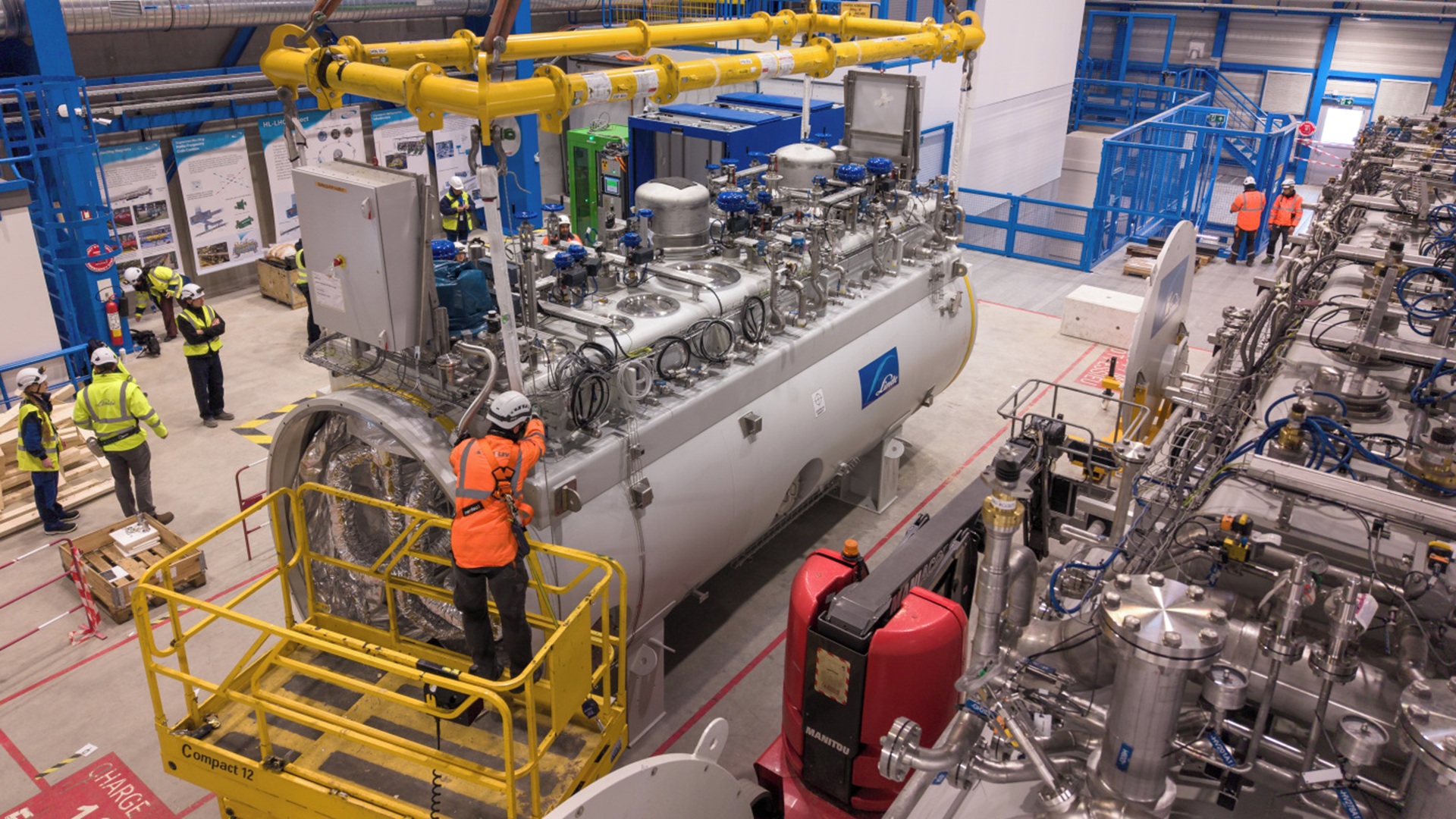
CERN engineers have transported two gleaming cryogenic “cold boxes” deep into the tunnels of the High-Luminosity Large Hadron Collider (HiLumi LHC), as part of the ambitious upgrade to the world’s most powerful particle accelerator.
Lowered close to the ATLAS and CMS experiment detectors, the two giant pieces of equipment were produced by the world’s largest industrial gas supplier Linde, located in the municipality of Pullach im Isartal, Germany.
The cold boxes are a critical part of the future HiLumi LHC accelerator’s two new refrigerators. They are reportedly set to prepare the advanced collider to operate at 1.9 kelvins (-456.25 degrees Fahrenheit). This temperature is just a few degrees above absolute zero (-459.67 degrees Fahrenheit).
“The two refrigerators, which will cool the new magnet systems installed on either side of the ATLAS and CMS experiments to -271.3 degrees Celsius (1.9 kelvins), are complex systems made up of a number of impressive pieces of equipment,” CERN representatives stated.
Chilling near absolute zero
These refrigerators will chill the HiLumi LHC‘s superconducting magnet systems, which are crucial for boosting the collider’s luminosity. The luminosity represents the rate at which particle collisions occur.
More collisions translate to more data, which, in turn, enables physicists to probe deeper into the building blocks of the universe. According to organization, the compressors and cold boxes were installed on the surface above the the ATLAS and CMS experiment points in December 2025. They will pre-cool the helium to 4.5 kelvins (451.48 degrees Fahrenheit).
The last couple of degrees needed to achieve -456.34 degrees Fahrenheit, roughly 3.6 degrees above absolute zero, will be reached by lowering the pressure of the helium circulating in the magnet cryostats.
This will be accomplished using four cold compressors connected in series and integrated into one of the cold boxes that have just been delivered. The cryogenic lines that will transport the helium are also being installed underground. “The teams have already completed the first phase of the installation work,” CERN said in a press release.
The HiLumi LHC upgrade
In June, CERN will begin the Long Shutdown 3 (LS3). It will enable the installation and commissioning of the High-Luminosity LHC equipment for the accelerator and the phase II upgrades of the ATLAS and CMS experiments.
The High-Luminosity LHC upgrade will upgrade the Large Hadron Collider (LHC), the world’s largest and highest-energy particle accelerator, so it can make even more discoveries after 2030. It is set to increase its total collision data tenfold.
“The HiLumi LHC will also explore uncharted territory and could reveal something completely new and unexpected,” Mark Thomson, CERN Director-General, stated. “That’s the whole point of exploring the unknown: you don’t know what’s out there”
Expected to start operations in the mid-2030s, the HiLumi LHC will give scientists an unprecedented chance to study known mechanisms with far greater precision, and track down new rare phenomena.
Over its timeline, the upgraded collider could generate around 380 million Higgs bosons. This represents a significant increase compared to the roughly 55 million Higgs bosons produced since the start of the original LHC.
[Source: interestingengineering.com]