ADVERTISEMENT

World-First in Oman

A momentous event unfolded as the world’s first-ever liquefied hydrogen carrier, Suiso Frontier, graced the shores of Sultan Qaboos Port in Muscat on August 14. Proudly crafted by the renowned Kawasaki Heavy Industries (KHI), this marks the long-anticipated debut of Suiso Frontier in the Sultanate of Oman. The name “Suiso”...
Breakthrough Enables Quench Detection in High-Field Magnets for Fusion Reactors

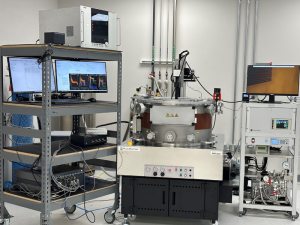
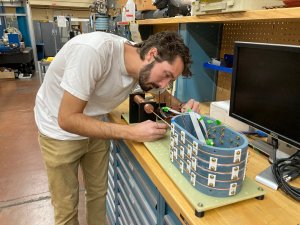
Researchers at Berkeley Lab’s Accelerator Technology & Applied Physics (ATAP) Division have developed a method for detecting and predicting the local loss of superconductivity in large-scale magnets that are capable of generating high magnetic fields. These high-field magnets are a core enabling technology for many areas of scientific research, medicine...

NASA Rocket Hardware Prepped for Shipment to Space Coast

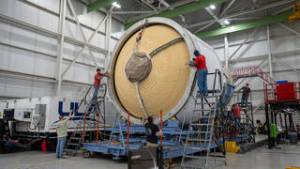
With Artemis teammates and media watching, United Launch Alliance (ULA) crews guided the interim cryogenic propulsion stage (ICPS) for NASA’s SLS (Space Launch System) rocket for Artemis III to the loading dock at ULA’s facility in Decatur, Alabama, July 31. ULA’s R/S RocketShip will transport the flight hardware to ULA’s...

Cryogenics at FAIR: Adaptability is Key

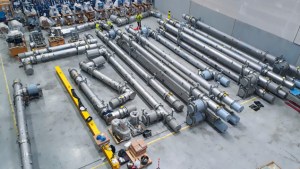
The Facility for Antiproton and Ion Research (FAIR) in Darmstadt, Germany, represents an ambitious reimagining of the GSI Helmholtz Center for Heavy Ion Research, one of Europe’s leading accelerator research laboratories. When it comes online for initial user experiments in 2027, FAIR will provide scientists from around the world with...

ADVERTISEMENT

Dewar

A dewar is a type of cryostat named after Sir James Dewar, the researcher who first developed the concept of a vacuum insulated container with silvered walls to reflect thermal radiation. Dewar was the first to liquefy hydrogen, and he created the device to store his discovery. The thermos bottle...

Stirling and Gifford-McMahon Cryocoolers

Stirling and Gifford-McMahon (GM) cryocoolers are two of the most commonly used cryocoolers in cryogenics. Both devices have a significant industrial base and operate at a wide range of temperatures and capacities. The thermodynamic cycles for both of these cryocoolers are quite similar. The Stirling cycle consists of a compressor,...

Liquefied Natural Gas (LNG)

A significant commercial application of cryogenics is the liquefaction, transport and storage of natural gas. Liquefied Natural Gas (LNG) is generally 95 percent methane with a few percent ethane and much lower concentrations of propane and butane. LNG liquefies at 111.6 K. Unlike many applications of cryogenics, the motivation for...

Magnetic Levitation

From http://www.superconductors.org. Magnetic-levitation is an application where superconductors perform extremely well. Transport vehicles such as trains can be made to “float” on strong superconducting magnets, virtually eliminating friction between the train and its tracks. Not only would conventional electromagnets waste much of the electrical energy as heat, they would have...

Superconductivity

From Superpower website. History of Superconductivity Superconductivity was discovered in 1911 by the Dutch physicist, Heike Kammerlingh Onnes when he was able to liquefy helium by cooling it to 4 Kelvin, or -452°F. This enabled him to cool other materials close to absolute zero and investigate their electrical properties. He...

Medical Applications of Cryogenics

Neutron Therapy Cryogenics is at the heart of nuclear accelerators. Accelerators such as Fermilab’s Tevatron make neutron therapy for cancer possible. From Fermilab Today 4/20/09: Fermilab currently offers neutron therapy. But staff at Fermilab designed and built the proton accelerator used by the nation’s first hospital-based treatment center to use...

Nuclear Physics

Al Zeller National Superconducting Cyclotron Lab (NSCL) at Michigan State University zeller@nscl.msu.edu Cryogenics has a long history in nuclear physics. The technology has its origins in the use of cold traps for maintaining a vacuum, which is required to prevent beam loss and for generating high voltages used in acceleration....

Getter materials to absorb out gassed materials?

Here’s one for the scientists: We would like to sell vacuum insulated pipe for high temperature fluid applications. Are there any good getter materials that we can place in the vacuum space of our VJP to absorb outgassed materials at elevated temperatures?