ADVERTISEMENT

NASA Inflatable Heat Shield Finds Strength in Flexibility

How does something that looks like a stack of orange inner tubes covered in a black tarp survive temperatures reaching 3,000 degrees Fahrenheit as it plunges through the atmosphere? An upcoming technology demonstration uses advanced materials to make a heat shield that’s tougher than it looks. Hypersonic Inflatable Aerodynamic Decelerator...

Pilot Project Tests New High-Capacity Transmission Lines

VEIR, an early-stage technology company based in Woburn, Mass., is pioneering the first application of superconducting transmission over long distances, a key component to deliver renewable sources of energy safely and reliably from where it is generated to where it is needed, often cross-country. VEIR is teaming up with National...

Thermal Control Designs Keep Astronauts Cool on Space Station

For astronauts, staying cool and comfortable on China’s Tiangong space station is no problem. The station orbits Earth in about 90 minutes at an altitude of 400 km. It experiences large fluctuations in temperature, ranging from 150 degrees Celsius when the station is exposed to the sun to minus 100...

First Radio-Astronomy Cryogenic Receivers with All-Metal 3D-Printed RF Components

The NAOJ ALMA Project and Advanced Technology Center have successfully fabricated corrugated all-metal 3D-printed horns for the ALMA Band 1 receivers (Radio Frequency: 35-50 GHz). Since around 2015, the NAOJ ALMA Project and the Advanced Technology Center have been studying the applications of additive manufacturing (AM), which produces three-dimensional objects by...

ADVERTISEMENT

Dewar

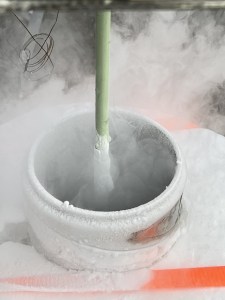
A dewar is a type of cryostat named after Sir James Dewar, the researcher who first developed the concept of a vacuum insulated container with silvered walls to reflect thermal radiation. Dewar was the first to liquefy hydrogen, and he created the device to store his discovery. The thermos bottle...

Stirling and Gifford-McMahon Cryocoolers

Stirling and Gifford-McMahon (GM) cryocoolers are two of the most commonly used cryocoolers in cryogenics. Both devices have a significant industrial base and operate at a wide range of temperatures and capacities. The thermodynamic cycles for both of these cryocoolers are quite similar. The Stirling cycle consists of a compressor,...

Liquefied Natural Gas (LNG)

A significant commercial application of cryogenics is the liquefaction, transport and storage of natural gas. Liquefied Natural Gas (LNG) is generally 95 percent methane with a few percent ethane and much lower concentrations of propane and butane. LNG liquefies at 111.6 K. Unlike many applications of cryogenics, the motivation for...

Magnetic Levitation

From http://www.superconductors.org. Magnetic-levitation is an application where superconductors perform extremely well. Transport vehicles such as trains can be made to “float” on strong superconducting magnets, virtually eliminating friction between the train and its tracks. Not only would conventional electromagnets waste much of the electrical energy as heat, they would have...

Superconductivity

From Superpower website. History of Superconductivity Superconductivity was discovered in 1911 by the Dutch physicist, Heike Kammerlingh Onnes when he was able to liquefy helium by cooling it to 4 Kelvin, or -452°F. This enabled him to cool other materials close to absolute zero and investigate their electrical properties. He...

Medical Applications of Cryogenics

Neutron Therapy Cryogenics is at the heart of nuclear accelerators. Accelerators such as Fermilab’s Tevatron make neutron therapy for cancer possible. From Fermilab Today 4/20/09: Fermilab currently offers neutron therapy. But staff at Fermilab designed and built the proton accelerator used by the nation’s first hospital-based treatment center to use...

Nuclear Physics

Al Zeller National Superconducting Cyclotron Lab (NSCL) at Michigan State University zeller@nscl.msu.edu Cryogenics has a long history in nuclear physics. The technology has its origins in the use of cold traps for maintaining a vacuum, which is required to prevent beam loss and for generating high voltages used in acceleration....

In search of a calculation for designing a cryostat

I am a final year physics student at the University of Birmingham, and as part of a group I am currently designing a cryostat. One of the calculations I need to make (very soon!) is how much heat will be conducted down the walls. All information I have found so...

Safety of ethylene glycol and pressurized oxygen

We are reviewing the product design of liquid filled differential level gauges and want to insure that they meet the industry requirements. The former license owner had authorized that a fill fluid of ethylene glycol (68%) and distilled water (32%) could be used for oxygen service up to 500 psi....