ADVERTISEMENT

Cryogenic Blast Freezing in Minutes Increases Throughput

The biotech and biopharma industries utilize freezers to rapidly freeze and store thermally sensitive products such as vaccines and biopharmaceuticals as well as biological materials such as blood plasma. However, conventional compressor-based systems can take hours to reach an ultra-low target temperature, which slows production throughput.  For these industries, the...

Element Strengthens Cryogenic and Hydrogen Testing Capacity

UK-based testing, inspection and certification services provider the Element Materials Technology Group (Element) has announced that it will expand its cryogenic testing capacities at its Milan laboratory. By investing in new fatigue testing frames, Element will strengthen its position in both aerospace and the energy sector by offering testing for hydrogen...

The Magneto-Optic Modulator

Many state-of-the-art technologies work at incredibly low temperatures. Superconducting microprocessors and quantum computers promise to revolutionize computation, but scientists need to keep them just above absolute zero (-459.67° Fahrenheit) to protect their delicate states. Still, ultra-cold components have to interface with room temperature systems, providing both a challenge and an...

Allen Dufort: Coding a cutting-edge space telescope

In July, as the world marveled at the first images of the Cosmic Cliffs and previously invisible areas of star birth revealed by the James Webb Space Telescope, Allen Dufort felt excited that he’d soon make his own contributions to space exploration. As a software engineer intern, Dufort is supporting Brown...

ADVERTISEMENT

Dewar

A dewar is a type of cryostat named after Sir James Dewar, the researcher who first developed the concept of a vacuum insulated container with silvered walls to reflect thermal radiation. Dewar was the first to liquefy hydrogen, and he created the device to store his discovery. The thermos bottle...

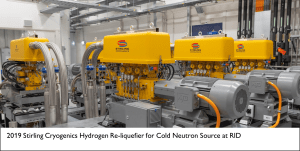
Stirling and Gifford-McMahon Cryocoolers

Stirling and Gifford-McMahon (GM) cryocoolers are two of the most commonly used cryocoolers in cryogenics. Both devices have a significant industrial base and operate at a wide range of temperatures and capacities. The thermodynamic cycles for both of these cryocoolers are quite similar. The Stirling cycle consists of a compressor,...

Liquefied Natural Gas (LNG)

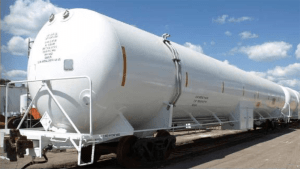
A significant commercial application of cryogenics is the liquefaction, transport and storage of natural gas. Liquefied Natural Gas (LNG) is generally 95 percent methane with a few percent ethane and much lower concentrations of propane and butane. LNG liquefies at 111.6 K. Unlike many applications of cryogenics, the motivation for...

Magnetic Levitation

From http://www.superconductors.org. Magnetic-levitation is an application where superconductors perform extremely well. Transport vehicles such as trains can be made to “float” on strong superconducting magnets, virtually eliminating friction between the train and its tracks. Not only would conventional electromagnets waste much of the electrical energy as heat, they would have...

Superconductivity

From Superpower website. History of Superconductivity Superconductivity was discovered in 1911 by the Dutch physicist, Heike Kammerlingh Onnes when he was able to liquefy helium by cooling it to 4 Kelvin, or -452°F. This enabled him to cool other materials close to absolute zero and investigate their electrical properties. He...

Medical Applications of Cryogenics

Neutron Therapy Cryogenics is at the heart of nuclear accelerators. Accelerators such as Fermilab’s Tevatron make neutron therapy for cancer possible. From Fermilab Today 4/20/09: Fermilab currently offers neutron therapy. But staff at Fermilab designed and built the proton accelerator used by the nation’s first hospital-based treatment center to use...

Nuclear Physics

Al Zeller National Superconducting Cyclotron Lab (NSCL) at Michigan State University zeller@nscl.msu.edu Cryogenics has a long history in nuclear physics. The technology has its origins in the use of cold traps for maintaining a vacuum, which is required to prevent beam loss and for generating high voltages used in acceleration....

Getter materials to absorb out gassed materials?

Here’s one for the scientists: We would like to sell vacuum insulated pipe for high temperature fluid applications. Are there any good getter materials that we can place in the vacuum space of our VJP to absorb outgassed materials at elevated temperatures?