
ADVERTISEMENT

Emission-Free Flying on the Horizon

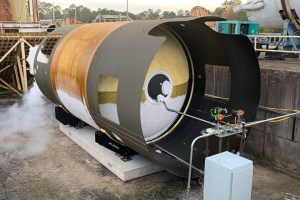
Boeing’s groundbreaking cryogenic fuel tank and Airbus’s hydrogen-powered jet engine bring promise to the future of aviation. A new type of cryogenic tank, designed and manufactured by Boeing, completed a critical series of tests at NASA’s Marshall Space Flight Center at the end of 2021. The successful test campaign advances the...


Physicists Observe “Quantum Boomerang” for First Time

Research on this project was also conducted by Jeremy L. Tanlimco, Hector Mas, Eber Nolasco-Martinez and Ethan Q. Simmons at UCSB; Tommaso Macri at Universidade Federal do Rio Grande do Norte in Brazil and Patrizia Vignolo at Universite Cote d’Azur in Nice, France. Image: The Weld Lab’s quantum boomerang showed...

Could Zero-Boiloff Storage Be Easier Than We Think?

CSA April Newsletter SponsorHigh-performance, highly reliable, long-lasting storage tanks for transporting hydrogen & helium molecules around the globe.​https://www.gardnercryo.com [Contact Jamie Luedtke for Newsletter Sponsorship] Home About Membership Login Calendar Cold Facts Buyer’s Guide News Publications Cryo Careers Resources Donate Join now Log in Cryogenic Society of America, Inc. Twitter Facebook...

2022 Women in Cryogenics

Each year, CSA celebrates women in the fields of cryogenics, superconductivity, and quantum in our annual Women in Cryogenics feature. This year, we meet eight women across various sub-industries of cryogenics who are not only making great accomplishments and impacts in their fields of work, but also who provide powerful advice for how...

Large Hadron Collider Comes Back to Life After Three-year Hiatus

The world’s most powerful particle accelerator—the Large Hadron Collider (LHC)—has sprung back to life after a three-year shutdown. After planned maintenance and upgrades, the Large Hadron Collider has been turned back on and will shortly start another run of cutting-edge experiments. The LHC, in Switzerland, was switched off in December 2018...

ADVERTISEMENT

Dewar

A dewar is a type of cryostat named after Sir James Dewar, the researcher who first developed the concept of a vacuum insulated container with silvered walls to reflect thermal radiation. Dewar was the first to liquefy hydrogen, and he created the device to store his discovery. The thermos bottle...

Stirling and Gifford-McMahon Cryocoolers

Stirling and Gifford-McMahon (GM) cryocoolers are two of the most commonly used cryocoolers in cryogenics. Both devices have a significant industrial base and operate at a wide range of temperatures and capacities. The thermodynamic cycles for both of these cryocoolers are quite similar. The Stirling cycle consists of a compressor,...

Liquefied Natural Gas (LNG)

A significant commercial application of cryogenics is the liquefaction, transport and storage of natural gas. Liquefied Natural Gas (LNG) is generally 95 percent methane with a few percent ethane and much lower concentrations of propane and butane. LNG liquefies at 111.6 K. Unlike many applications of cryogenics, the motivation for...

History of Cryogenics

From the Fall 1999 issue of Cold Facts magazine Millennium Breakthroughs A variety of CSA members give different perspectives on the past millennium: What were the most significant breakthroughs in cryogenics during the past millennium? Prof. R.G. Scurlock, Kryos Technology, scurlock@soton.ac.uk (“Breakthrough” = way through obstacles — Oxford English Dictionary)...

Cryobiology

Andreas Sputtek Past President Society for Cryobiology sputtek@uke.uni-hamburg.de or http://www.sputtek.de/. The word cryobiology (from the Greek words “cryo” = cold, “bios” = life, and “logos” = science) literally signifies the science of life at low temperatures. In practice, this field comprises the study of any biological material or system (e.g.,...

Cryogenic Insulation

James E. Fesmire Cryogenics Test Laboratory NASA Kennedy Space Center james.e.fesmire@nasa.gov Introduction In today’s world, the use of cryogenics and low-temperature refrigeration is taking a more and more significant role. From the food industry, transportation, energy, and medical applications to the Space Shuttle, cryogenic liquids must be stored, handled, and...

Cryogenic Treatment of Materials

F.J. Diekman Controlled Thermal Processing, Inc. info@metal-wear.com Cryogenic Processing (also called cryogenic treatment, and incorrectly “cryogenic tempering”) is a process that uses cryogenic temperatures to modify materials to enhance their performance. Cryogenic Processing involves the slow reduction in temperature of the material to at least -300°F (-185°C) and holding the...


