ADVERTISEMENT

The Most Powerful MRI Scanner in the World Delivers Its First Images

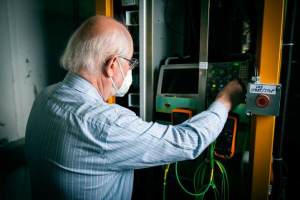
In September, the 11.7 Tesla MRI of the Iseult project, the most powerful in the world for human imaging, has just unveiled its first images. They validate the entire process that has enabled, thanks to multiple technological breakthroughs, the transformation of an “outstanding” magnet, delivered in 2017 to the French...

Book Review: The Safe Use of Cryogenic Technologies by Robert Done

It is becoming common for large-scale scientific projects to include cryogenic systems provided by other countries. Examples of this include CERN, the European Spallation Source, ITER and the PIP II project at Fermilab (CSA CSM). While these contributions are quite valuable, one of the big challenges in such projects is...

Cool Fuel: Hydrogen, Lenses and Lasers, Oh My!

The bar for getting the suffix of PhD after your name is high – you have to fundamentally change the philosophy in a field. As a faculty member responsible for training some of these individuals, I’m sometimes faced with the conundrum that advancing the philosophy implies that I have to...

Groundbreaking Alternative to Invasive Breast Cancer Surgery Now Available in Monroe NJ

Patients in Central New Jersey with early-stage breast cancer can now access a highly effective treatment that does not require traditional invasive surgery. Performed at Princeton Radiology's Minimally Invasive Care Center in Monroe Township by interventional radiologist Kenneth R. Tomkovich, MD, the procedure, called cryoablation, uses a small needle and...

INEOS Announces over €2 Billion Investment in Green Hydrogen Production

INEOS has announced that it is to invest more than €2 billion into electrolysis projects to make zero carbon, green hydrogen across Europe. Its first plants will be built in Norway, Germany, Belgium with investment also planned in the UK and France. The announcement was made on October 18. INEOS,...

Heating Up Quantum Science Education with Laser Cooling

A series of interactive workshops developed by Columbia University physicist Sebastian Will and STEMteachersNYC will give educators tips and tools to cover quantum science in their classrooms. If you imagine a laser, you might think of beams of light popping balloons or slicing through a metal slab like butter. Lasers...

ADVERTISEMENT

Dewar

A dewar is a type of cryostat named after Sir James Dewar, the researcher who first developed the concept of a vacuum insulated container with silvered walls to reflect thermal radiation. Dewar was the first to liquefy hydrogen, and he created the device to store his discovery. The thermos bottle...

Stirling and Gifford-McMahon Cryocoolers

Stirling and Gifford-McMahon (GM) cryocoolers are two of the most commonly used cryocoolers in cryogenics. Both devices have a significant industrial base and operate at a wide range of temperatures and capacities. The thermodynamic cycles for both of these cryocoolers are quite similar. The Stirling cycle consists of a compressor,...

Liquefied Natural Gas (LNG)

A significant commercial application of cryogenics is the liquefaction, transport and storage of natural gas. Liquefied Natural Gas (LNG) is generally 95 percent methane with a few percent ethane and much lower concentrations of propane and butane. LNG liquefies at 111.6 K. Unlike many applications of cryogenics, the motivation for...

Magnetic Levitation

From http://www.superconductors.org. Magnetic-levitation is an application where superconductors perform extremely well. Transport vehicles such as trains can be made to “float” on strong superconducting magnets, virtually eliminating friction between the train and its tracks. Not only would conventional electromagnets waste much of the electrical energy as heat, they would have...

Superconductivity

From Superpower website. History of Superconductivity Superconductivity was discovered in 1911 by the Dutch physicist, Heike Kammerlingh Onnes when he was able to liquefy helium by cooling it to 4 Kelvin, or -452°F. This enabled him to cool other materials close to absolute zero and investigate their electrical properties. He...

Medical Applications of Cryogenics

Neutron Therapy Cryogenics is at the heart of nuclear accelerators. Accelerators such as Fermilab’s Tevatron make neutron therapy for cancer possible. From Fermilab Today 4/20/09: Fermilab currently offers neutron therapy. But staff at Fermilab designed and built the proton accelerator used by the nation’s first hospital-based treatment center to use...

Nuclear Physics

Al Zeller National Superconducting Cyclotron Lab (NSCL) at Michigan State University zeller@nscl.msu.edu Cryogenics has a long history in nuclear physics. The technology has its origins in the use of cold traps for maintaining a vacuum, which is required to prevent beam loss and for generating high voltages used in acceleration....