ADVERTISEMENT

Call for Photo Submissions: Support the AIP Visual Archives

AIP is working to enrich Niels Bohr Library & Archives collections by improving the documentation of women and underrepresented people in the physical sciences.  They collect visual documentation of the personal and professional lives of physical scientists. Their collection contains images of modern American physicists, astronomers, geophysicists and many other kinds of scientists.   In general, they...
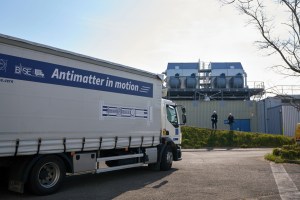
BASE Experiment at CERN Succeeds in Transporting Antimatter

Today, in a world first, a team of scientists from the BASE experiment at CERN successfully transported a trap filled with antiprotons in a truck across the Laboratory’s main site. The team managed to accumulate a cloud of 92 antiprotons in an innovative portable cryogenic Penning trap, then disconnect it from the...

Solving a Mystery in Dark Matter Detectors Could Improve Quantum Computers

By Lauren Biron Although dark matter makes up most of the mass in our universe, it has never been directly observed. To hunt for lighter dark matter and other rare phenomena, researchers must solve a puzzle in their supersensitive detectors: an unexpected number of low-energy events, called the “low-energy excess”...

Hydrogen Aviation Advances With Airbus and RWTH Aachen’s GENtwoPRO Fuel Cell Project

By Erin Kilgore If you’ve been tracking the future of hydrogen aviation, you know it’s a path packed with big ideas and tricky engineering puzzles. Now, Airbus and RWTH Aachen University have kicked off an Airbus RWTH Aachen partnership laser-focused on a near-term, high-impact goal: using scalable fuel cell technology to power regional aircraft. Early in Airbus’s hydrogen journey,...

ADVERTISEMENT

Dewar

A dewar is a type of cryostat named after Sir James Dewar, the researcher who first developed the concept of a vacuum insulated container with silvered walls to reflect thermal radiation. Dewar was the first to liquefy hydrogen, and he created the device to store his discovery. The thermos bottle...

Stirling and Gifford-McMahon Cryocoolers

Stirling and Gifford-McMahon (GM) cryocoolers are two of the most commonly used cryocoolers in cryogenics. Both devices have a significant industrial base and operate at a wide range of temperatures and capacities. The thermodynamic cycles for both of these cryocoolers are quite similar. The Stirling cycle consists of a compressor,...

Liquefied Natural Gas (LNG)

A significant commercial application of cryogenics is the liquefaction, transport and storage of natural gas. Liquefied Natural Gas (LNG) is generally 95 percent methane with a few percent ethane and much lower concentrations of propane and butane. LNG liquefies at 111.6 K. Unlike many applications of cryogenics, the motivation for...

Wind Tunnels

Dr. Robert Kilgore The development of the cryogenic wind tunnel is one of many significant breakthroughs in both cryogenics and wind-tunnel technology made during the past millennium. Interest in the development of high-speed commercial and military aircraft resulted in a review of problems of flow simulation in transonic wind tunnels...

History of Cryogenics

From the Fall 1999 issue of Cold Facts magazine Millennium Breakthroughs A variety of CSA members give different perspectives on the past millennium: What were the most significant breakthroughs in cryogenics during the past millennium? Prof. R.G. Scurlock, Kryos Technology, scurlock@soton.ac.uk (“Breakthrough” = way through obstacles — Oxford English Dictionary)...

Cryobiology

Andreas Sputtek Past President Society for Cryobiology sputtek@uke.uni-hamburg.de or http://www.sputtek.de/. The word cryobiology (from the Greek words “cryo” = cold, “bios” = life, and “logos” = science) literally signifies the science of life at low temperatures. In practice, this field comprises the study of any biological material or system (e.g.,...

Cryogenic Insulation

James E. Fesmire Cryogenics Test Laboratory NASA Kennedy Space Center james.e.fesmire@nasa.gov Introduction In today’s world, the use of cryogenics and low-temperature refrigeration is taking a more and more significant role. From the food industry, transportation, energy, and medical applications to the Space Shuttle, cryogenic liquids must be stored, handled, and...

Getter materials to absorb out gassed materials?

Here’s one for the scientists: We would like to sell vacuum insulated pipe for high temperature fluid applications. Are there any good getter materials that we can place in the vacuum space of our VJP to absorb outgassed materials at elevated temperatures?