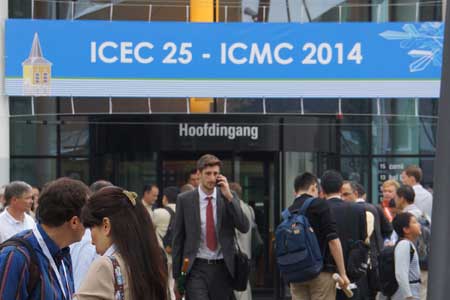
 The 25th International Cryogenic Engineering Conference and International Cryogenic Materials Conference (ICEC25/ICMC2014) took place July 7-11 at the University of Twente, Enschede, the Netherlands.
On Monday, July 7, three short courses were held and very well attended. A total of 476 participants (including 17 companions) from 23 countries attended the conference, a number well beyond expectations. The exhibition drew 25 exhibitors.
There were six plenary sessions, 133 oral presentations—12 invited—and 215 posters in three sessions. Online publication of all presentations, courses, orals and posters in Indico was very successful.
Conference chairs were Dr. Marcel ter Brake, University of Twente, ICEC, and Dr. Herman ten Kate, University of Twente and CERN, ICMC. A team of about 35 people, including staff and students of the research group, other students and the local congress bureau, did an excellent job of handling the conference.
Several important awards were conferred at the conference. The 2014 ICMC Mendelssohn award was presented to Dr. Ralph Scurlock, former BOC professor of cryogenic engineering and director, Institute of Cryogenics, University of Southampton, now director, Kryos Technology. (See page 8 for the text of his address.) The inaugural ICMC award for a young talent (under 40) went to Fumitake Kametani, Department of Materials Science, Kyoto University, for outstanding research on the microstructure of cuprate and pnictide-based high temperature superconductors. Also being given for the first time was the ICEC Gustav and Ingrid Klipping Award, which went to Dr. Younghua Huang, associate professor at Shanghai Jiao University for his work on the thermophysical properties of helium-3 down to the millikelvin range. The award was presented by Elisabeth Engelmann-Klipping, the late Klippings’ daughter.
There was ample time for networking and socializing, as the evening programs included a welcome reception, exhibition reception, museum evening and banquet with musical entertainment. Generous lunches and breaks were also included in the conference fee. Attendees enjoyed the welcome reception on Monday in the University’s Faculty Club. The exhibitors’ reception was held on Tuesday in the main conference center, the Waier, on campus. On Wednesday, a museum party was held in the Twentse Welle, which showcases the history, nature and culture of the Twente region. Housed in a former textile factory with its unique atmosphere, the venue lent itself to lively networking. On Thursday, the conference banquet was held at the restaurant De Jaargetijden, located in Het Volkspark, Encschede’s central park, which dates from 1872. This venue provided an attractive setting with lots of live music.
Three Friday excursions were well attended: There was a visit to AmpaCity, the superconducting joint cable/fault current limiter project in the German city of Essen, a common project of RWE, Nexans and KIT, followed by a visit to the High Magnetic Field Laboratory at Radboud University in Nijmegen, part of the European Magnetic Field Laboratory. Another trip, to the city of Eindhoven, combined visits to Philips Healthcare’s MRI assembly and test site, Stirling Cryogenics’ cryocooler and liquefaction plant facility, and Thales Cryogenics, a specialist in miniature coolers. The third excursion was on the University of Twente campus, including the Nanolab of the MESA+ Institute and the laboratories of the EMS group, the local conference organizer. Throughout the conference, attendees could also visit the EMS lab.
The next conference, ICEC26/ICMC2016, will be held March 7-11, 2016, in Delhi, India.
View the ICEC25/ICMC2014 and the booth gallery