Interlune, a U.S.-based space resources company, has signed landmark agreements to supply lunar-sourced helium-3 to both Maybell Quantum and the U.S. Department of Energy (DOE).
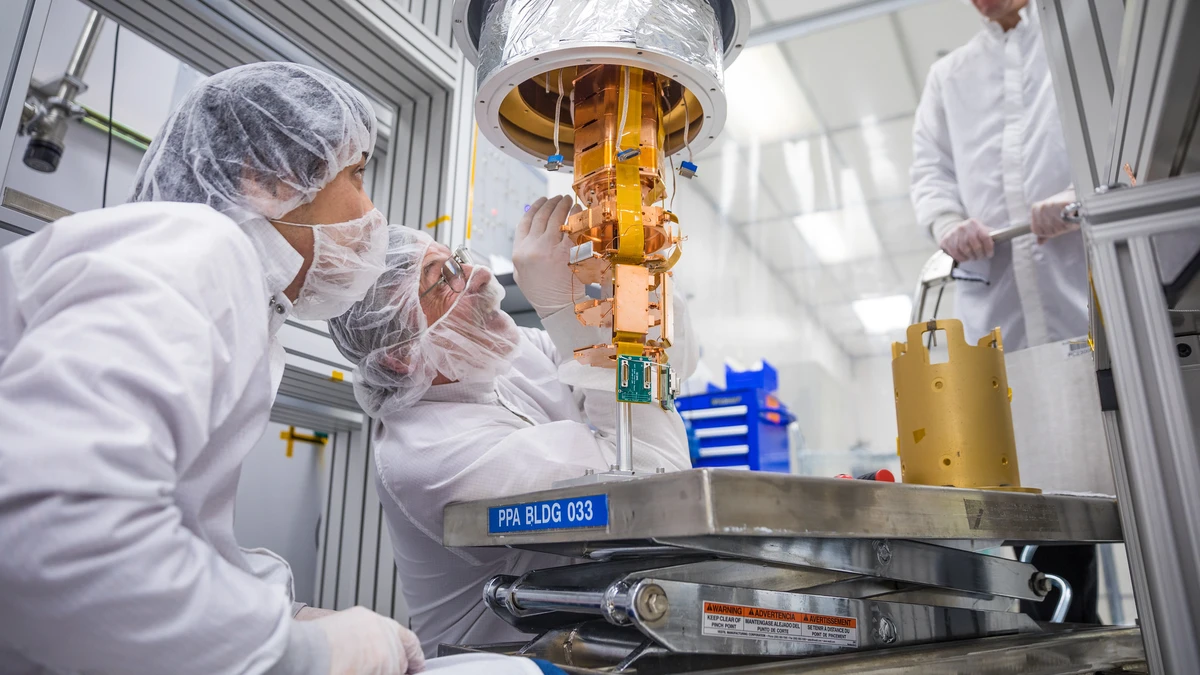
Maybell Quantum will be Interlune’s first commercial customer, receiving thousands of liters of helium-3 annually from 2029 to 2035. The helium-3 will support Maybell’s advanced cryogenic platforms, including its compact “Big Fridge” dilution refrigerator, which operates below 10 millikelvin and boosts qubit density significantly compared to other systems.
Simultaneously, Interlune reached a first-of-its-kind deal with the DOE Isotope Program to deliver three liters of helium-3 from the Moon by 2029—the first government purchase of a space-derived natural resource. Helium-3 is rare on Earth but found in recoverable quantities on the Moon due to solar wind exposure, and it is critical for quantum communication, neutron detection, fusion research, and ultra-low-temperature refrigeration.
These deals support Interlune’s plan to build a commercial supply chain for helium-3, sourcing it both from Earth and the Moon. Extraction will occur through a pilot plant deployed on the lunar surface, using the company’s proprietary, compact regolith harvester. Processing must occur in situ, with roughly the volume of a swimming pool’s worth of regolith required to extract just three liters of gas.
Interlune has raised $18 million in seed funding and secured additional support from NASA’s TechFlights program, the National Science Foundation, and the DOE. It plans a resource validation mission in 2027 and aims to deploy its pilot lunar facility by 2029.
If successful, Interlune would become the first dual-source helium-3 supplier at scale—serving growing needs in fusion energy, defense, quantum networking, and cryogenic computing. However, the venture carries significant risks, including technical hurdles, high costs, regulatory uncertainty, and the challenge of returning resources from the Moon. Still, the DOE’s involvement and Maybell’s order underscore strong interest from both government and commercial sectors in advancing space-based helium-3 infrastructure.
Published: May 8, 2025, Quantum Computing Report