ADVERTISEMENT

Air Products to Build Europe’s Largest Blue Hydrogen Plant

Air Products announced it will build, own and operate a state-of-the-art carbon capture and carbon dioxide (CO2) treatment facility at its existing hydrogen production plant in Rotterdam, the Netherlands. The facility is expected to be on-stream in 2026, and the resulting “blue” hydrogen product to serve ExxonMobil’s (Esso) Rotterdam refinery...
Maddox Industrial Group Announces Expansion to Gulf Coast

Maddox Industrial Group (MIG), a leader in delivering specialized industrial solutions to the air separation, energy, refining, petrochemical, wastewater, and other industries, has announced its strategic expansion into the Gulf Coast region. This growth is in collaboration with partner, Metalforms LLC (Metalforms), an industrial fabrication, services, and heat transfer solutions...

Cryo-Engineering for SRF

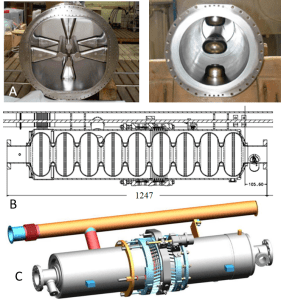
Fifty-Five Years of Inextricable Success-Superconducting Radio Frequency (SRF) cavities are vitally central to SRF accelerators, boasting a Q factor about 105 times higher than copper cavities and the capability to produce accelerating fields (Eacc) on an order of magnitude greater than copper in CW. In the 1960s, SRF cavities were...

H2FLY Pioneers Emissions-Free Flight with Successful Liquid-Hydrogen-Powered Aircraft

Stuttgart-based innovator H2FLY has achieved an unprecedented breakthrough in aviation history by successfully conducting the world’s first piloted flight of an electric aircraft powered by liquid hydrogen. This remarkable milestone marks a pivotal moment in the journey towards sustainable aviation, showcasing the immense potential of hydrogen-based technology in revolutionizing the...

HeLIUM Cryogenics Redefines Cryogenic Technology

In an era where technological innovation is not just an advantage but a necessity, HeLIUM Cryogenics™, stands at the vanguard, continually pushing the boundaries of whatʼs possible in cryogenic technology. Presently, a significant milestone is being marked in HeLIUMʼs journey as it unveils its latest innovation: a new line of...

LCLS-II’s ‘First Light’ Revolutionizes X-ray Science

The LCLS-XFEL at SLAC National Accelerator Lab has launched its upgraded version, LCLS-II, generating its first X-rays. This advancement is set to revolutionize research, offering unparalleled capabilities for studying quantum materials with remarkable precision. Scientists worldwide are queued up to explore various applications, from improving computing and communication technologies using...

ADVERTISEMENT

Dewar

A dewar is a type of cryostat named after Sir James Dewar, the researcher who first developed the concept of a vacuum insulated container with silvered walls to reflect thermal radiation. Dewar was the first to liquefy hydrogen, and he created the device to store his discovery. The thermos bottle...

Stirling and Gifford-McMahon Cryocoolers

Stirling and Gifford-McMahon (GM) cryocoolers are two of the most commonly used cryocoolers in cryogenics. Both devices have a significant industrial base and operate at a wide range of temperatures and capacities. The thermodynamic cycles for both of these cryocoolers are quite similar. The Stirling cycle consists of a compressor,...

Liquefied Natural Gas (LNG)

A significant commercial application of cryogenics is the liquefaction, transport and storage of natural gas. Liquefied Natural Gas (LNG) is generally 95 percent methane with a few percent ethane and much lower concentrations of propane and butane. LNG liquefies at 111.6 K. Unlike many applications of cryogenics, the motivation for...

Magnetic Levitation

From http://www.superconductors.org. Magnetic-levitation is an application where superconductors perform extremely well. Transport vehicles such as trains can be made to “float” on strong superconducting magnets, virtually eliminating friction between the train and its tracks. Not only would conventional electromagnets waste much of the electrical energy as heat, they would have...

Superconductivity

From Superpower website. History of Superconductivity Superconductivity was discovered in 1911 by the Dutch physicist, Heike Kammerlingh Onnes when he was able to liquefy helium by cooling it to 4 Kelvin, or -452°F. This enabled him to cool other materials close to absolute zero and investigate their electrical properties. He...

Medical Applications of Cryogenics

Neutron Therapy Cryogenics is at the heart of nuclear accelerators. Accelerators such as Fermilab’s Tevatron make neutron therapy for cancer possible. From Fermilab Today 4/20/09: Fermilab currently offers neutron therapy. But staff at Fermilab designed and built the proton accelerator used by the nation’s first hospital-based treatment center to use...

Nuclear Physics

Al Zeller National Superconducting Cyclotron Lab (NSCL) at Michigan State University zeller@nscl.msu.edu Cryogenics has a long history in nuclear physics. The technology has its origins in the use of cold traps for maintaining a vacuum, which is required to prevent beam loss and for generating high voltages used in acceleration....

Assistance with resolving a sealing problem?

We are fabricating piping components for refrigeration service. These components must be leak checked at 15 bar (218 psig). We are using a gas test media that is 25% helium and experiencing difficulty on maintaining a seal on the flanged connections. Do you know anyone or any references that could...

Cryogenic data on leather and nomex

Could anyone please help me out with the following cryogenics data: Leather — mechanical properties at 77 K or lower Nomex — thermal conductivity @ 4 to 50 K I lost the data I had some time ago and although this should be easily accessible, I can’t find any reference...