ADVERTISEMENT

Indirect Cryogenic Grinding Enhances Steel Alloy Properties

The machining process covers many material removal procedures; among them, grinding is one of the most important. Improved grinding is crucial to improve the overall machining process; hence, many researches focused on enhancing the performance of grinding operations by focusing on factors like wear, chattering vibrations, grinding wheel topography, temperature,...


GenH2 Supplies Cryostat CS500 System to University

GenH2 has signed an agreement with the University of Melbourne to provide the Cryostat CS500 simulation platform for cryogenic and hydrogen R&D projects. GenH2’s Cryostat CS500 system is capable of testing a wide range of thermal insulation systems, materials, composites, or panels under both cryogenic-vacuum conditions and real-world conditions. The University...

Air Products to Build Europe’s Largest Blue Hydrogen Plant

Air Products announced it will build, own and operate a state-of-the-art carbon capture and carbon dioxide (CO2) treatment facility at its existing hydrogen production plant in Rotterdam, the Netherlands. The facility is expected to be on-stream in 2026, and the resulting “blue” hydrogen product to serve ExxonMobil’s (Esso) Rotterdam refinery...

Maddox Industrial Group Announces Expansion to Gulf Coast

Maddox Industrial Group (MIG), a leader in delivering specialized industrial solutions to the air separation, energy, refining, petrochemical, wastewater, and other industries, has announced its strategic expansion into the Gulf Coast region. This growth is in collaboration with partner, Metalforms LLC (Metalforms), an industrial fabrication, services, and heat transfer solutions...

Cryo-Engineering for SRF

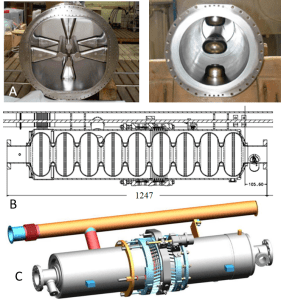
Fifty-Five Years of Inextricable Success-Superconducting Radio Frequency (SRF) cavities are vitally central to SRF accelerators, boasting a Q factor about 105 times higher than copper cavities and the capability to produce accelerating fields (Eacc) on an order of magnitude greater than copper in CW. In the 1960s, SRF cavities were...

H2FLY Pioneers Emissions-Free Flight with Successful Liquid-Hydrogen-Powered Aircraft

Stuttgart-based innovator H2FLY has achieved an unprecedented breakthrough in aviation history by successfully conducting the world’s first piloted flight of an electric aircraft powered by liquid hydrogen. This remarkable milestone marks a pivotal moment in the journey towards sustainable aviation, showcasing the immense potential of hydrogen-based technology in revolutionizing the...

ADVERTISEMENT

Liquid Hydrogen

Hydrogen becomes a liquid at 20K and 1 bar. Liquid hydrogen (LH2) is an important substance in industry, transportation and research. Industrial uses of hydrogen include applications in the electronics, glass, chemical and metal processing fields. In these applications, the hydrogen is generally used as a room temperature gas but...

Superconducting Radiofrequency Cavities

Superconducting radio frequency (SRF) cavities represent an important application of cryogenics and superconductivity. SRF cavities are a technology for accelerating charged particle beams via the transfer of radiofrequency (RF) energy to the beams via resonant structures. As such, they are frequently found in large particle accelerators used for scientific research....

Thermal Radiation Shields

Actively cooled thermal radiation shields are a common feature of cryostats whose lowest temperature is less than 77K. These shields, which typically operate at temperatures between that of LN2 and 40K, block thermal radiation from higher temperatures from reaching lower temperature cryogenic components or fluids. Since the heat radiated from...

Cryogenic Treatment of Materials

F.J. Diekman Controlled Thermal Processing, Inc. info@metal-wear.com Cryogenic Processing (also called cryogenic treatment, and incorrectly “cryogenic tempering”) is a process that uses cryogenic temperatures to modify materials to enhance their performance. Cryogenic Processing involves the slow reduction in temperature of the material to at least -300°F (-185°C) and holding the...

Cryogenics in Space

Peter Kittel University of California-Berkeley pkittel@cal.berkeley.edu Space Cryogenics is the application of cryogenics to space missions. These applications fall into two broad areas, supporting space science missions and supporting the space transportation infrastructure. Science applications: The atmosphere is opaque to much of the electro-magnetic spectrum. In space, the absence of...

Cryosurgery

Review of Cryosurgery Boris Rubinsky, PhD Hebrew University School of Science and Engineering Research Center for Biomedical Engineering 78b Ross Building Givat Ram, Jerusalem 91904 Israel rubinsky@cs.huji.ac.il as published in Annual Review of Biomedical Engineering, August 2000, Vol. 2, pp. 157-187. Abstract: Cryosurgery is a surgical technique that employs freezing...

Liquefied Natural Gas

Liquefied Natural Gas as it relates to the Field of Cryogenics John W. Bonn VJ Systems, LLC johnbonn@vjsystems-lic.com Today the world is looking for a cleaner fuel and Liquefied Natural Gas (LNG) plays a large part in achieving this goal. LNG in a liquid form is at -162°C (-259°F) and...

An Issue of Pressure and Flow Rate in a Supply Tank

Please help solve this problem: A supply tank requires a vaporizer to generate sufficient pressure to pump stored fluid up into a vehicle or tank. The available head is limited as the tank level falls and it is important to minimize the system pressure drop to maintain the desired flow...

Using MLI on VJ Line Joints or Cryo Storage Tanks

When installing Multi Layer Insulation (MLI) blankets on VJ line joints or cryo storage tanks should they be wrapped and tied down tight or loose? These are usually pre-cut to size. Also should they have an access hole at the point of where the molecular sieve is installed to help...