ADVERTISEMENT

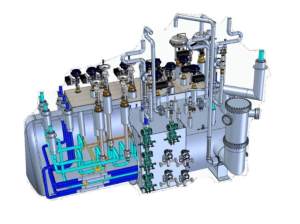
CryoHiVac Investigates Cryogenic Market, Affordability from Earth to Space

Today’s time-sensitive market needs revolutionization of traditional costly technologies. The cryogenic and electronic market development and utilization started from 1970 for commercial applications, and both are fast-growing technologies. There has been significant advancement of electronic products. Nowadays, a small smartphone has much more data storage and processing power capability than...
Valcor Releases New White Paper on Cryogenic Launch Vehicle Valves

Launch vehicles, particularly the upper stages, often use cryogenic rocket propellants such as liquid oxygen, liquid hydrogen and liquid methane because of their high specific impulse and high storage density. The pressurization, control and distribution of these propellants requires sophisticated valving that can operate and seal at these extreme temperatures....

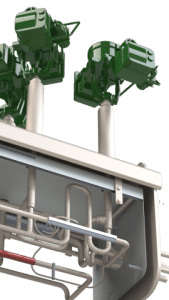
Demaco Produces ESS Hydrogen Distribution System

Hydrogen is the most abundant chemical element in the universe and the most important feedstock for life. In Greek, the word “hydrogen” is composed of the terms “hydro” and “genes,” which means water generator. In 1766, the English chemist Henry Cavendish distinguished hydrogen from other flammable gases and identified its properties,...

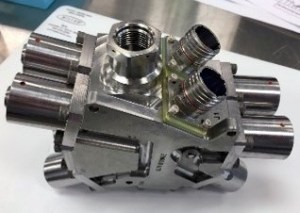
Ability Engineering Technology Introduces Ultra Precise Cryo Valve to Public

Ability Engineering Technology (AET), an Illinois-based manufacturer of equipment used in cryogenic process applications, has announced the introduction of a standard product line of Cryogenic Valves. According to Matt Resler, Sales Director at AET, “Our cryogenic valves have been successfully used for more than 30 years by our DOE clients, and...

ADVERTISEMENT

Dewar

A dewar is a type of cryostat named after Sir James Dewar, the researcher who first developed the concept of a vacuum insulated container with silvered walls to reflect thermal radiation. Dewar was the first to liquefy hydrogen, and he created the device to store his discovery. The thermos bottle...

Stirling and Gifford-McMahon Cryocoolers

Stirling and Gifford-McMahon (GM) cryocoolers are two of the most commonly used cryocoolers in cryogenics. Both devices have a significant industrial base and operate at a wide range of temperatures and capacities. The thermodynamic cycles for both of these cryocoolers are quite similar. The Stirling cycle consists of a compressor,...

Liquefied Natural Gas (LNG)

A significant commercial application of cryogenics is the liquefaction, transport and storage of natural gas. Liquefied Natural Gas (LNG) is generally 95 percent methane with a few percent ethane and much lower concentrations of propane and butane. LNG liquefies at 111.6 K. Unlike many applications of cryogenics, the motivation for...

Cryogenics in Space

Peter Kittel University of California-Berkeley pkittel@cal.berkeley.edu Space Cryogenics is the application of cryogenics to space missions. These applications fall into two broad areas, supporting space science missions and supporting the space transportation infrastructure. Science applications: The atmosphere is opaque to much of the electro-magnetic spectrum. In space, the absence of...

Cryosurgery

Review of Cryosurgery Boris Rubinsky, PhD Hebrew University School of Science and Engineering Research Center for Biomedical Engineering 78b Ross Building Givat Ram, Jerusalem 91904 Israel rubinsky@cs.huji.ac.il as published in Annual Review of Biomedical Engineering, August 2000, Vol. 2, pp. 157-187. Abstract: Cryosurgery is a surgical technique that employs freezing...

Liquefied Natural Gas

Liquefied Natural Gas as it relates to the Field of Cryogenics John W. Bonn VJ Systems, LLC johnbonn@vjsystems-lic.com Today the world is looking for a cleaner fuel and Liquefied Natural Gas (LNG) plays a large part in achieving this goal. LNG in a liquid form is at -162°C (-259°F) and...

Food Processing

Cryogenics and Food The industrial gas industry provides a host of products and services related to food. The various gases have useful and sometimes fascinating applications in food industry. “The food industry is not a homogenous industry. The needs of customers processing hamburger vs. poultry vs. strawberries vs. seafood, for...