ADVERTISEMENT

NSF Grant Funds New 40T Superconducting Magnet Design

A new $15.8 million grant from the National Science Foundation (NSF) will produce a detailed design for the world’s most powerful superconducting magnet at the Florida State University-headquartered National High Magnetic Field Laboratory (CSA CSM). While the National MagLab is already home to more than a dozen world-record magnets used...


Webb Space Telescope Will “Revolutionize Our Understanding” of the Universe

On December 25, the largest and most powerful space telescope ever constructed by NASA was successfully launched from Earth. With unprecedented technology, the James Webb Space Telescope (JWST) will peer both near and far, from the planets and bodies in our solar system to the deepest reaches of space, where the...

CryoHiVac Investigates Cryogenic Market, Affordability from Earth to Space

Today’s time-sensitive market needs revolutionization of traditional costly technologies. The cryogenic and electronic market development and utilization started from 1970 for commercial applications, and both are fast-growing technologies. There has been significant advancement of electronic products. Nowadays, a small smartphone has much more data storage and processing power capability than...

Demaco Produces ESS Hydrogen Distribution System

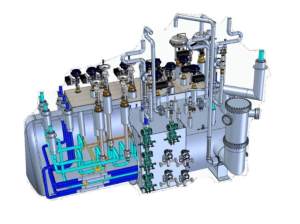
Hydrogen is the most abundant chemical element in the universe and the most important feedstock for life. In Greek, the word “hydrogen” is composed of the terms “hydro” and “genes,” which means water generator. In 1766, the English chemist Henry Cavendish distinguished hydrogen from other flammable gases and identified its properties,...

Ability Engineering Technology Introduces Ultra Precise Cryo Valve to Public

Ability Engineering Technology (AET), an Illinois-based manufacturer of equipment used in cryogenic process applications, has announced the introduction of a standard product line of Cryogenic Valves. According to Matt Resler, Sales Director at AET, “Our cryogenic valves have been successfully used for more than 30 years by our DOE clients, and...

ADVERTISEMENT

Dewar

A dewar is a type of cryostat named after Sir James Dewar, the researcher who first developed the concept of a vacuum insulated container with silvered walls to reflect thermal radiation. Dewar was the first to liquefy hydrogen, and he created the device to store his discovery. The thermos bottle...

Stirling and Gifford-McMahon Cryocoolers

Stirling and Gifford-McMahon (GM) cryocoolers are two of the most commonly used cryocoolers in cryogenics. Both devices have a significant industrial base and operate at a wide range of temperatures and capacities. The thermodynamic cycles for both of these cryocoolers are quite similar. The Stirling cycle consists of a compressor,...

Liquefied Natural Gas (LNG)

A significant commercial application of cryogenics is the liquefaction, transport and storage of natural gas. Liquefied Natural Gas (LNG) is generally 95 percent methane with a few percent ethane and much lower concentrations of propane and butane. LNG liquefies at 111.6 K. Unlike many applications of cryogenics, the motivation for...

History of Cryogenics

From the Fall 1999 issue of Cold Facts magazine Millennium Breakthroughs A variety of CSA members give different perspectives on the past millennium: What were the most significant breakthroughs in cryogenics during the past millennium? Prof. R.G. Scurlock, Kryos Technology, scurlock@soton.ac.uk (“Breakthrough” = way through obstacles — Oxford English Dictionary)...

Cryobiology

Andreas Sputtek Past President Society for Cryobiology sputtek@uke.uni-hamburg.de or http://www.sputtek.de/. The word cryobiology (from the Greek words “cryo” = cold, “bios” = life, and “logos” = science) literally signifies the science of life at low temperatures. In practice, this field comprises the study of any biological material or system (e.g.,...

Cryogenic Insulation

James E. Fesmire Cryogenics Test Laboratory NASA Kennedy Space Center james.e.fesmire@nasa.gov Introduction In today’s world, the use of cryogenics and low-temperature refrigeration is taking a more and more significant role. From the food industry, transportation, energy, and medical applications to the Space Shuttle, cryogenic liquids must be stored, handled, and...

Cryogenic Treatment of Materials

F.J. Diekman Controlled Thermal Processing, Inc. info@metal-wear.com Cryogenic Processing (also called cryogenic treatment, and incorrectly “cryogenic tempering”) is a process that uses cryogenic temperatures to modify materials to enhance their performance. Cryogenic Processing involves the slow reduction in temperature of the material to at least -300°F (-185°C) and holding the...

Need help with calculating flow rate

I have to maintain a certain mass (some tons) at 100 K by circulating in it GHe (through apposite channels). How can I calculate the flow rate needed? I suppose that the delta T (T inlet and T outlet) and the heat load on the mass are necessary. Knowing the...