
ADVERTISEMENT

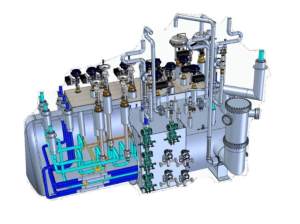
Demaco Produces ESS Hydrogen Distribution System

Hydrogen is the most abundant chemical element in the universe and the most important feedstock for life. In Greek, the word “hydrogen” is composed of the terms “hydro” and “genes,” which means water generator. In 1766, the English chemist Henry Cavendish distinguished hydrogen from other flammable gases and identified its properties,...


Ability Engineering Technology Introduces Ultra Precise Cryo Valve to Public

Ability Engineering Technology (AET), an Illinois-based manufacturer of equipment used in cryogenic process applications, has announced the introduction of a standard product line of Cryogenic Valves. According to Matt Resler, Sales Director at AET, “Our cryogenic valves have been successfully used for more than 30 years by our DOE clients, and...

Space Cryogenic Workshop Recap

During a year filled with uncertainty, many were worried about the effects of the pandemic on CSA’s biennial Space Cryogenics Workshop (SCW). After much consideration and effort, we are pleased to report the successful execution of our first – and hopefully only – virtual SCW. Hosted virtually on the Remo®...

Jefferson Lab Accelerator Gets a Fresh Pair of Eyes

A newly invented detector is allowing physicists at the US Department of Energy’s Thomas Jefferson National Accelerator Facility (CSA CSM) to “see” neutrons like never before. Fresh insight from these devices has improved operation of the lab’s powerful electron accelerator, which is used in nuclear physics studies of the atom’s...

ADVERTISEMENT

Mixed Refrigerant Cycles

Most cryogenic refrigeration systems, both large scale systems and cryocoolers, use helium as a working fluid. There are a number of advantages to helium, not the least of which is that helium remains a fluid down to the lowest achievable temperatures. In order to freeze helium, pressures of over 20...

Fountain Pumps and He II Phase Separators

Helium II (He II), the second liquid phase of the 4He isotope described in this column in Cold Facts Spring 2010 (http://2csa.us/he2), can be modeled as consisting of two interpenetrating fluids. One, the superfluid component, has zero viscosity and entropy and the other, the normal fluid component, has nonzero viscosity...

Turboexpanders

A vital technology in the refrigerators and liquefiers described in Cold Facts Volume 31 Number 3 is that of turboexpanders. These devices are rotating machines in which the process fluid (e.g., helium) does work against the turboexpander while moving from high pressure to a lower pressure and thus is cooled....

History of Cryogenics

From the Fall 1999 issue of Cold Facts magazine Millennium Breakthroughs A variety of CSA members give different perspectives on the past millennium: What were the most significant breakthroughs in cryogenics during the past millennium? Prof. R.G. Scurlock, Kryos Technology, scurlock@soton.ac.uk (“Breakthrough” = way through obstacles — Oxford English Dictionary)...

Cryobiology

Andreas Sputtek Past President Society for Cryobiology sputtek@uke.uni-hamburg.de or http://www.sputtek.de/. The word cryobiology (from the Greek words “cryo” = cold, “bios” = life, and “logos” = science) literally signifies the science of life at low temperatures. In practice, this field comprises the study of any biological material or system (e.g.,...

Cryogenic Insulation

James E. Fesmire Cryogenics Test Laboratory NASA Kennedy Space Center james.e.fesmire@nasa.gov Introduction In today’s world, the use of cryogenics and low-temperature refrigeration is taking a more and more significant role. From the food industry, transportation, energy, and medical applications to the Space Shuttle, cryogenic liquids must be stored, handled, and...

Cryogenic Treatment of Materials

F.J. Diekman Controlled Thermal Processing, Inc. info@metal-wear.com Cryogenic Processing (also called cryogenic treatment, and incorrectly “cryogenic tempering”) is a process that uses cryogenic temperatures to modify materials to enhance their performance. Cryogenic Processing involves the slow reduction in temperature of the material to at least -300°F (-185°C) and holding the...

An Issue of Pressure and Flow Rate in a Supply Tank

Please help solve this problem: A supply tank requires a vaporizer to generate sufficient pressure to pump stored fluid up into a vehicle or tank. The available head is limited as the tank level falls and it is important to minimize the system pressure drop to maintain the desired flow...

Using MLI on VJ Line Joints or Cryo Storage Tanks

When installing Multi Layer Insulation (MLI) blankets on VJ line joints or cryo storage tanks should they be wrapped and tied down tight or loose? These are usually pre-cut to size. Also should they have an access hole at the point of where the molecular sieve is installed to help...




