

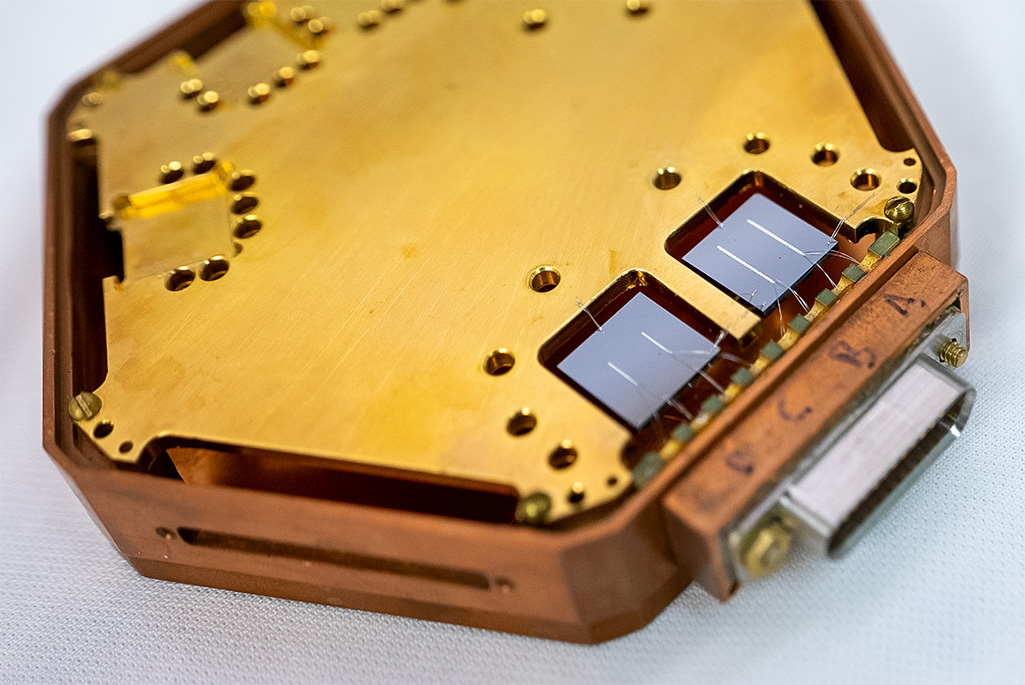
I have a cryostat with closed cycle cryocooler attached. The case is aluminum with a G-10 spacer between the case and a stainless steel bellows that supports the cryocooler. We have a customer that will use this cryostat in Antarctica, so we are required to ensure that no leaks will be present when exposed to this environment. We evacuate the cryostat at room temperature and everything works fine, no vacuum leaks.
We ran an experiment by putting the cryostat in a cooler surrounded by dry ice to simulate Antarctic conditions. At about 243K, we lost some vacuum and found a leak near the aluminum and G-10 spacer. When the joint was warmed up, the leak was gone. We use indium wire in a v-groove to provide the seal.
We don’t think the contraction of the material is the problem. Do you know anyone in your group that has experience with G-10 in extremely cold environment? I am concerned the epoxy used to seal the G-10 or the indium wire may be failing.




1 Comment
Dr. Peter V. Mason
October 29, 2008As a matter of fact, I have been at the South Pole and talked to the cryogenic technicians about a similar problem. Normal dewars with Viton seals were left outside, where the temperature can go to – 100 F and is usually below in -20 F, even in summer. There was enough contraction and Viton hardening so that the O-ring seals opened up. The solution was never to leave the dewars outside long enough to get that cold.
Am I correct that the G-10 and epoxy are part of the vacuum seal? Plastics have a high rate of contraction and I’d be surprised if that didn’t contribute to the problem. I suggest that the bond between the epoxy and the G-10 or the metal casing may have cracked and opened at low temperature. I’d need to see a design drawing to really assess the problem.
I’d be surprised if the indium wire seal was the problem, because we use them all the time at liquid helium temperatures. It is necessary to overfill the groove.
I don’t know of any measurement of G-10 porosity at low temperatures. We normally use it internally, not as part of a vacuum seal. I doubt if it goes up sharply.
Can you tell me who the cryocooler is for? I may know him, or I may be able to offer some advice.
Dr. Peter V. Mason
MS 59-33
California Institute of Technology
1201 E. California Bl.
Pasadena, CA 91125
Ph. 626-395-3341
Fax 626-584-9929
Email pmason@alumni.caltech.edu