The following article was submitted by Dr. Ralph G.Scurlock, Emeritus Professor of Cryogenic Engineering,
Kryos Technology, 22 Brookvale Road, Southampton, UK.
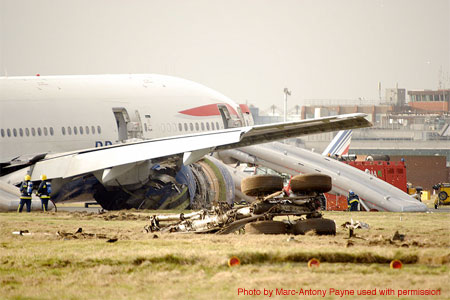
The Boeing 777 crash-landing at London Heathrow in January 2008
Flying at 40,000 ft in air at -57 C may lead to additional Ice in Fuel problems.
1.Background
On 7th January 2008, British Airways flight BA038 from Beijing was on its final approach to landing at London Heathrow and within 60 seconds of touchdown when both its jet engines lost power, or rolled back. The aircraft, a Boeing 777 with two of the latest Rolls-Royce Trent 800 jet engines, was making a standard powered descent and in the last stage of its final approach and landing.
During such a powered descent on the final approach, engine thrust is needed to fly down the shallow descent path (much less than the steeper gliding angle of the aircraft, at zero power). Additional engine thrust is then needed to balance the increased drag as the undercarriage is lowered, and as full wing flaps are lowered to reduce the landing speed. The balance is controlled by the computerized “autothrottle” maintaining the aircraft on its correct descent path.
At some point within 60 seconds of touchdown, the autothrottle made four commands in quick succession to increase thrust; the 777 was deviating below the correct descent path, possibly as it experienced some sink as it descended through a wind gradient. In spite of the autothrottle commands, both engines failed to increase power and began to roll back with reducing thrust due to reduced fuel flow.
The big jet was too low, with too little engine power, and was in trouble.
The captain quickly took over full control from the computers, reduced drag by partially raising the wing flaps, and eased back the stick to gain a few feet of height, just enough to clear the roads at the end of the runway. Then, the big jet began to stall as it lost speed, and hit the ground very heavily, so that the undercarriage collapsed; it then skidded to a halt on the end of the runway. Very fortunately, only 13 of the 152 people on board were hurt. The aircraft was a write-off.
Questions to be asked include:
(1) Why did both engines suddenly roll-back at a critical point in the final approach?
(2) What was different about this flight compared with many hundreds of previous flights and normal landings by the same type of Boeing 777 aircraft?
(3) Was this an isolated happening?
Then, on 26th November 2008, another uncontrolled roll-back on one engine occurred on a Delta Airline 777 flight from Shanghai to Atlanta, whilst cruising at 39,000ft. The engine responded normally after the aircraft descended to warmer temperatures
The UK and US Air Accident Investigation authorities, together with Boeing and Rolls-Royce, have carried out simulation tests and decided that the uncontrolled roll-back appears to arise from water freezing to ice in the jet fuel and creating unexpected blockages in the fuel supply systems on the aircraft.
Now, water in aviation fuel at temperatures below 0 degrees Centigrade has been a problem for many years, ever since aircraft started to fly higher and higher in atmospheric temperatures below 0 degrees C (eg during WW1 in 1915 – 1918).
The obvious way forward is to prevent water getting into the fuel in the first place. However, this is difficult to achieve in practice, and a statutory limit based on research carried out in the 1950s is used to determine the maximum permitted level of dissolved and entrained (suspended) water allowed in the fuel when refuelling any aircraft.
To counter the problem of this limited amount of water turning to ice in the fuel, the fuel supplied to each engine is heated by an engine-mounted heat exchanger so that any ice in the fuel is melted and does not clog the filters and inlets to the fuel pumps. The Rolls-Royce Trent engines have such heat exchangers, using the hot lubricating oil from the engine as the heating medium, the fuel-oil heat exchangers, FOHE.
So, what is different, since the roll-backs appear to be arising from unexpected fuel blockages?
2. The temperature difference between 30,000 and 40,000 ft of -12 to -32 C
The difference is that the Trent engined 777s are able to achieve greater fuel economy by cruising at heights up to 40,000 ft, at the bottom of the stratosphere (which is just over 36,000 ft in the Standard Atmosphere), where the static air temperature or local ambient temperature can drop to a mean of -57 C but with variations down to -77 C in practice.
Other large passenger jets like the 747s have older designs of jet engine and cruise normally at lower heights in the troposphere around 30,000 to 34,000 ft (but not up to 40,000 ft); where the static air temperature is around -45 C.
Further, the newer types, like some 777 variants, have appreciably longer ranges and therefore fly for longer periods at their highest altitude.
Thus flying higher to obtain greater fuel economy with more modern designs of jet engine exposes the aircraft to significantly lower temperatures, for periods of many hours, on long haul flights around the world. These lower temperatures may be 12 to 32 C lower than those experienced over many years by 747s and the like.
The problems being introduced by the colder environment at 40,000 ft need to be questioned, examined, understood and dealt with satisfactorily.
This is where multi-disciplinary, cryogenic technology, normally associated with lower temperatures than the stratosphere, comes in because the handling and transfer of impurity-laden, cryogenic liquid mixtures is widely practiced. Hence, the fuel transfer problems of the Trent engine/777 aircraft combination parallels the problems already met at lower temperatures by the cryogenic industry.
3. AAIB recommendations
Meanwhile, the UK Air Accidents Investigation Branch in conjunction with the US National Transportation Safety Board have made the following interim safety recommendations in AAIB Interim Report 2, March 2009.
Safety Recommendation 2009 – 028
“Boeing and Rolls-Royce jointly review aircraft and engine fuel system design to develop changes which prevent ice from causing a restriction to the fuel flow at the fuel/oil heat exchanger FOHE.” In response, Rolls-Royce have developed a modification to the FOHE to improve its capability in the event of a fuel system ice release event, and Boeing is currently testing the modified FOHE and fuel system.
Safety Recommendation 2009 – 029
“The Federal Aviation Administration and European Aviation Safety Agency consider mandating design changes to prevent ice from causing a restriction to fuel flow at the FOHE on 777 aircraft with Trent 800 engines”.
The simulation tests carried out on the 777+Trent 800 fuel system tell nothing about other aircraft/engine combinations, which might be susceptible to ice.
Safety Recommendation 2009- 030
“ The FAA and EASA conduct a study into the feasibility of expanding the use of anti-ice additives in fuel on civil aircraft.” A 777 carries some 50 tonnes of fuel at the start of a long haul flight. The cost of any effective additive would be very expensive.
Safety Recommendation 2009—031
“The FAA and EASA jointly conduct research into ice formation in aviation turbine fuels”. There is a lack of data on ice formation in hydrocarbon liquid mixtures and on the properties of solid hydrates.
Safety Recommendation 2009-032
“Recommended that the FAA and EASA jointly conduct research into ice accumulation and subsequent release mechanisms within aircraft and engine fuel systems”. The results can then be used to further develop the industry guidance on fuel system design, materials and test procedures.
As an interdisciplinary, cryogenic problem, and reading between the lines of these recommendations, there are a number of unknowns about water and ice in jet fuel, as well as the fuel itself, at temperatures down to -57 C, perhaps as low as -77 C. There is also a surprisingly large, possible decrease in environmental temperature between flying below the top of the troposphere and above the bottom of the stratosphere at around 40,000 ft. This decrease means that the static environmental temperature can be as much as -12 C to -32 C lower than the temperatures normally met by aircraft flying at cruising altitudes around 30,000 to 34,000 ft.
4. The unknown questions and factors associated with flying in the stratosphere
The questions and factors, associated with flying higher in the stratosphere, which need to be considered under Safety Recommendations 2009-031 and 2009-032 include the following, all of which may be particularly relevant in preventing an uncommanded roll-back in the future.
4.1. The different atmospheric weather in the stratosphere
In the troposphere, up to around 34,000 ft, the atmospheric circulations or weather patterns are determined by cyclonic and anticyclonic motions and jet streams which may be predicted largely from widespread instrumental measurement at ground level.
In the stratosphere above 36,000 ft, the large scale circulations are totally different from those below in the troposphere and are not so easy to predict on a day-to-day basis. While the mean (Standard Atmosphere) temperature is -57 C, large swings in temperature, up to 20 degrees either side, are a consequence of global stratospheric “weather” patterns.
Thus, very low temperatures down to -77 C must be accepted as one of the normal environmental conditions which subsonic aircraft will meet when cruising at 40,000 ft.
4.2 Solubilities of impurities
The limit in solubility of impurities in hydrocarbon liquids reduces very rapidly with decreasing temperature. For example, if the solubility of water was, say, 50 ppm at -30 C, (this is not a measured quantity) it could fall to 10 ppm at -50 C, i.e., 80% of the water would come out of solution and precipitate as ice at the lower temperature, either as fine particles suspended in the fuel, or in solid sheets on colder surfaces in contact with, and/or containing, the fuel.
Thus, the prescribed limit of water dissolved in the jet fuel may not begin to precipitate out as ice until the aircraft climbs above, perhaps, 24,000 ft.
Unfortunately, while the solubility of many impurities in liquids at low temperatures has been measured in order to understand and counter blockages, the solubility of water in jet fuel as a function of temperature is not known.
4.3. Why so much water in the fuel?
In cryogenics, the presence of unwanted impurities is not tolerated and they are prevented from entering the bulk liquid. Why, then, does the aviation industry risk the presence of water in aviation fuel under freezing conditions, at possible levels which could lead to blockages?
When the criteria for limiting the amount of water in aviation fuel was determined in the 1950s, the amount of fuel carried was measured in tonnes. The risk of a fuel blockage is determined by the probability of a quantity of ice building up (say 200 gm) at one critical point in the fuel delivery system. Today, the amount of fuel carried by large aircraft is 10 times larger than in the 1950s. With the same specified limit, the risk of a blockage from the same amount of ice is surely 5 to 10 times higher.
Surely the limit on water in jet fuel, whether dissolved or entrained, should be reduced consequently to help prevent roll back as a result of cruising in the stratosphere?
4.4. Heat transfer leading to cooldown of the fuel
During the climb mode, the fuel tanks are vented to atmosphere and there is self-cooling of the fuel induced by the fall in pressure.
Besides fuel tanks in the body, the 777 has sets of fuel tanks inside each wing, the containing walls being mainly the metal skin of the wing. Each set of wing tanks has a volume of 25-30 cubic metres and holds 15-20 tonnes of fuel. The wing surfaces therefore provide a large heat exchanger surface for transmitting very large amounts of heat, between the environmental air stream and the fuel. During the climb mode and cruise at altitude, there is considerable cooling of the fuel by heat exchange (in addition to self-cooling) down to an equilibrium temperature determined by an effective stagnation temperature, or “true air temperature” TAT, in the turbulent boundary layers of the air flow over the wing surfaces. Theoretically, for subsonic flight, the TAT is a few degrees hotter than the static environmental air due to kinetic heating.
However, the local effective TAT, driving the heat transfer, varies from front to rear of the wing, as the boundary layer grows in thickness, and as the air flow over the wing surfaces suffer isentropic changes of pressure and temperature. The effective TAT is therefore difficult to predict, and needs experimental measurement.
The cooling of the fuel will be via liquid boundary layer flows from upper to lower regions of the tank, and density/temperature stratification may be a major feature despite mixing procedures. Unless the temperature sensors are mounted in the liquid boundary flows, they will not register the lowest temperatures reached locally in the fuel at the cold tank walls. In addition to not detecting temperature stratification between upper and lower levels in the same tank, the bulk fuel temperature sensors will not detect the much lower boundary layer temperatures which the fuel experiences during cooldown.
It is these much colder boundary temperatures which will dictate the precipitation of water as ice, not the bulk temperature.
4.5. Allotropy of ice and hydrates
Ice is known to have many allotropes, and it is possible that ice precipitate below -30 C has different blocking properties in coagulated form, than above -30 C.
There is complicating evidence that the water also forms solid ice-like hydrocarbon hydrates, for example in the proportion of 70% hydrocarbon 30% water, and these have significantly different physical and blocking properties at different temperatures.
4.6. Partial freezing of the jet fuel
The temperatures experienced by the fuel in the uninsulated wing tanks are close to the freezing temperature range of the fuel itself. Jet fuel is a liquid mixture of hydrocarbons with differing molecular weights MW with widely different freezing temperatures. As a mixture, it does not have a single freezing temperature, but a likely freezing temperature range of the order of 10 to 20 C, with higher MW hydrocarbons freezing out at higher temperatures. It is therefore possible that partial freezing of higher MW components in the fuel may take place on to the walls of the fuel tanks at temperatures considerably above the “specified freezing temperature” of -47 C of the fuel.
4.7. Wall temperature sensors and optical sensors
Wall surface temperatures are not the same as bulk liquid temperatures and are more difficult to measure. Some instrumentation should be installed to measure wall temperatures, including the lower inner surface of the wing tanks, where colder stratified fuel and/or ice may collect, and the inner upper surface in contact with much colder environmental air.
Optical probes are needed in the wing tanks and their outlets to see directly whether, and when, the frozen solid precipitate collects on the floor of the tank, or in the outlets, or remains in suspension.
4.8. Stratification leading to pump stalling
When pumping liquid stratified in a tank, it is common cryogenic engineering experience that a centrifugal liquid pump taking liquid from the tank bottom may stall due to loss of NSPH, when the liquid inlet temperature suddenly rises.
Could such stalling of high volume flow rotodynamic fuel pumps be a contributing factor after a descent from a freezing environment at 40,000ft, during which the now, more than half empty, fuel tanks will have suffered unequal environmental heating, leading to considerable stratification of warm above cold fuel in the wing tanks?
Alternatively, is it possible that positive displacement pumps may be more sensitive to blockage by ice in fuel at -30 to -40 C ?
4.9. Heat transfer during descent.
The descending mode to warmer temperatures and higher pressures requires, in particular, close monitoring of what is happening to the frozen precipitate, i.e. whether there is a sudden release of precipitate from the inner tank walls, or from the walls of fuel lines. Also whether sudden movement or release of the precipitate during descent can be prevented or controlled or delayed by varying engine power, hence fuel flow rates, up and down during the descent. Also, whether sudden release can be encouraged and completed before, say, 5000 ft so as to guarantee no roll-backs occur during final approach and landing.
4.10. Additives.
The use of anti-freeze additives has been shown to be useful in stopping freezing down to about -20C with sufficient additive in the fuel. Lowering the freezing point to -40C would require a much larger percentage of additive; for the 50 tonne fuel load on a 777, this would probably be prohibitively expensive.
4.11. Control of water impurities in jet-fuel.
If water/ice is the major problem, then a restriction on the amount of water in the fuel is needed, whether the water is in solution or is just entrained. In addition, the loss by evaporation, and gain by condensation, of water in fuel, during ground storage and during flight climb and descent, needs to be evaluated. For example there is evidence that dissolved water evaporates as the fuel tanks are vented down to low pressures during climbing.
4.12. Embrittlement of Materials below -40 C
In cryogenics, it is well known that many synthetic and natural materials become brittle and susceptible to fracture below -40 C. Flying sub-sonic at 40,000 ft may expose many parts of an aircraft to possible embrittlement, including the seals and pump diaphragms in fuel systems, the insulation of electric wires, load-bearing plastic composites, etc.
A factor to be noted is that the use of any materials, which embrittle on cooling, is strictly avoided in cryogenic engineering practice.
5. Conclusions
Early attention to all these questions and factors is needed so that a satisfactory understanding of the consequences of flying higher in the stratosphere is gained.
This will enable further changes in operating procedures to be introduced, in addition to those currently used, to eliminate the risk of any uncontrolled roll-back in the future. For example, if the static air temperature falls below -50 C, then the aircraft must descend from 40,000 ft towards 30,000 ft until the temperature rises to -40 C.
Obtaining answers to these questions will reduce significantly the risks that appear to have been introduced unknowingly by flying longhaul in the stratosphere. Therefore, if you or your colleagues in cryogenics can address any of these questions based on your own cryogenic experience, please get in touch with Rolls-Royce or Boeing as soon as possible.
Otherwise, if a further uncontrolled roll-back occurs, or is suspected following a crash, then the grounding of the 777s and other new-generation passenger jets, including the A380 and Boeing 787 Dreamliner, may have to be considered.
6. Acknowledgements
This paper is the result of considerable discussion with my colleagues at the University of Southampton. I am most grateful to them, and for their expertise, including Professor Mike Goodyer in Aeronautics, Professor Henry Rishbeth in Upper Atmosphere Physics, and Dr.Tony Rest in Low Temperature Chemical Infra-red Spectroscopy.
R.G.Scurlock, 26th July 2009