Cold Facts’ Executive Editor met with Dr. Philippe Lebrun, formerly head of the Accelerator Technology Department for the LHC at CERN, Switzerland, in July 2010 at ICEC/ICMC in Wroclaw, Poland.
Now that LHC is up and running, Lebrun has joined the team working on the Compact Linear Collider (CLIC), also at CERN. He is a member of the CLIC Steering Committee.
With CERN as lead laboratory, the CLIC study involves 30 other entities worldwide, including representatives from China, Denmark, Finland, France, Germany, Greece, India, Italy, Japan, Norway, Pakistan, Russia, Spain, Sweden, Switzerland, Turkey, Ukraine, United Kingdom and USA.
The project is in the conceptual design phase, not yet approved. Although aiming at the same goal for physics, i.e. colliding electrons and positrons at high center-of-mass energy, CLIC would use a different technology from the International Linear Collider. It would be a shorter machine using non-superconducting Radio Frequency technology. This machine would go to higher accelerating gradients than the ILC for the same final energy.
Lebrun said that the idea has been around for decades. Today they are in the phase of preparing a conceptual design proposal for 2011. “The next machine will be a lepton collider, probably linear,” he said. They are working to find the best way to build it. They are cooperating with the ILC groups, as they have a common goal: to prepare the construction of the next high-energy machine for particle physics. Therefore, there is an established collaboration on several common issues, taking several forms, e.g., joint ILC-CLIC working groups, as well as a cross participation of representatives of both projects in their executive bodies. The goal of building such a machine is challenging enough that the whole community pool their resources worldwide.
symmetry, August 2005, reports “CLIC is an ambitious project that proposes colliding beams of positrons and electrons at an energy of 3 TeV (teraelectronvolts—thousands of billions of electronvolts). It would achieve this by using a new accelerating technology to reach the multi-TeV energy range in approximately the same distance that the ILC would require to reach its 0.5-1 TeV design specification.
“CLIC, however, is not an easy project. From building the novel power supply to squeezing the beam down to a diameter of about a nano-meter at the collision point, CLIC faces many obstacles that must be overcome before it can be considered as a future project for the particle physics field.”
The CLIC Web site gives more detail on the project: “CLIC is a study for a future electron-positron collider that would allow physicists to explore a new energy region beyond the capabilities of today’s particle accelerators. It would provide significant fundamental physics information even beyond that available from the LHC and a lower-energy linear e+/e- collider, as a result of its unique combination of high energy and experimental precision.
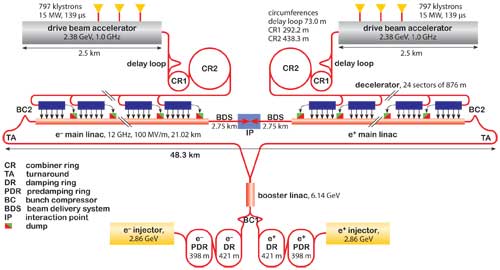
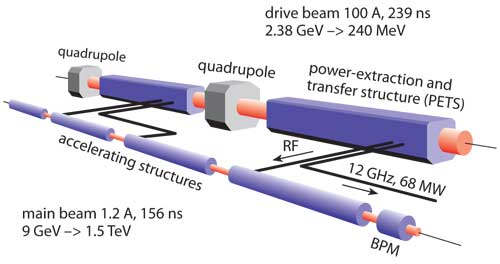
“Within the framework of a world-wide collaboration on Linear Colliders, the Compact Linear Collider (CLIC) study aims at a center-of-mass energy range for electron-positron collisions of 0.5 to 5 TeV, optimized for a nominal center-of-mass energy of 3 TeV (3 TeV CLIC). In order to reach this energy in a realistic and cost efficient scenario, the accelerating gradient has to be very high – CLIC aims at an acceleration of 100 MV/m. Superconducting technology being fundamentally limited to lower gradients, only room temperature traveling wave structures at high frequency (12 GHz) are likely to achieve this gradient. In order to optimize the production of sufficient RF power for this high gradient, and CLIC relies upon a two-beam-acceleration concept: The 12 GHz RF power is generated by a high current electron beam (drive beam) running parallel to the main beam. This drive beam is decelerated in special power extraction structures (PETS) and the generated RF power is transferred to the main beam. This leads to a very simple tunnel layout without any active RF components (i.e. klystrons). Both beams can be generated in a central injector complex and are transported along the linac.
CLIC general layout
“A number of challenges have to be mastered:
• The efficient generation of the high-intensity drive beam
• The Power Extraction Structures generating the required power
• The 12 GHz accelerating structures capable of producing the required gradient at a low RF breakdown rate
• The generation and preservation of a small emittance main beam
• The focusing of the beam to nanometer beam size
• The precise alignment of the different components.
“Many key aspects of the CLIC scheme have been experimentally validated already in different test facilities (CTF, CTF2 and CTF3). The goal of the present CLIC Test Facility CTF3 is to demonstrate all the remaining CLIC specific key issues until 2010 to show the feasibility of the CLIC scheme.”
In recent developments, funding problems have arisen, according to Physics World. Worst hit could be work on the Compact Linear Collider (CLIC) – CERN’s own blueprint for a future electron–positron collider – that could be built once the LHC reaches the end of its life. Although research on CLIC and a “higher-energy proton machine” will continue, CERN’s contribution to CLIC will be held at around €16m and not be increased as was previously proposed. “In the present financial and political climate, I think it was inevitable that CLIC would be among the programs to suffer,” particle theorist John Ellis told physicsworld.com.
Ellis told physicsworld.com that resources already made available by CERN will, however, allow an upgrade to the CLIC test facility to go ahead. But the budget cut means that an engineering demonstration facility called CLIC0, which would have to be built before CLIC could be approved, will not now go ahead unless external funds are sought. CLIC0 is supposed to demonstrate beam acceleration to around 6.5 GeV.
Ellis notes that the recent decision to open membership to CERN to countries outside Europe could mean that the extra funds are instead provided by these nations.