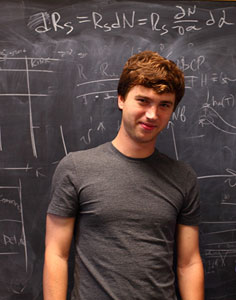
Fermilab’s Alex Romanenko recently unlocked secrets hidden beneath the mirror-smooth surface of niobium superconducting radiofrequency (SRF) cavities that may hold the key to the success of future linear colliders. Romanenko’s discovery, which was carried out as part of his doctoral thesis at Cornell University, has earned him “The Particle Accelerator Science and Technology Award” from the Nuclear Plasma and Science Society, part of Institute of Electrical and Electronic Engineers (IEEE).
Romanenko’s thesis work centered around one pressing question: why does a very modest final bake of niobium improve performance of cavities by as much as 30%, when the 120۫C baking temperature is far below temperatures of metallurgical significance for the metal?
Lance Cooley, head of the Technical Division’s SRF material group, says the community had previously looked to the oxide that naturally occurs on the metal’s surface to account for improved performance at this baking temperature.
“A rather wide group of scientists had postulated that a ‘pollution’ layer exists near the oxide, and that the particular temperature was related to the diffusion of oxygen over distances important to RF superconductivity,” Cooley said. “Alex found that there was little if any evidence to support oxygen acting alone – something else had to contribute.”
Even more puzzling was the fact that there was improvement in the perfection of the niobium grains, a phenomenon not expected to occur at these temperatures.
To get to the bottom of the mystery, Romanenko applied very sensitive materials science probes to investigate the near-surface structure and contamination in niobium. Cooley says Romanenko’s thesis uncovered evidence that hydrogen – in addition to oxygen – was the active element, and that the 120۫C baking temp was ideal for providing hydrogen enough energy to escape from various defects in the niobium metal, which allowed those defects to heal and improve the grains.
This new information has had a profound effect on the Technical Division’s plans for making accelerator cavities for upcoming projects like Project X and the International Linear Collider. The group is now focusing on the link between niobium hydride formation and losses in cavity performance.
“When cavities have a lot of hydrogen dissolved in the metal, e.g., due to polishing using concentrated acids, many precipitates of niobium hydride form during the cooldown to cryogenic temperature,” Cooley explained. “Dissipation of RF power occurs at these precipitates, resulting in behavior called ‘Q sickness’, where the quality factor Q of the resonating cavity falls steeply as it is energized to produce accelerating electric field.”
Normal protocol to combat “Q sickness” has been to bake the cavities at 800۫C in high vacuum ovens, which de-gasses the hydrogen. But Alex’s work suggests that either residual hydrogen can still be present or new hydrogen is introduced by final wet processing steps. While not in sufficient size or number to cause “Q sickness”, Alex’s discovery implies that a small level of hydride precipitates could lead to losses at high accelerating fields. This problem must be met head-on by the Technical Division, since an accelerator like the ILC would require only the best performing cavities for its very high accelerating fields.
Romanenko’s recent uncovering of hydrogen’s role in cavity performance has not come without its challenges. Hydrogen is very mobile and can give false readings of its distribution, requiring Romanenko to invent new characterization techniques or apply techniques from other areas of materials science. In a collaboration with the University of Western Ontario, Romanenko is applying helium atom recoil spectroscopy to explore the concentration of hydrogen just under the surface, a technique borrowed from silicon semiconductors.
“It’s examples like this that lead me to believe Alex will continue to be creative and effective in his approach to the materials science of hydrogen in niobium,” Cooley said.
Romanenko will be presented with the IEEE-NPSS award on March 31 at the 2011 Particle Accelerator Conference in New York.