A high-powered team of physicists and engineers has concluded that NASA’s $700 million Gravity Probe B (GP-B) experiment demonstrated two key aspects of Albert Einstein’s General Theory of Relativity, but not to the hoped-for degree of confidence.
Results from the mission will inform astronomy and cosmology for decades, scientists say, while its engineering lessons may guide future spacecraft developments in unexpected ways. One specific technology developed for GP-B already has enabled Nobel Prize-winning space-based science in an unrelated field, and the mission spacecraft development has demonstrated some pitfalls for future high-precision space applications.
After five years of data processing to eliminate unexpected system noise that obscured the extremely subtle space¬time “frame-dragging” effect predicted from Einstein’s theory, researchers were able to claim only a 20% margin of error in declaring success. They had hoped for 1% or better, and they achieved it with a second measurement of what is known as the geodetic effect.
Using Einstein’s theory, the experiment’s designers calculated that the rotors would drift off the guide star by 6,606.1 milliarcseconds over a year because of the geodetic effect—basically, the effect of Earth’s gravity on spacetime. For frame-dragging, which has been compared to spinning a bowling ball in a pool of molasses, the predicted value was 39.2 milliarcseconds.
The final results, as presented by GP-B Principal Investigator Francis Everitt of Stanford University at NASA headquarters May 4, were a geodetic drift of 6,601.8 milliarcseconds (±18.3), and a frame-dragging drift of 37.2 milliarcseconds (±7.2). The team published its findings in the journal Physical Review Letters.
“The frame-dragging we’ve measured to a little better than 20%, so that’s the results of the experiment,” Everitt says.
Experimenters using laser-ranging data from the two reflective Laser Geodynamics Satellites (Lageos-1 and -2) to measure frame-dragging shifts in their orbital planes claimed a 10% error margin in 2004, the same year GP-B was launched into a 650-mi. polar orbit from Vandenberg AFB, Calif., on a Delta II.
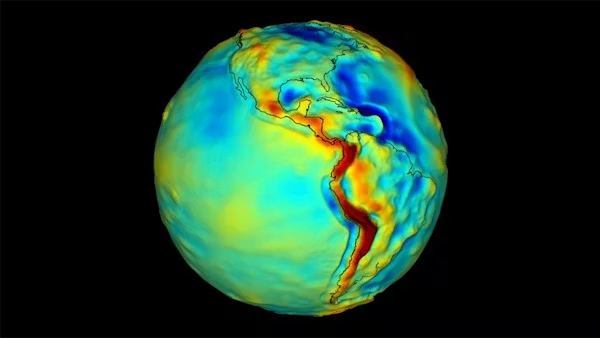
In those measurements, which were corrected for gravitational shifts using a model generated by NASA’s two-satellite Gravity Recovery and Climate Experiment (Grace), researchers found the orbital planes of the twin Lageos satellites changed by about 6 ft. a year as a result of frame-dragging—the predicted effect of the rotating Earth on spacetime.
By comparison, the changes GP-B was trying to gauge are measured in milliarcseconds. Achieving that level of precision required development of 13 new spacecraft technologies and produced a unique spacecraft that merged its instrument, guidance and control functions into a single system.
At the core of the 3.4-ton GP-B were four spheres of fused quartz and silicon about the size of ping-pong balls, machined to a tolerance of 40 atoms in thickness and coated with niobium metal. When cooled with liquid helium to 1.8K and spun up with helium gas to 5,000 rpm, the spheres became superconducting gyroscope rotors generating a magnetic pointer along the axis of rotation that could be measured with great precision by digital magnetometers.
The four gyros were housed in a quartz block that was optically linked to a telescope/star tracker that split the guide star IM Pegasi into four quadrants for greater precision. They were shielded from Earth’s magnetic field by a superconducting lead “bag,” spun in an extreme vacuum and protected from atmospheric drag and other bumps in orbit. For that task, engineers devised a system using helium evaporating from the spacecraft’s 650-gal. dewar to drive 16 thrusters that kept the rotors from touching the sides of their housing as they spun through free-fall around the Earth.
Unfortunately, there was an unanticipated electric polarity in the rotors’ niobium layer that manifested as surface magnetic fields when they were spun up. Ground testing had not detected it, and it proved extremely complicated to process out.
“In this case, there was data taken having to do with the very small additional magnetic fields that these rotors obtained, and that was in some sense housekeeping data that wasn’t super-relevant to the main mission,” says Clifford Will, a physics professor at Washington University in St. Louis who headed the independent advisory panel that oversaw the GP-B experiment for NASA. “At the end of the day, exploiting this data was really critical to modeling these strange anomalous torques in such detail that they could track the orientation of each rotor with a tolerance of a very small angle over the billions of cycles over which each rotor spun during the mission.”
The processing was so time-consuming and complex that NASA gave up in 2008 and dropped its funding, except for a small amount to support spacecraft operations until it was decommissioned in 2010. The GP-B project continued its data analysis with the financial backing—and “some very good brains,” in Everitt’s words—from the King Abdulaziz City for Science and Technology in Saudi Arabia.
Despite the higher-than-expected error margin, GP-B has had some significant spin-offs since it was conceived 40 years ago. They include 100 doctorates generated by work on the project and its science, and a porous plug used to manage the liquid helium. That technology in turn enabled NASA’s Cosmic Background Explorer, which won John Mather and George Smoot the 2006 Nobel Prize in Physics for work with that spacecraft confirming the Big Bang Theory.
“It’s a little bit of a leap to imagine some of this technology being used in a typical spacecraft, because no spacecraft or experiment has those kind of very, very unique requirements,” says Teledyne Brown Engineering President Rex Geveden, who was the GP-B project manager at the Marshall Space Flight Center. “[But] when people started thinking about how to measure the cosmic background, I don’t think they were thinking very hard about how to manage a superfluid helium dewar. There’s a case where the technology came about and found an application in a very important other scientific experiment. So I think there’s a sense in which, in the field of technology dreams, people find a way to use what you produce.”
-Frank Morring, Jr.