by Dr. Randall K. Kirschman, Consulting Physicist, Silicon Valley, ExtElect@gmail.com
 Low-power cryogenic electronics, based on semiconductor devices, has seen success in space exploration, micro-wave and millimeter-wave communications, and recently, cryobanking of biological samples. Probably its most familiar application is low-noise preamplifiers for receivers in cell phone stations, in combination with superconducting filters. In brief, low-power cryogenic electronics has proven itself practical in a variety of areas to improve system performance.
Such power electronics could benefit from even modest cooling, above the liquid-nitrogen temperature range: Many power semiconductor devices continue to operate in this temperature range and moreover exhibit decreased parasitic losses and increased switching speed. The first translates to more efficient power conversion; the second to higher-frequency operation and thus smaller, lighter components (capacitors, inductors, transformers). Laboratory studies and simulations have shown that electric power generation, conversion and distribution systems could be made more efficient, as well as smaller, lighter and lower-maintenance by applying cryogenics.
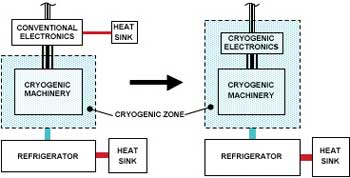
Higher efficiency resulting from cooling the power electronics translates directly to decreasing the amount of heat that must be removed. Another advantage of relocating the power electronics to the cold environment is that power transfer from the cold equipment to the room-temperature environment can be at higher voltage and lower current, so that the heat input from the wiring can be greatly reduced. These benefits from cooling can more than offset the additional refrigeration power required for the electronics (see Fig. 1). In addition, thermal conductivities of good conductors are greatly increased as temperatures are lowered, facilitating heat removal from the dissipative electronic components.
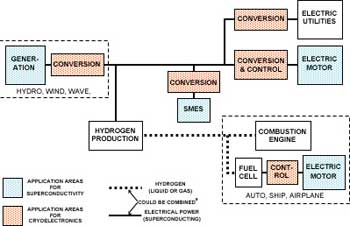
Examples of application areas for power cryoelectronics include
• Ground vehicles (e.g. automobiles) using hy-drogen (from liquid), either directly as fuel for a combustion engine or for fuel cells for electric motors—possibly even vehicles using liquefied natural gas at ~ –160˚C;
• Aircraft using superconducting engines or actuators or using hydrogen as fuel (1, 2);
• Naval, cargo and cruise ships, which are expanding their use of electrical systems to meet general demand as well as for propulsion;
• Existing and alternative electric power generation, including hydro, wind and wave (3, 4, 5);
• Electric power conversion and distribution for utilities, especially using superconducting cables, fault current limiters (FCLs) or transformers (6, 7);
• Superconducting (or very low-temperature) energy storage, either with magnetic systems (SMES—superconducting magnetic energy storage) or capacitor banks, for utilities or vehicles (8);
• Industrial processes involving low temperatures (e.g. natural gas or hydrogen liquefaction plants); and
• High-power superconducting magnets, for physics research, induction heating or levitating trains.
To explore beyond this brief overview, consult the references below, see “Cryogenic Electronics” under “Resources” on the CSA website, or visit “Resources” at http://www.ExtremeTemperatureElectronics.com.
1) R. Radebaugh, “Superconductivity in future aircraft,” Cryo Frontiers column in Cold Facts, v. 25, n. 4, p. 12, Fall 2009.
2) “SC motors could propel all-electric aircraft,” Cold Facts, v. 23, n. 5, pp. 70-71, Dec. 2007 (2008 Buyer’s Guide).
3) R. Radebaugh, “From sailboats – to windmills – to superconducting wind turbines,” Cryo Frontiers column in Cold Facts, v. 26, n. 4, p. 12, Fall 2010.
4) “Renewable energy: opportunities for cryogenics and SC,” Cold Facts, v. 24, n. 4, pp. 8-9+13+15, Fall 2008.
5) “Superconductivity: leaders speak out on progress, future,” Cold Facts, v. 24, n. 3, pp. 6+8-9+13+16-17, Summer 2008.
6) M. Gouge, “Cryogenic cooling systems for SC grid applications,” Cold Facts, v. 24, n. 1, pp. 16-17+26-28, Winter 2008.
7) P. M. Grant, “Upbraiding the utilities,” Cold Facts, v. 27, n. 3, pp. 4+6, Summer 2011.
8) “Eden Energy’s Hythane Company gets patent for new SMES,” Cold Facts, v. 24, n. 2, p. 42, Spring 2008.
9) R. Radebaugh, “Electricity and hydrogen: competitors or companions?,” Cryo Frontiers column in Cold Facts: Part 1, v. 25, n. 1, pp. 12-13, Winter 2009; Part 2, v. 25, n. 2, pp. 12-13, Spring 2009; Part 3 and Conclusions, v. 25, n. 3, pp. 12-13, Summer 2009.