by Harrie Vermeulen, DH Industries USA Inc.
Interest in use of Stirling cryogenerators (cryocoolers) for liquefied natural gas (LNG) applications has grown with the increasing worldwide demand for the gas. Cryogenerators act as cold heat exchangers which can directly reliquefy methane gas. They are typically used for direct liquefaction of an LNG stream, e.g. that produced from a biogas plant, or for reliquefaction of boiloff gas from an LNG system.
Stirling cryocoolers have been used in the LNG market since the 1970s, when they were manufactured and supplied by Stirling Cryogenics’ predecessor, Philips of the Netherlands. Philips was known as Norelco in the US.
Applications
Stirling cryocoolers can be used in several ways and for many LNG-related applications. The purpose, however, is always the same: remove heat from an LNG gas stream to make it liquid again.
Whether a cryocooler makes sense in a particular application will be a decision based on economics, logistics and environment. We ask, “Does it make sense to remove heat from an LNG stream at a particular location, to make it liquid at a certain cost (investment and operational), or should we vent, burn or turn the gas into CNG (compressed natural gas), and at what cost/benefits?” Typically we decide to turn gas into LNG and transport it to a location where it is of more value.
Stirling coolers have proved useful in the following applications:
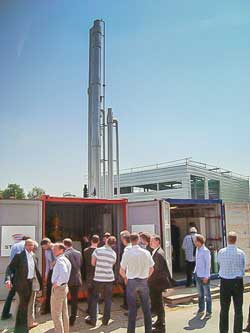
Storage tank boiloff reliquefaction. At locations where large quantities of LNG are stored, such as LNG fuel stations, ships and terminals, vent gas (methane) will be produced as a result of heat leak. This gas can be reliquefied and put back into the system. Also, trucks running on LNG typically carry an amount of methane gas which can be dumped back into the station. This will be reliquefied with the same system.
Process cooling. Whatever the LNG process—cleaning, enrichment, etc.—there will be process losses and/or there will be need of cooling. A Stirling cooler can remove that heat from the process.
Common Configurations

Here clean, ambient temperature LNG gas is directly fed to the cryocooler, where it is liquefied. As the LNG drains into the tank due to gravity, the cooler must be positioned above the tank or else an intermediate vessel with some kind of pressure buildup system is required (picture 2). Temperature of the incoming gas can be anywhere from 400 – 98K. Pressure of the gas can be from 0 – 2MPa.
Reliquefaction of boiloff gas:
In this case clean and cold boiloff gas from an LNG system or tank (not from a source) is fed to the cryocooler where it is reliquefied. As the LNG drains into the tank due to gravity, the cooler must be positioned above the tank or else an intermediate vessel with some kind of pressure buildup system is required. Compared with the direct liquefaction of source gas, boiloff gas tends to be colder and present in smaller quantities. However, integration into the process might require a bit more consideration, especially if there are significant fluctuations in the load.
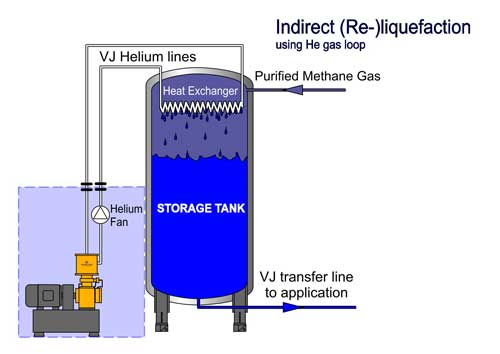
Heat can also be removed with an intermediate fluid or gas such as liquid nitrogen or helium gas (see Picture 3). In a closed loop, this medium is pumped from the cooler to the system tank and back. CryoZone Cryofans/gas circulators (See Cold Facts Summer 2013) can be used–and integrated in the Stirling cooler–to transfer the helium gas. For liquid nitrogen, a cryogenic pump will be needed.
Indirect reliquefaction with LNG:
As a third alternative, liquid LNG can be fed to the cooler and subcooled (liquid in/liquid out) to add the required cooling to the system. This requires a cryogenic pump for the LNG and proper connections on the storage tank.
Configurations
Extracting energy from a methane (LNG) gas stream to make it liquid again can be done in two ways. Direct: The gas stream to be reliquefied can be fed directly to the cooler; or indirect: The energy can be extracted from the process through an intermediate gas or liquid. Typically this will be helium gas or liquid nitrogen. This medium will transfer the heat from the LNG process to the cryocooler.
The method chosen depends on several factors: how easily the gas is collected and fed to the cryocooler; how, and where, the tie-ins are in the process; which process equipment, e.g. intermediate tanks, pumps, cryofans and valves, is preferred, and what are the plot space and explosion-proof zone restrictions and requirements.
Capacity and Restrictions
The cryogenerator works as a cold head exchanger in which feed gas will liquefy. It operates at the saturated liquefaction point of methane, which depends on the pressure. As other components in the feed gas will reach this temperature as well, it is important that certain components are removed. This is especially true for carbon dioxide and water, but also for other impurities that might damage the copper internal components of the cooler. If CO2 and water are present, they will freeze on the cold head and block the cooler in a short amount of time, preventing it from operating properly.
The typical required feed gas specifications for a cryocooler are as follows:
Main stream CH4
CxHy (C2 to C4) < 10%
CxHy (C5+) < 1 ppm
CO2 < 50 ppm
H2O < -70˚C dew point
H2S < 3.3 ppm
Oil content < 0.01 mg/m3
Particles < 0.1 micron
N2/O2 < 10%
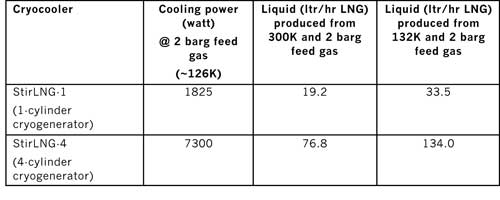
Stirling Cryogenics’ StirLNG product range was developed for the LNG market. These products consist of the standard SPC 1 and 4 cryocooler, with a methane liquefaction cold head and explosion-proof execution (ATEX or US/NEC 500).
The amount of LNG that the StirLNG-1 and StirLNG-4 can produce depends on the temperature and pressure of the feed gas. The pressure determines the liquefaction point and the cooling power that the cryogenerator will produce. The temperature of the gas determines the amount of heat that has to be removed. A few typical indicators:
Other process conditions are available upon request.
Obviously, for higher capacities, multiple coolers can be used.
Stirling Cryogenics recently participated in several demonstration projects using this technology: An SPC-4 cryocooler for methane reliquefaction (LNG storage) for a client in South Korea.; an SPC-1 cryocooler for biogas liquefaction (a demonstration and test on direct liquefaction of methane gas produced from a water treatment biogas plant in the Netherlands); a demonstration in the Netherlands for LNG fuel gas systems; two SPC-4 cryocoolers for methane reliquefaction for LNG carbon capturing in the US; and one SPC-4 cryocooler for methane (LNG) reliquefaction of boiloff gas from a LNG fuel station in the US.
For more information, contact Harrie Vermeulen, info@d-h-industries.us, 781/229-5814, www.d-h-industries.us.