by Dr. Lance Cooley, Technical Division, Fermilab, ldcooley@fnal.gov; Claire Antoine, CEA-Saclay, SRF Chair, claire.antoine@cea.fr;
Sébastien Bousson, CNRS/IN2P3/IPNO, SRF Co-chair, bousson@ipno.in2p3.fr
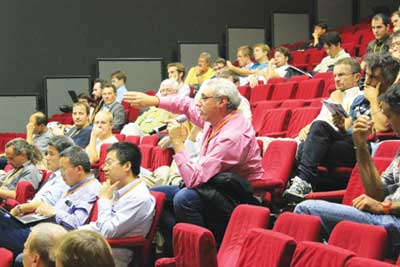
The biennial SRF conference series is the most important conference in the field of superconducting cavities for particle accelerators. Chair Claire Antoine from Centre d’Etudes de Saclay and Co-Chair Sébastien Bousson from Institut de Physique Nucléaire d’Orsay organized the event around its traditional themes, ranging from project needs and drivers, basic materials R&D, advances in processing, technical implementation and production, and novel approaches.
The International Linear Collider has dominated the conference activity over the past decade or more, and the 2013 conference extended this long-standing discussion with the possibility of a Higgs Factory located in Japan. The construction of the European X-Ray Free Electron Laser (XFEL), recent upgrades at Thomas Jefferson National Accelerator Facility (TJNAF), construction of the Facility for Rare Isotope Beams (FRIB) or Spiral-2 in Ganil (France) and planned neutron sources around the world also stimulated attendance and discussions.
Other headlines included possibilities for high-power proton accelerators, accelerator-driven nuclear systems, the evolution of SRF cavities beyond niobium metal and energy-recovery linacs. The breadth and number of projects emphasized the health and robustness of the field. Seven institutional sponsors and four major industrial sponsors contributed to support 32 student attendees.
Technical Program

Focused “hot topic” sessions bring together a panel of experts to debate more controversial themes. Contributed work is mostly organized into large poster sessions. The conference presents awards for the best presentations, oral and poster, by young researchers.
The technical program took place over five days, with afternoons set aside for lab tours and a social event. Keynote presentations, “Pathways to a Higgs Factory” by Hitoshi Murayama and “Quantum Measurement with ‘Trapped’ Microwave Photons in a SRF Cavity” by Michel Brune, punctuated the 370 presentations listed in the program.
SRF Challenges and Projects
Several projects involving the use of SRF cavity technology are in the process of construction. A main conclusion of the overview presentations is that projects are proceeding well, with successful industrialization of the SRF cavity fabrication and processing being clearly emphasized.
At Michigan State University, the FRIB project contributed 16 presentations to the program. Cryomodule and cold mass designs were summarized by M. Leitner in an invited oral presentation, and several poster presentations followed up with details ranging from materials and processing to couplers, bellows and other cavity components.
W. Singer summarized the status of cavity procurement for XFEL, emphasizing how full production and chemical processing is being successfully performed by industrial cavity manufacturers. An additional 34 presentations during poster sessions covered many aspects of cryomodule design and performance, RF systems, materials and processing, technology transfer and other topics.
Projects to upgrade light sources, improve other ion or neutron sources, or contribute intense and continuous electron beams marked a transition in the program discussion toward continuous-wave linacs. This is somewhat of a departure from past conferences, which have been dominated by discussions related to pulsed linacs connected to the International Linear Collider and similar machines. Various problems associated with “CW linacs” were captured in more than 60 presentations. The emphasis on CW cavity themes carried over to other program areas.
Several presentations focused on commissioning of injectors, photoemission guns, quadrupole resonators and other front-end and low-energy components.
Basic and Materials R&D
The 2013 conference saw “breakthrough” presentations in at least two areas. The first is research into very high quality factor Q. Slight modifications to cavity heat-treatment procedures led to significant reductions of the surface resistance, with Q well above 5 × 10¹¹ being reported between 5 and 20 MV/m at 2.0K. In some observations, a steady increase of Q occurred over this field range, which is behavior not like that previously discussed at this conference for pulsed cavities. Multiple processing strategies to attain surface resistance at or approaching the lowest values yet recorded were presented by collaborators at Fermilab (including A. Romanenko and A. Grassellino), Cornell (D. Gonella and R. Eichorn), and other labs.
Collaborators at Cornell and at Helmholtz-Zentrum Berlin, including best oral presentation winner J. Vogt, showed results for reducing dissipation by trapped flux via slow cooling through the critical temperature. A modification of the Matthias-Bardeen theory of surface resistance, taking into account the dependence on RF fields, was presented by C. Reece on behalf of B. Xiao from TJNAF. This work demonstrated that the increasing quality factor observed by the researchers above should be expected when RF effects are taken into account. Evidently, a new era of niobium processing for very high Q is now active.
The second “breakthrough” area is the advent of cavities made from Nb3Sn with high Q well above 1010 for fields above
10 MV/m at 4.2K. Among the many presentations that addressed cavities not manufactured from bulk niobium, one by researchers at Cornell, including S. Posen and M. Liepe, described the successful growth of Nb3Sn coatings inside bulk Nb. The reported behavior was different than that observed many years ago, with characteristics like those associated with successful niobium cavity processing.
Many other presentations addressed cavity fabrication approaches using thin films of niobium, MgB2, nitrides, and other superconducting materials. In particular, several laboratories demonstrated the enhanced screening effect of nanometric multilayers (NbN or MgB2). The winner of the Young Scientist Poster award, T. Kubo from KEK, developed a complete vortex penetration field for the multilayer model, showing the optimum range of thicknesses for the respective insulating and superconducting layers. His results for Nb3Sn rejoin the calculation presented by S. Posen: no improvement can be awaited for thin layers compared to the bulk Nb3Sn, whereas for other superconductors, e.g. NbN, a factor 10 can be gained on the field limitation. First RF test on multilayers were also presented by C. Baumier (IPNO/Irfu).
Several presentations addressed the materials science of niobium. These presentations emphasized niobium hydrides (since hydrogen is acquired via chemical polishing treatments), multi-modal interactions between hydrogen and other atoms including carbon, nitrogen and oxygen, influences of material vacancies and dislocations, recovery of materials, and the effect of various defects and contaminants on observed properties.
Technical R&D and Processing Advances
A number of advances in processing and technical areas were described. While cavities presently continue to receive chemical polishing with dangerous acids as a standard, new techniques to remove hydrofluoric acid showed promise. This includes mechanical polishing techniques, polishing approaches using alternative wet ionic solutions and approaches that adjust the application of current pulses to control the electrochemical behavior. Several laboratory-industry partnerships were announced to transfer and scale these promising developments. A review of mechanical polishing by A. Palczewski from TJNAF mentioned the first success for an entirely acid-free process at Fermilab. In concert with various polishing strategies, several presentations addressed heat treatments at very high temperatures to heal damage or promote changes in the material.
TJNAF, XFEL and KEK each reported aspects of construction and first operations with new cavity processing infrastructure, clean rooms and other integrated systems. Fabrication and testing infrastructure has also advanced, with the notable developments of infrastructure for testing 800 cavities and assembling 100 cryomodules for XFEL. The large activities at XFEL, FRIB and elsewhere promoted substantial discussion about quality control and quality assurance, tracking, dimensional and engineering controls, production tracking systems and other issues related to production. DESY alone is responsible for over 24,000 articles manufactured from niobium or niobium-titanium alloy, according to one presentation. Acceptance testing for niobium showed that worldwide vendors of raw material are maintaining an acceptance rate of about 98% of material, despite recent cost escalation.
New Projects and New Cavity Development
A series of presentations outlined anticipated projects for future ion linacs, the European Spallation Source, Project X, upgrades to the Large Hadron Collider, energy recovery linacs, and for nuclear energy systems. The anticipated projects emphasized relatively new cavity activities, including more emphasis on spoke cavities, quadrupole resonators, and deflecting cavities. Discussions about high-power CW operations comprised more of the “future projects” section of the program than in past conferences. Cost analyses were also updated in view of improved technology, better understanding of performance that has actually been obtained in production cycles and possible improvements for Q.
On to Vancouver!
The 2015 conference will be held in Vancouver, BC, Canada; Dr. Robert Laxdal of TRIUMF will be the conference Chair.