by Dr. Philippe Lebrun, philippe.lebrun@cern.ch, and Dr. Laurent Tavian, laurent.jean.tavian@cern.ch, CERN
Since the invention of the cyclotron by Lawrence and Livingston at Berkeley in 1930, particle accelerators at the energy frontier have shown rapid and sustained development in performance, both through an increase in size and through the use of more advanced technology. Thus the largest machine today, the Large Hadron Collider (LHC) at CERN, which permitted the discovery of the Higgs boson in 2012, with its 26.7 km circumference and 7 TeV proton beams, produces accelerated beams one hundred million times more energetic than the first Berkeley cyclotron, but it is “only” one hundred thousand times larger. If this trend continues, one would expect the next discovery machine to be both larger and more technologically advanced than the present LHC.
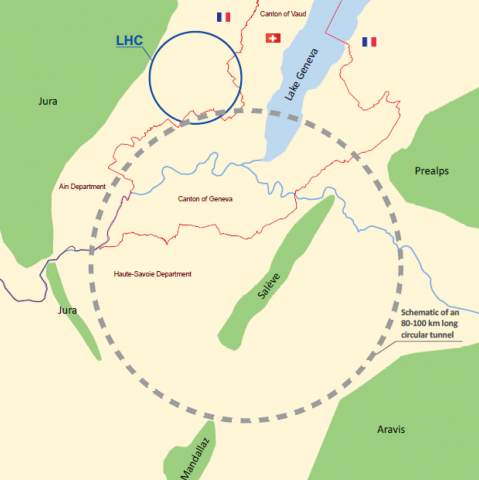
Of course, the first priority of the European community of particle physicists, and therefore of CERN, for the next two decades is to maximize the return on investment by exploiting the full potential of the LHC, first with nominal parameters up to 2023 and then with its high-luminosity upgrade up to 2035. In parallel, and given the long lead times of such big projects—the first LHC studies started in the early 1980s—CERN will launch the study of Future Circular Colliders (FCC) beyond the LHC, based on a new 80-100 km circumference tunnel infrastructure in the Geneva basin. The FCC study, which will be organized as a worldwide international collaboration, comprises an energy-frontier 100 TeV proton and heavy-ion collider, a high-luminosity electron-positron collider as a potential intermediate step and the analysis of options for a hadron-lepton collider. The goal of the study is to deliver a conceptual design report, together with a cost estimate, in time for the next update of the European strategy in particle physics, due to take place in 2018.
Superconductivity and helium cryogenics will be present in all machine options. Key technologies are high-field superconducting magnets for the hadron collider and an efficient high-power RF system based on superconducting cavities for the lepton collider. In all cases, large-capacity helium refrigeration down to 4.5K and possibly 1.8K will be required, together with the corresponding distribution, recovery and inventory storage systems. Possible R&D goals for the study include the development of short 16 T dipole models by 2018, investigation of 20 T magnet technology based on a combination of low- and high-temperature superconductors, superconducting RF developments aiming at overall system optimization and further progress in large unit-size cryogenic plants producing efficient refrigeration down to 4.5K and 1.8K.
More than 350 experts in accelerators and particle physics from around the world came together at the University of Geneva on February 12-15, 2014, to launch the FCC study. After two days of plenary sessions surveying the scope, plan, international situation and design starting points of the FCC, parallel break-out sessions provided the opportunity for feedback, additional topical presentations and lively discussions. Worldwide collaboration in all areas—physics, detectors, accelerators and technology—was considered essential for meeting the deadline of 2018 for the conceptual design report.
Institutes around the world are now invited to join the global FCC effort and submit non-committing “expressions of interest” with regard to specific contributions.
All presentations at the FCC kick-off meeting on February 12-15, 2014, can be found at http://indico.cern.ch/e/fcc-kickoff.