by Dr. Peter V. Mason, California Institute of Technology, retired Jet Propulsion Laboratory, CSA Fellow, pmason@alumni.caltech.edu
Many scientific observations must be done in space at cryogenic temperatures a few millidegrees to a few degrees above absolute zero (-273°C). These include observations of the behavior of superfluid helium in space and observations with instruments and millimeter-wave telescopes operating at liquid helium temperatures.
Until recently, most observations at deep cryogenic temperatures have been done with liquid helium, cooled by venting to space. This raises the problem that in the absence of gravity, the liquid helium vents to space about as easily as the boiloff gas, shortening the operating life drastically.
To solve this problem, a member of the Gravity Probe B team proposed the use of a unique feature of superfluid liquid helium (SFHe), the fountain effect (Everitt, Fairbank and Selzer, “A Superfluid Plug for Space,” 1971). This effect, first observed by Dutch SFHe pioneer Hans Kammerlingh-Onnes, showed that superfluid helium will flow vigorously toward the warmest surface in the cryostat. He proposed venting the helium to space through a porous plug. The inner surface would be at the bath temperature. The plug will fill with liquid helium and the outer surface will be cooled by evaporation to space. Thus there will be a substantial pressure (typically several millibars) keeping the liquid in the cryostat, many times what is needed to retain it. In fact, we have shown that a small dewar in
1 G (say 20x20x20 cm) can be vented and pumped through a porous plug at the bottom, as long as a reasonable vacuum is maintained below it by a small forepump.
The first operation of a helium cryostat in zero gravity took place on the NASA KC-135 zero-gravity aircraft. This facility was developed to provide training for astronauts in zero G before their actual flight. (More than one candidate found out that he could not take being in zero G.) It was soon realized that it was an ideal place to perform tests of equipment as well, and also to perform extremely useful measurement. Our flights demonstrated the expected behavior of SFHe in zero gravity and validated its use in IRAS.
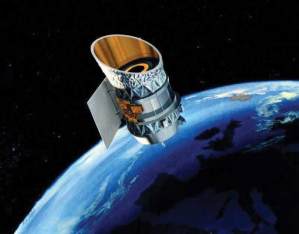
The first flight of SFHe was in IRAS in 1983. Its task was to observe the entire sky in the far infrared. The flight was entirely successful. The SFHe was maintained at about 1.4K by venting through the porous plug. The temperature was set only by the equilibrium between the heat input and the flow impedance. IRAS was placed in an orbit maintained perpendicular to the sun-Earth line, so solar input and hence temperature were nearly constant. The helium supply lasted for 10 months. Well over 200,000 infrared objects were observed, most of them at wavelengths not observable from the ground because of atmospheric interference.
A later flight was the Superfluid Helium Experiment on the shuttle. It was intended as a test predecessor of IRAS, but shuttle priorities and difficulties prevented this and, as described above, the KC-135 tests had already demonstrated the physics. However, it did conduct three experiments of considerable scientific interest. These were 1) measurement of the slosh and damping in thin films of SFHe, 2) measurements of the thickness and thermal conductivity of thin films of SFHe, and 3) measurement of third sound (surface waves in which the restoring force is Van der Waals forces) in thin SFHe films. Experiments 1 and 2 provided data useful in the design of future systems using SFHe. Experiment 3 did not provide useful data due to strong electromagnetic interference with the measuring apparatus coming from an unknown source.