In from the cold? Really? Isn’t “cold” an inevitable and immutable component of superconductivity?
Both these issues were recently addressed by this writer in a talk given this past April at the San Francisco Spring Meeting of the Materials Research Society [3]. What the electricity enterprise requires for significant deployment of superconductivity, in my honest opinion, is a “compelling need” similar to that presented in the decades of the 1920s and ’30s to provide “cheap power to the people,” which inspired Samuel Insull to invent the investor-owned and regulated private utility and David Lilienthal to establish that paradigm of public generation, the Tennessee Valley Authority. Each required and engendered massive utilization of the alternating current technology pioneered by Nicola Tesla [4]. So what would present today an emerging “compelling need” for a power application on the exascale of the warehouse of high temperature superconducting materials discovered and developed over the last quarter-century?
We now know the world is literally awash in hydrocarbon fossil fuels, especially methane (natural gas) but also “tight crude.” The co-evolution of seismic imaging and hydraulic fracturing (“fracking”) gives us their location and “how to get both out.” There are plans worldwide to extract natural gas and install pipeline infrastructure for its end-use delivery [5]. In North America, there are a variety of schemes/proposals pending, ranging from the long-proposed Mackenzie Valley Pipeline to co-use of Keystone XL rights-of-way to opportunities to exploit the Dakotas and New York/Pennsylvania methane fields. At present, some 30 percent of delivered natural gas in North America and Europe is combusted at delivery point to generate electricity. And that fraction is expected to increase in the future. Why not burn that portion at the well head using (possibly superconducting) combined cycle turbine technology and deliver the electrons/holes in a superconducting cable laid alongside a reduced capacity (and cheaper) gas pipeline in a common right-of-way [6, 7]? A very preliminary “engineering economy” study of such a scenario was published as far back as 2006 [8], and proposals to consider its extension will be submitted to DOE and Electric Power Research Institute (EPRI) for review in 2015.

OK, now how about escaping the upper limit on Tc to below 200K if your present materials are traditional Eliashberg-McMillan “strong-coupled” compounds, as are all compounds with Tcs greater than 20K? What nanoscale “design” would be necessary to really bring us in from the cold?
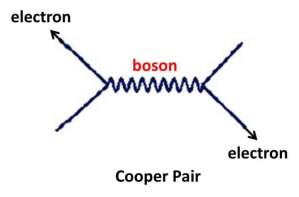
This question was raised decades ago, originally by Bill Little and Vitaly Ginzburg in the 1960s and ’70s [9, 10]. Both pointed out the “way upward” might be to employ a BCS pairing boson with a much higher characteristic energy than phonons or magnons. Recall “grammar school” BCS theory scales the transition temperature as Tc ≈ ΘB exp(-1/λe-B), where ΘB is the characteristic boson temperature (w 400K, phonons; 800K, magnons; 11,000K, excitons!), and λe-B represents the electron (hole)-boson coupling constant (0.2, weak; 1.7, strong). We can easily see for ΘB on the exciton scale, even for weak coupling, Tc might well exceed 300K!
Little and Ginzburg suggested various polymeric structures wherein a one-dimensional metallic chain would be surrounded by polarizable aromatic molecules providing the source of the excitonic boson. One such idealization was studied analytically by Davis, Gutfreund and Little, using a dielectric response method known as KMK (Kirzhnits-Maximov-Khomskii) as a more general alternative to Eliashberg-McMillan, and found very sensitive structural features required control to manifest electron-exciton pairing, principally the spacing between the “conducting spine” and its aromatic molecular wrapping. If such were too far, the itinerant electron-holes would not “feel” the presence of the excitons, and, if too close, these same carriers would “screen” the very formation of the excitons [11].
The last dozen or so years have witnessed the rapid and extensive development of computational chemistry, known as density-functional theory (DFT), which in principle will allow the quantitative analysis of any number of atomic-molecular arrangements that could possibly exploit the Little-Ginzburg mechanism, without having to, at least initially, actually synthesize each one. One relatively straightforward embodiment to the model was proposed in 1973 by Allender, Bray and Bardeen [12], simply a thin metal film deposited on a semiconductor surface, in which tunneling of itinerant electrons into the energy gap of the semiconductor excites the excitons required for pairing. One intriguing, to me at least, geometry to explore would be simply a quasiperiodic chain of, say, sodium atoms, decorating a dislocation line on the surface of silicon. I predict, once the next wave of physics and chemistry graduate students undertakes the tedious and time-consuming task of writing the required DFT-based code employing appropriate response algorithms (e.g. KMK), we will find a proper embodiment of excitonic superconductivity to then proceed to synthesize.
To close, this physicist will enter his eighth decade on the planet in 2015. I truly and sincerely hope those in the younger generation of SuperFolks will find “warm answers” to both the exascale and nanoscale challenges raised here soon, so I can still be around to enjoy and admire the fruits of their labors! [13]
References
* For entries marked with an asterisk, a PDF of the reference is available at Dr. Grant’s website, http://w2agz.com.
- P. M. Grant, “Out into the Cold: Early Experiences with Superconductivity,” Cold Facts 27(1), 4 (2011). This piece ended anticipating the possible existence of room temperature superconductivity, when “I can finally come in from the cold.”
- P. M. Grant, “Upbraiding the Utilities,” Cold Facts 27(3), 4 (2011). This article speculated “what it might take” for investor-owned-utilities to substantially “invest” in superconducting power equipment.
- P. M. Grant, “Challenges Confronting High Temperature Superconducting Materials: From Nanoscale Theories to Exascale Energy Applications,” presented at the 2014 Spring Meeting of the Materials Research Society and accepted for publication in the conference proceedings. PDF preprints of the paper and presentation may be obtained by emailing w2agz@w2agz.com, subject: Spring MRS 2014.
- * A truly excellent history and commentary on the evolution of the transmission, distribution and end use of electricity in the United States, can be found in “The Grid: A Journey Through the Heart of Our Electrified World,” by Phillip Schewe, Joseph Henry Press: 2007, reviewed by P. M. Grant, Nature 447, 145 (2007).
- Recently, the Russian Federation and the People’s Republic of China announced plans to construct a 2500 mile pipeline running from Siberia to central China. See the following New York Times coverage: http://www.nytimes.com/2014/05/22/world/asia/china-russia-gas-deal.html?_r=0
- * The “dual use” concept is concisely summarized in an interview with the author that appeared in 2013 in SmartGridNews.
- * A detailed overview, along with extensive bibliographical links, can be found in: P. M. Grant, “Dual use of future natural gas pipeline rights-of-way for the transport of electricity via HTSC cables,” EUCAS 11, September, 2013, Genova, Italy.
- * P. M. Grant, “Cryo-Delivery Systems for the Co-Transmission of Chemical and Electrical Power,” AIP Conf. Proc. 823, 291 (2006); doi: 10.1063/1.2202428.
- * W. A. Little, “Superconductivity at Room Temperature,” Scientific American 212, 21 (1965).
- W. A. Little, “Vitaly Ginzburg and High Temperature Superconductivity,” J. Supercon. Novel Mag. 19, 441 (2006).
- * D. Davis, H. Gutfreund and W. A. Little, “Proposed Model of a High Temperature Excitonic Superconductor, Phys. Rev. B 13, 4766 (1976).
- * D. Allender, J. Bray and J. Bardeen, “Model for an Exiton Mechanism of Superconductivity,” Phys. Rev B 7, 1020 (1973).
- * Paul M. Grant, “Researchers Find Extraordinarily High Superconductivity in Bio-inspired Nanopolymer,” Physics Today (2028).