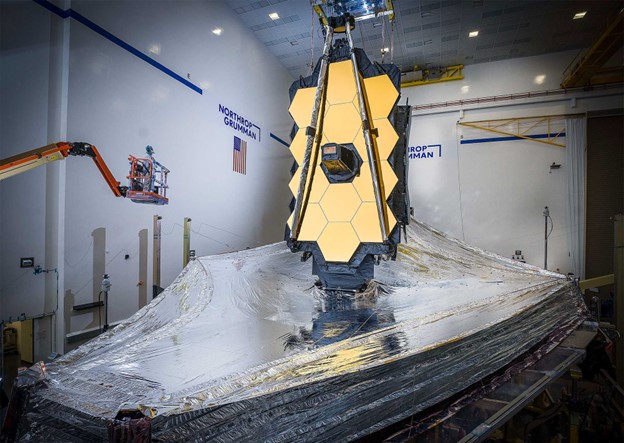
 To look back in time at the cosmos’s infancy and witness the first stars flicker on, you must first grind a mirror as big as a house. Its surface must be so smooth that, if the mirror were the scale of a continent, it would feature no hill or valley greater than ankle height. Only a mirror so huge and smooth can collect and focus the faint light coming from the farthest galaxies in the sky — light that left its source long ago and therefore shows the galaxies as they appeared in the ancient past, when the universe was young. The very faintest, farthest galaxies we would see still in the process of being born, when mysterious forces conspired in the dark and the first crops of stars started to shine.
But to read that early chapter in the universe’s history — to learn the nature of those first, probably gargantuan stars, to learn about the invisible matter whose gravity coaxed them into being, and about the roles of magnetism and turbulence, and how enormous black holes grew and worked their way into galaxies’ centers — an exceptional mirror is not nearly enough.
The reason no one has seen the epoch of galaxy formation is that the ancient starlight, after traveling to us through the expanding fabric of space for so many billions of years, has become stretched. Ultraviolet and visible light spewed by the farthest stars in the sky stretched to around 20-times-longer wavelengths during the journey here, becoming infrared radiation. But infrared light is the kind of atom-jiggling light we refer to as heat, the same heat that radiates from our bodies and the atmosphere and the ground beneath our feet. Alas, these local heat sources swamp the pitiful flames of primeval stars. To perceive those stars, the telescope with its big perfect mirror has to be very cold. It must be launched into space.
The catch is that a house-size mirror is too large to fit in any rocket fairing. The mirror, then, must be able to fold up. A mirror can only fold if it’s segmented — if, instead of a single, uninterrupted surface, it’s a honeycomb array of mirror segments. But in order to collectively create sharp images, the mirror segments, after autonomously unfolding in space, must be in virtually perfect alignment. Spectacularly precise motors are needed to achieve a good focus — motors that can nudge each mirror segment by increments of half the width of a virus until they’re all in place.
The ability to see faint infrared sources doesn’t just grant you access to the universe’s formative chapter — roughly the period from 50 million to 500 million years after the Big Bang — it would reveal other, arguably just as significant aspects of the cosmos as well, from properties of Earth-size planets orbiting other stars to the much-contested rate at which space is expanding. But for the telescope to work, one more element is required, beyond a flawless mirror that autonomously unfolds and focuses after being shot into the sky.
Even in outer space, the Earth, moon and sun all still heat the telescope too much for it to perceive the dim twinkle of the most distant structures in the cosmos. Unless, that is, the telescope heads for a particular spot four times farther away from Earth than the moon called Lagrange point 2. There, the moon, Earth and sun all lie in the same direction, letting the telescope block out all three bodies at once by erecting a tennis court-size sunshield. Shaded in this way, the telescope can finally enter a deep chill and at long last detect the feeble heat of the cosmic dawn.
The sunshield is both an infrared telescope’s only hope and its Achilles heel.
In order to unfurl to large enough proportions without weighing down a rocket, the sunshield must consist of thin fabric. (The whole observatory, for that matter, including its mirrors, cameras and other instruments, its transmitters and its power sources, must have only about 2% of the typical mass of a large ground-based telescope.) Nothing about building a giant yet lightweight infrared-sensing spacecraft is easy, but the unavoidable use of fabric makes it an inherently risky affair. Fabric is, engineers say, “nondeterministic,” its movements impossible to perfectly control or predict. If the sunshield snags as it unfurls, the whole telescope will turn into space junk.
Currently, the telescope — which has, incredibly, been built — is folded up and ready to be placed atop an Ariane 5 rocket. The rocket is scheduled for liftoff from Kourou, French Guiana, on December 22, more than 30 years after its payload, the James Webb Space Telescope (JWST), was first envisioned and sketched. The telescope is 14 years behind schedule and 20 times over budget. “We’ve worked as hard as we could to catch all of our mistakes and test and rehearse,” said John Mather, the Nobel Prize-winning astrophysicist who has been chief scientist of the NASA-led project for 25 years. Now, he said, “we’re going to put our zillion-dollar telescope on top of a stack of explosive material” and turn things over to fate.
The story of JWST’s development over the past three decades has paralleled the tremendous progress we’ve made in our understanding of the cosmos, not least because of Webb’s predecessors. With the Hubble Space Telescope, we’ve learned that stars, galaxies and supermassive black holes existed far earlier in cosmic history than anyone expected, and that they have since undergone radical change. We’ve learned that dark matter and dark energy sculpt the cosmos. With the Kepler telescope and others, we’ve seen that all manner of planets decorate galaxies like baubles on Christmas trees, including billions of potentially habitable worlds in our Milky Way alone. These discoveries have raised questions that the James Webb Space Telescope can address. Astronomers also hope that, as with other telescopes, its sightings will raise new questions. “Every time we build new equipment,” Mather said, “we get a surprise.”
The launch will begin what the astronomer Natalie Batalha called “six months of pins and needles,” as the staggeringly complex telescope will attempt to unfold and focus itself in hundreds of steps. The observatory will spend a month floating 1 million miles to Lagrange point 2. On the way, it will transform into a celestial water lily, positioning its giant blossom of gold-plated mirror segments atop an even bigger silver leaf.
“It will be our own ‘dare mighty things’ moment,” said Grant Tremblay, an astrophysicist at Harvard University who served on the telescope’s time allocation committee. “It’s going to do amazing things. We’ll be in The New York Times talking about how this is witnessing the birth of stars at the edge of time, this is one of the earliest galaxies, this is the story of other Earths.”
“Please work,” Tremblay added, his eyes fluttering upward.
From Smooth to Lumpy
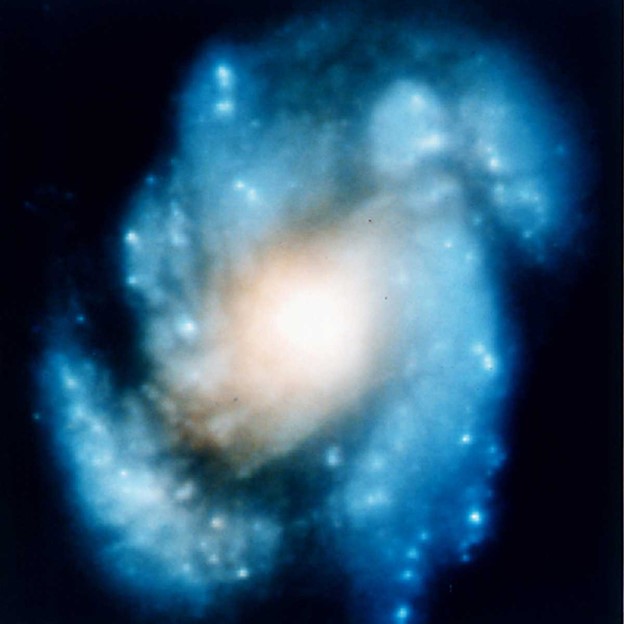
The last time NASA launched an observatory of such significance — the Hubble Space Telescope, in 1990 — it was a disaster. “Absolutely catastrophic,” the veteran astronomer Sandra Faber told me. Faber was on the team that camped out at NASA’s Goddard Space Flight Center in Greenbelt, Maryland, to diagnose the disorder. From the way a star in one of Hubble’s photos looked like a ring, she and a colleague inferred that the primary mirror — the big, concave one that bounced light to a secondary mirror that then reflected it onto a camera lens — had not been ground down to quite the right concavity to focus the light; it was half a wavelength too thick around the edge. If the primary and secondary mirrors had been tested together before launch, this aberration would have been noticed, but in the rush to get the long-delayed and over-budget telescope aloft, that testing never happened.
Some NASA leaders called for abandoning the telescope, which was already a controversial project. Instead, Senator Barbara Mikulski of Maryland secured the funds for a rescue mission. Fixing it was possible because, as an optical telescope that’s sensitive to the colors of the rainbow rather than to infrared light, Hubble can get a clear view from low-Earth orbit, only 340 miles up, instead of having to travel a million miles away. In 1993, the space shuttle docked with Hubble, and astronauts installed a sort of contact lens. The telescope would go on to revolutionize astronomy and cosmology.
 Perhaps the most important question about the universe for much of the 20th century was whether it had a beginning or if it has always been this way. For the British cosmologist Fred Hoyle and other believers in the latter “steady state” theory, “the compelling logic was simplicity,” said Jay Gallagher, an astronomer and professor emeritus at the University of Wisconsin, Madison. “That at one point something changed and the universe created matter, why did that have to be?” Hoyle, the steady-state proponent, attributed his rivals’ belief in the “Big Bang” (as he dubbed it) to the influence of the Book of Genesis.
Then came a hiss in a radio antenna at Bell Labs in New Jersey in 1964. The hiss was generated by microwaves arriving from everywhere in the sky, exactly as predicted by the Big Bang theory. (The light was released in an early phase transition as the hot, dense universe cooled.) The discovery of the cosmic microwave background, as it was called, did not immediately end the debate — steady-state folks like Hoyle distrusted its interpretation and clung to their theory for many more decades. But for others, who recognized the afterglow of the Big Bang when they saw it, the CMB created a puzzle. The near-perfect uniformity of microwaves coming from all parts of the sky indicated that the newborn universe was astonishingly smooth — a purée of matter. “The puzzle is we see a very lumpy universe today,” said Faber, who was a graduate student studying galaxies in the late ’60s. “So the first challenge in understanding galaxies is to understand how the universe goes from smooth to lumpy.”
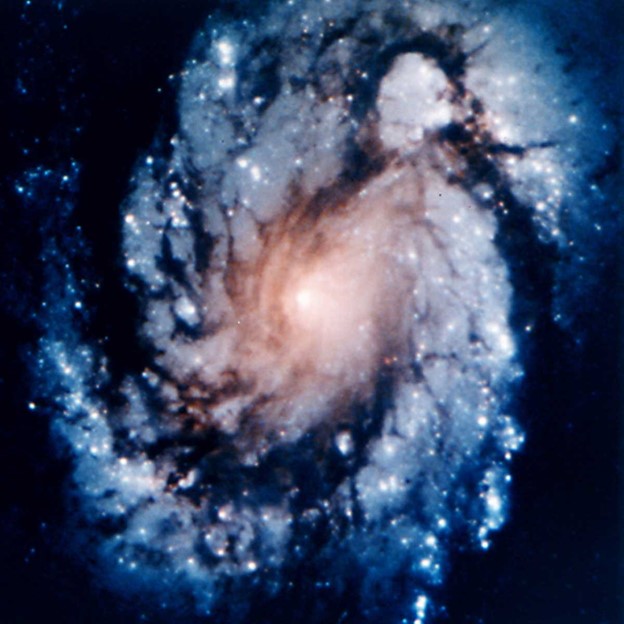 Cosmologists knew atoms must have gradually clumped together because of gravity, eventually fracturing into structures like stars and galaxies. But on paper, it seemed that the growth of structure would have been extraordinarily slow. Not only was matter initially smoothly distributed, and thus pulled in no particular direction by gravity, but the expansion of space and the pressure created by light itself would both have worked to separate matter, counteracting its weak gravitational attraction.
Enter dark matter. In the 1970s, Vera Rubin of the Carnegie Institute of Washington observed that the outskirts of galaxies rotate much faster than expected, as if whipped around by some extra, invisible source of gravity. This evidence for substantial missing matter in and around galaxies, dubbed dark matter, matched Fritz Zwicky’s 1930s observations that galaxies seem to attract each other more than they should based on their luminous matter alone. Also in the ’70s, Jim Peebles and Jerry Ostriker of Princeton University calculated that rotating galactic disks consisting only of stars, gas and dust should become unstable and swell into spheres; they posited that invisible matter must be creating a stronger gravitational well within which the visible disk rotates. In 1979, Faber and Gallagher wrote an influential paper compiling all the evidence for dark matter, which they pegged at about 90% of the matter in the universe. (The current estimate is about 85%.)
These researchers realized that dark matter, with its substantial gravity and imperviousness to light’s pressure, could have bunched up relatively quickly in the early universe. Peebles, who won half of the 2019 Nobel Prize in Physics for his contributions to cosmology, developed a qualitative picture in which dark matter particles would have glommed together into clumps (known as halos) that then combined into bigger and bigger clumps. The British astrophysicist Simon White demonstrated this “hierarchical clustering” process in primitive 1980s computer simulations. Though visible matter was at that time too complicated to simulate, researchers surmised that the conglomerating dark matter would have brought luminous matter along for the ride: Corralled within dark matter halos, atoms would have bumped together, heated up, sunk toward the center and eventually gravitationally collapsed into stars and disk-shaped galaxies.
Although most cosmologists became convinced of this picture, a big question was how variations in the density of matter initially set in, jump-starting the gravitational clustering process. “People had no clear idea about what were reasonable initial conditions about the formation of cosmic structure,” White, who is now retired and living in Germany, told me over Zoom. “You could run these simulations, but you didn’t have any idea what you should put in at the beginning.”
“SPECTACULAR REALIZATION,” the cosmologist Alan Guth scrawled in his notebook in 1979. He had calculated that if space suddenly blew up like the surface of a balloon at the start of the Big Bang, this would explain how it got so huge, smooth and flat. Cosmic inflation, as Guth dubbed the primordial growth spurt, quickly became popular as a Big Bang add-on. Cosmologists soon noted that, during inflation, quantum fluctuations in the fabric of space would have gotten frozen in as space blew up, producing subtle density variations throughout the universe. The putative dense spots created by inflation could have served as the seeds of future structures.
In 1979, Alan Guth realized that a burst of exponential expansion at the start of the Big Bang would explain several puzzling properties of the universe.
On loan to the Adler Planetarium’s collection by Dr. Alan Guth
These tiny density variations were indeed measured in the CMB in the early 1990s — the feat that earned John Mather, the Webb telescope’s top scientist, his Nobel. But even before they were measured, people like Faber were working the dense spots into the plot. In 1984, she and three co-authors published a paper in Nature that strung everything together. “It’s the first soup-to-nuts description of how inflation can make fluctuations and what the fluctuations would do later to make galaxies,” she said.
But the story was speculative from start to finish. And even if it was broadly true, key dates and details were unknown.
One of the Hubble telescope’s most impactful discoveries, and a major impetus for building its successor, the Webb, occurred in 1995, two years after its corrective lens was installed. Bob Williams, then the director of the Space Telescope Science Institute in Baltimore, the operations center for Hubble as it will be for Webb, decided at the suggestion of some postdocs to devote all 100 hours of his “director’s discretionary time,” with which he could point Hubble wherever he wanted, to pointing it at nothing — a dark, featureless little patch of sky narrower than a thumbnail moon. The idea was to look for any incredibly faint, distant objects that might have been hiding beyond the reach of less sensitive telescopes.
Colleagues thought this was a waste. The late John Bahcall tried to talk Williams out of it. Bahcall and his wife, Neta Bahcall, well-known astrophysicists, were typical in thinking that structures like stars and galaxies arose relatively late in cosmic history. If so, then trying to resolve faint, faraway, long-ago objects wouldn’t work, because none would exist. The Bahcalls and many other theorists thought Williams’ photo would come out dark.
But during the 100-hour exposure, the lid of a treasure chest opened: The small rectangle of space glittered with thousands of galaxies of all shapes, sizes and hues. Astronomers were stunned.
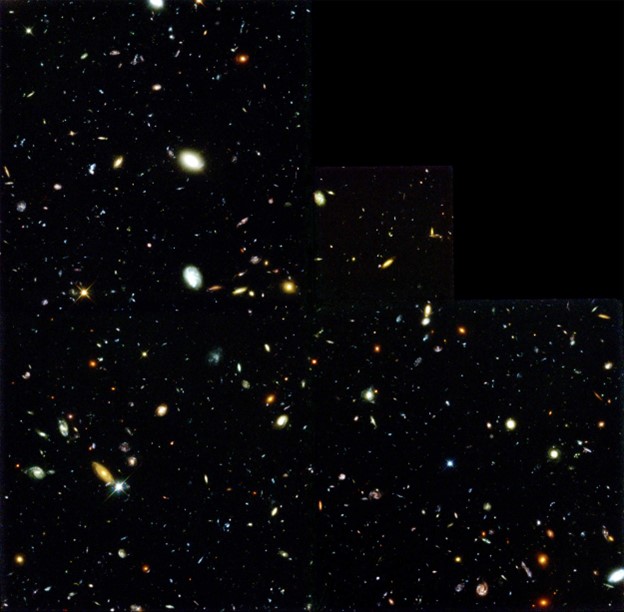
Farther-away galaxies in the Hubble Deep Field photo appear redder, since their light has traveled longer through expanding space to get here and therefore has been stretched, or “redshifted,” to longer wavelengths. Through this color-coding, the Deep Field image provides a 3D view of the cosmos and a timeline of galaxy evolution. Galaxies appear at all ages and stages of development — proof that the universe has changed radically over time. “Gone out of the window, never to be heard from again, was the steady-state theory,” said Faber. “That was a great intellectual breakthrough, that you could take one picture with a telescope, you could look back in time, and you could see that the universe was a different beast back then.”
The photo showed that bright objects formed in the universe far more quickly than most experts expected. This bolstered the theory that they didn’t form on the strength of their gravity alone, but were carried on the backs of merging dark matter halos.
Galaxies in early times were strange-looking — small and disheveled, like ugly ducklings that would take billions of years to grow into swans. “The beautiful universe with the beautiful [spiral and elliptical galaxies] of today is really kind of a late development,” Faber said, “and that too was visible in the picture.” Some of the duckling galaxies were colliding and merging, supporting the hierarchical clustering theory of cosmic structure growth. And clumps of stars in the long-ago galaxies were surprisingly bright, indicating that the stars were far more massive and luminous than modern, sun-type stars.
Astronomers observed that most galaxies reached peak luminosity, forming stars most quickly, around “redshift 2” — the distance from which light has stretched to twice its emitted wavelength by the time it gets here, corresponding to about 2 billion years after the Big Bang. After that, for reasons now thought to relate to the mysterious supermassive black holes growing at galaxies’ centers, many galaxies dimmed.
The most striking thing about the timeline of galaxy evolution visible in the Deep Field photo, though, was that there’s no beginning in sight. As far as Hubble’s glass eye could see, there were galaxies. In even deeper-field photos taken with upgraded cameras that astronauts installed on the telescope later, smudges of light have been tentatively spotted as far off as redshift 10, which corresponds to around 500 million years after the Big Bang. It’s now thought likely that structures started forming hundreds of millions of years before that.
But galaxies in the process of forming, their matter somehow fragmenting into stars for the first time, are both too far and too faint for Hubble to detect, and too redshifted: The light from these galaxies has stretched straight out of the visible part of the electromagnetic spectrum and into the infrared. To see them, we need a bigger, infrared-sensing telescope.
“What Hubble succeeded in doing with the Hubble Deep Field is finding that there were galaxies at redshifts much higher than we thought,” Neta Bahcall told me. “A question for James Webb is when did it start, and how did it start so early.”
Planets Out the Wazoo
In October 1995, two months before Hubble stared at nothing and glimpsed the history of time, the Swiss astronomer Michel Mayor announced another major discovery at a conference in Florence, Italy: He and his graduate student, Didier Queloz, had spotted a planet orbiting another star.
In the back of the auditorium at Mayor’s talk, Natalie Batalha, then a graduate student from California, failed to register the importance of what she had just heard. “It’s funny how these things happen, because in retrospect it was a pivotal moment,” Batalha said recently, framed by three planets orbiting a star in her virtual background. “It was the dawn of this new era of exoplanet exploration, but was also a transformational moment in my life, and I didn’t know it yet.”
Farther-away galaxies in the Hubble Deep Field photo appear redder, since their light has traveled longer through expanding space to get here and therefore has been stretched, or “redshifted,” to longer wavelengths. Through this color-coding, the Deep Field image provides a 3D view of the cosmos and a timeline of galaxy evolution. Galaxies appear at all ages and stages of development — proof that the universe has changed radically over time. “Gone out of the window, never to be heard from again, was the steady-state theory,” said Faber. “That was a great intellectual breakthrough, that you could take one picture with a telescope, you could look back in time, and you could see that the universe was a different beast back then.”
The photo showed that bright objects formed in the universe far more quickly than most experts expected. This bolstered the theory that they didn’t form on the strength of their gravity alone, but were carried on the backs of merging dark matter halos.
Galaxies in early times were strange-looking — small and disheveled, like ugly ducklings that would take billions of years to grow into swans. “The beautiful universe with the beautiful [spiral and elliptical galaxies] of today is really kind of a late development,” Faber said, “and that too was visible in the picture.” Some of the duckling galaxies were colliding and merging, supporting the hierarchical clustering theory of cosmic structure growth. And clumps of stars in the long-ago galaxies were surprisingly bright, indicating that the stars were far more massive and luminous than modern, sun-type stars.
Astronomers observed that most galaxies reached peak luminosity, forming stars most quickly, around “redshift 2” — the distance from which light has stretched to twice its emitted wavelength by the time it gets here, corresponding to about 2 billion years after the Big Bang. After that, for reasons now thought to relate to the mysterious supermassive black holes growing at galaxies’ centers, many galaxies dimmed.
The most striking thing about the timeline of galaxy evolution visible in the Deep Field photo, though, was that there’s no beginning in sight. As far as Hubble’s glass eye could see, there were galaxies. In even deeper-field photos taken with upgraded cameras that astronauts installed on the telescope later, smudges of light have been tentatively spotted as far off as redshift 10, which corresponds to around 500 million years after the Big Bang. It’s now thought likely that structures started forming hundreds of millions of years before that.
But galaxies in the process of forming, their matter somehow fragmenting into stars for the first time, are both too far and too faint for Hubble to detect, and too redshifted: The light from these galaxies has stretched straight out of the visible part of the electromagnetic spectrum and into the infrared. To see them, we need a bigger, infrared-sensing telescope.
“What Hubble succeeded in doing with the Hubble Deep Field is finding that there were galaxies at redshifts much higher than we thought,” Neta Bahcall told me. “A question for James Webb is when did it start, and how did it start so early.”
Planets Out the Wazoo
In October 1995, two months before Hubble stared at nothing and glimpsed the history of time, the Swiss astronomer Michel Mayor announced another major discovery at a conference in Florence, Italy: He and his graduate student, Didier Queloz, had spotted a planet orbiting another star.
In the back of the auditorium at Mayor’s talk, Natalie Batalha, then a graduate student from California, failed to register the importance of what she had just heard. “It’s funny how these things happen, because in retrospect it was a pivotal moment,” Batalha said recently, framed by three planets orbiting a star in her virtual background. “It was the dawn of this new era of exoplanet exploration, but was also a transformational moment in my life, and I didn’t know it yet.”