by Tina Hilding, Voiland College of Engineering and Architecture, Washington State University
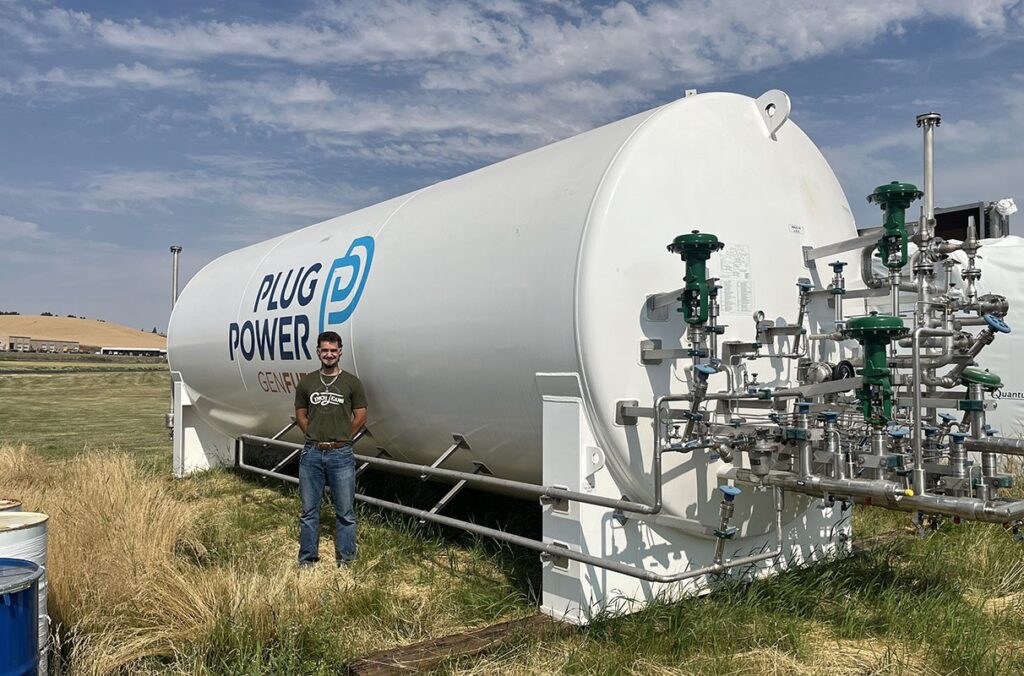
Washington State University researchers have developed a mathematical model and a set of recommendations to improve liquid hydrogen storage tank operations that could someday make hydrogen a more viable alternative for powering vehicles and other industrial processes.
The researchers used real-world tank data to identify operational regimes in which hydrogen boils off and is lost — as much as 25% of the hydrogen delivered to storage tanks. The work is published in the journal Cryogenics.
“If we want to reduce reliance on fossil fuels and come up with fuel that is clean and produced from renewable energy sources, then liquid hydrogen is a most suitable candidate for that purpose,” said Konstantin Matveev, professor in the School of Mechanical and Materials Engineering and a co-author on the paper. “Now we have a tool that can model important parts of the liquid hydrogen supply chain, and using that tool, we can make this technology for the green economy more feasible.”
Hydrogen-powered vehicles are an alternative to gasoline or diesel-powered combustion engines because they don’t emit harmful greenhouse gases. They are particularly appealing for heavy machinery, such as forklifts or trucking, where electric vehicles require too many batteries. One company, Plug Power, currently operates about 250 liquid hydrogen tanks that power 70,000 hydrogen-powered forklifts around the world, moving approximately 30% of groceries in the U.S.
But storing and transporting hydrogen remains a major challenge. Liquid hydrogen is the most convenient form for most industrial uses, but keeping it liquid requires extremely low temperatures. Any exposure to normal air temperatures causes rapid boil-off. To minimize these losses, tanks rely on complex systems of insulating shells, pressure valves, fluid circuits, and pumps.
“There are several complex processes happening at the same time, which makes developing a theoretical model really important not only to understand the current operations, but also to invest in technology to improve those operations,” said Jake Leachman, corresponding author and professor in the School of Mechanical and Materials Engineering.
One area of significant loss occurs during hydrogen transfer. “The transfer line has to be cooled down, and during that process, around 13% of hydrogen molecules stored in the liquid form are lost due to evaporation and can’t be utilized as a liquid hydrogen fuel,” said Kyle Appel, first author and recent master’s degree graduate from the same school.
The WSU team developed a theoretical model for real-world tank performance and verified it using data from a fleet of Plug Power’s in-service tanks. The researchers demonstrated that operational adjustments can yield significant reductions in boil-off loss — and even reach zero boil-off with system modifications. For instance, adjusting the pressure limits for valve activation could decrease hydrogen loss by about 26%.
“That’s just changing the set parameters of a valve, which is pretty simple,” said Appel.
The new mathematical model is also computationally efficient. Whereas previous models required supercomputers and days of processing to simulate only a few hours of operation, WSU’s model can simulate hundreds of hours in minutes.
“Using this tool, you can effectively explore a variety of operational changes,” Matveev said. “Our contribution here is in developing an efficient mathematical model that can be used in industry — by customers, designers, and government entities.”
The researchers continue to work with Plug Power to implement their recommendations and refine their model to better understand transfer operations, pumps, and other components of hydrogen systems. They are also conducting additional studies for the Federal Aviation Administration, evaluating and modeling the storage of liquid hydrogen at airports.
Source:
Washington State University – WSU Insider, August 21, 2025.