by Dr. Lakshya Gangwar, University of Minnesota
Imagine a future where organs can be stored indefinitely “as glass,” and ready to be brought back to life at a moment’s notice. That’s the bold horizon sketched by a new study from University of Minnesota researchers, published in Nature Communications, 16 8511 (2025). A team of University of Minnesota engineers and medical school researchers remarkably presents the first physical proof that samples of human size organs can be indeed cryopreserved using vitrification and nanowarming technology, a milestone on the path toward true organ banking.
Dr. Lakshya Gangwar, a Cold Facts 2023 Young Professionals, and a postdoctoral researcher in the Bio-Heat and Mass Transfer Laboratory at the University of Minnesota, is the lead first-author of this breakthrough study. He describes: “This research brings the field of cryobiology a step closer to cryopreserving large human-size samples. We show that vitrification and rewarming is physically achievable in volumes as large as 3 liters, paving the way towards human organ banking becoming a reality. Even though this pioneering step is achieved nearly a century after the first vitrification of a biological system, i.e. frog sperm, but now we are equipped to stop the ‘biological clock’ of any large biological material such as human organs and not just sperms and embryos.”
To understand the motivation of this study, one has to look at organ transplantation statistics. For example, in the United States alone, more than 100,000 people are on the transplant list according to Organ Procurement and Transplantation Network (OPTN) statistics. Yet many will never get a call, not because a match wasn’t found but because the donated organ couldn’t be stored long enough. Today, most organs have a shelf life measured in hours such as ~6 hours for heart. When time runs out, hope is lost. Human organ banking could change everything, turning today’s transplant shortage into a future of availability on-demand. The key is cryopreservation by vitrification, cooling an organ so quickly that it turns into a glass-like state without forming damaging ice crystals. But large organs are tricky. You must cool them fast to avoid ice and uniformly to prevent cracks. Hence, vitrification has worked in small samples of tissue and more recently smaller rat organs, but it has never been shown to physically succeed with an organ as large and complex as a human organ.
For decades, the dream of storing organs has been haunted by two fatal physical pitfalls: ice formation (which damages tissues) and fracturing (caused by thermal stress when cooling and warming unevenly). While small tissues and organs (1 to 10s of mL) have been vitrified or revived, scaling up to human-organ dimensions (100s to 1000s of mL) has resisted success. Conventional rewarming as in immersion in a warm bath simply can’t keep up in large volumes, edges warm too fast while centers stay cold, causing cracks or internal ice. The team’s prior transformative work in rat kidneys showed life-sustaining transplant utilized “nanowarming” technology: loading magnetic iron oxide nanoparticles into a cryoprotectant solution infused through tissue vasculature, then applying a radiofrequency (RF) magnetic field to uniformly heat from within the organ.
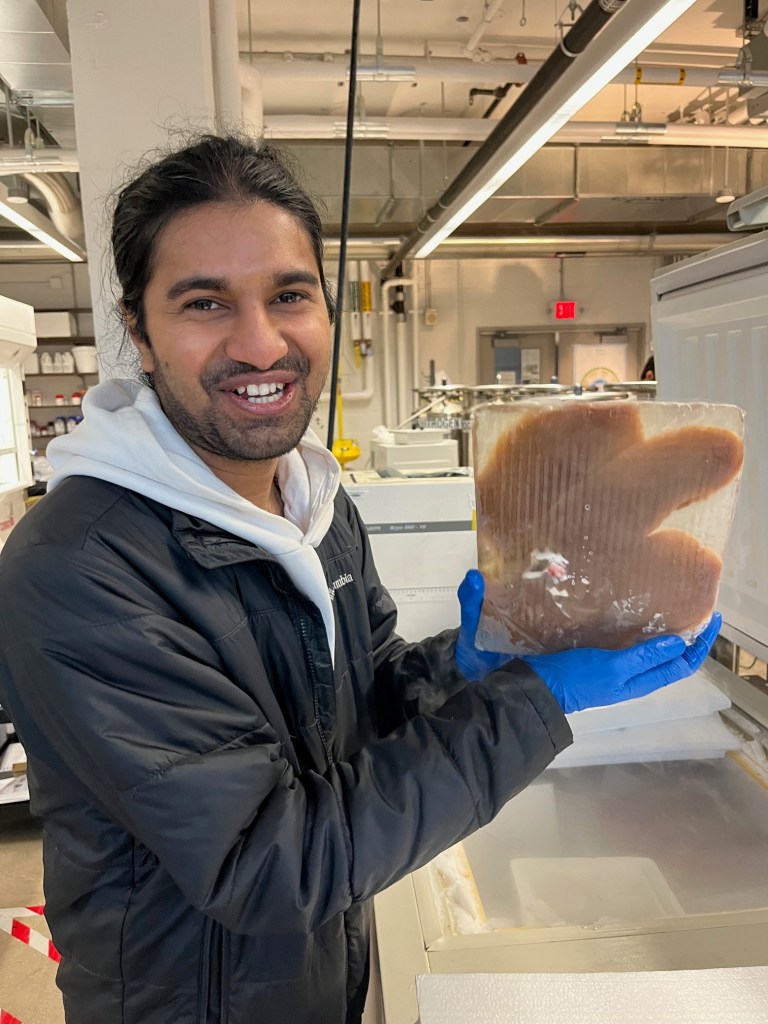
Achieving vitrification in a whole human-size organ becomes more physically challenging than a rat organ because of not being able to cool such large thermal mass (a) fast enough to avoid spontaneous ice crystallization needed for glass formation and (b) uniform enough to avoid thermal stress-induced fractures once the glass is formed. Their breakthrough study overcame physical challenges of ice and fractures by utilizing high concentrations of cryoprotective agents (CPAs) such as M22 and carefully optimized cooling protocols using principles of thermal annealing. They show that they can cool large volumes (up to 3 liters) without ice formation or cracking and even whole organs such as porcine livers (~1 liter) showing translational success of their developed cooling protocols.
To demonstrate rewarming at human-organ scales, the team partnered with AMF Life Systems, who designed a custom 120 kW RF coil capable of delivering spatially uniform magnetic fields over a 2.5 liter sample region. Using the state-of-art RF coil, the team “nanowarmed” vitrified the CPA + nanoparticle mixtures up to 2 Liter volumes very uniformly (<5°C non-uniformity) at 100s of °C/min (effectively in <2 mins).
John Bischof, Ph.D., a Distinguished McKnight University Professor in the Departments of Mechanical and Biomedical Engineering and the Director of the University of Minnesota’s Institute for Engineering in Medicine was one of the senior authors in this study. He stated: “careful thermal engineering allowed us to achieve vitrification up to 3 liters of CPA volume. Additionally, our results show that nanowarming is indeed scalable to the L scale which overlaps with human organ scales.”
“Not only did we show vitrification in Liter scale CPA volumes but also a whole porcine liver. To our knowledge, this is the first report of a vitrified clinical-scale organ. This opens the door to storing human organs long term, a paradigm shift for transplantation,” said Erik Finger, MD, Ph.D., Eunice L. Dwan Endowed Diabetes Research Chair Professor of surgery at the University of Minnesota Medical School. Dr. Finger jointly supervised this study along with John Bischof.
This research is a part of groundbreaking efforts in cryopreservation being executed at the U.S. National Science Foundation (NSF) Engineering Research Center for Advanced Technologies for the Preservation of Biological Systems (ATP-Bio). ATP-Bio center brings together 30+ leading scientists from seven institutions across the United States, all working toward transformative cryopreservation advances to a wide array of living biological systems.
Looking forward, Dr. Gangwar concludes that the findings of this study prove that, at least on a physical level, the two core obstacles to organ cryopreservation ice and cracks can be overcome at relevant human scales. Dr. Gangwar, who was also profiled in the Young Professionals feature in Cold Facts (Vol 39, No 1) states that “By applying fundamental engineering principles of heat and mass transport, I want to advance the field of cryobiology and organ cryopreservation.” He highlights the need for faster, uniform cooling approaches for achieving reversible vitrification of larger human organs such as hearts and lungs as crucial. As part of his postdoctoral work, he is working on next generation cooling, storage and transport devices employing a careful balance of thermal, environmental and safety properties of cryogenic refrigerants. Dr. Gangwar is driven towards securing a faculty position in mechanical engineering as he envisions applying his thermal-sciences skills and cryogenics knowledge in solving cryobiology challenges, improving biomedicine and beyond.
If successful biologically, this work could usher in the era of “organ banking” a world where donor organs are stored like blood in a refrigerator, ready for transplant anytime. What seems like science fiction today may become routine medicine tomorrow. This study is a landmark: the first step across a threshold long thought impassable and science fiction.
Image: Dr. Lakshya Gangwar is advancing cryopreservation at the human-organ scales using vitrification and nanowarming technologies demonstrating success in physical volumes and porcine livers. Credit: Lakshya Gangwar and Bat-Erdene Namsrai