by Prabhat Kumar Gupta, SCRF Cavity Characterization and Cryogenics Section, Raja Ramanna Centre for Advanced Technology (RRCAT), Indore (MP), India and Homi Bhabha National Institute (HBNI), Mumbai, India
Introduction
Helium purification is central to stable cryogenic operation—whether in superconducting magnet facilities, accelerator test stands, quantum computing labs, or helium liquefaction plants. Even a few hundred ppm of air contamination can degrade liquefaction capacity, reduce refrigeration performance and, in severe cases, block cold channels with frozen nitrogen or oxygen. Experience across laboratories consistently shows that ppm-level impurities can accumulate inside cold boxes, damage expansion turbines and reduce system availability.
Helium becomes contaminated at multiple stages in recovery and processing. Common pathways include:
• Air ingress at compressor suction during sub-atmospheric operation or imperfect sealing
• Vacuum pumping system leaks or oil back-streaming
• Helium storage bags and buffer tanks exchanging moisture with ambient air
• Experimental facilities during warm-up, venting, or maintenance
• Inadequate purging during installation and commissioning
• Thermal breathing during night–day transitions
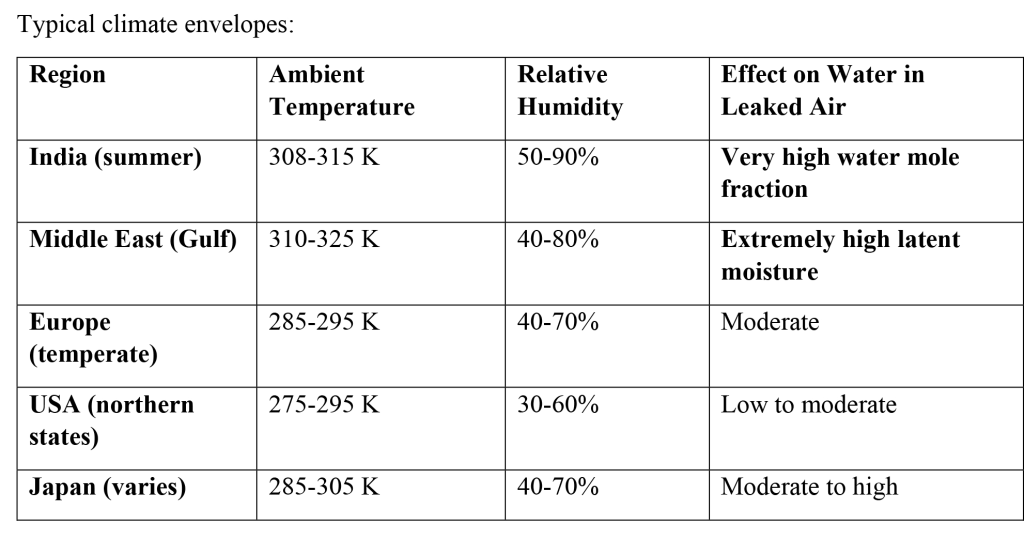
While these impurity mechanisms are well recognized, an important and often underestimated factor is regional climate, particularly in India and other tropical countries. Any air that leaks into the helium system—whether through suction leaks, storage bags, recovery lines, or experimental equipment—enters at the ambient temperature and relative humidity of the surrounding environment. In tropical regions, ambient temperatures routinely reach 308 to 320 K
(35 to 47°C) with relative humidity often above 60-80%, creating much wetter air compared to temperate climates.
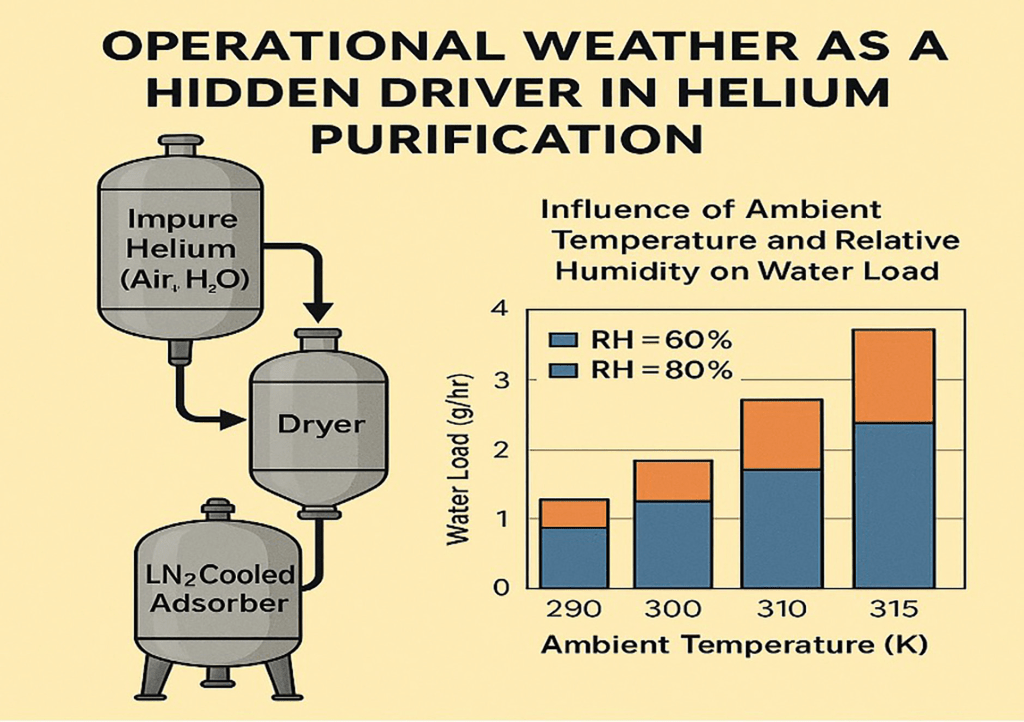
Because the moisture-holding capacity of air increases exponentially with temperature, the moisture mole fraction in leaking air is intrinsically higher in tropical climates. Thus, for the same 500 ppm(v) air leak, a helium purifier in India, Southeast Asia, Brazil, or the Middle East receives three to four times more water vapor than a purifier operating in Europe or North America. This climate-driven increase in water load is the core reason why purifier operation, regeneration frequency, and LN₂ consumption differ significantly across regions. The remainder of the article explains this effect in thermodynamic terms and provides guidance for designing and operating purifiers in weather-intensive environments.
Why ambient weather – especially in tropical regions – controls the water load
Water vapor in air is governed by saturation thermodynamics. The saturation vapor pressure rises exponentially with temperature (Clausius–Clapeyron relation). For example:
• At 40°C (313 K), saturated air holds >10× more water than at 0°C (273 K).
Warm climates inherently inject more water into the helium system for the same air leak rate.
Key Physical Fact
When moist air enters helium:
This water fraction is fixed at the moment of leakage and is independent of what happens to the helium afterward. Thus, every cubic centimeter of leaked air is effectively a fixed package of moisture determined solely by the climate at the leak point.
• Why tropical climates are fundamentally different
Thus:
• India and the Middle East represent worst-case purifier loads globally.
• Europe and North America operate under much more forgiving humidity envelopes.
The compressor does NOT create the water
Even though air-cooled compressors show higher discharge temperatures in tropical climates, the water is determined by the ambient leaking air, not by the helium temperature after compression. Compressor discharge temperature correlates with weather, but does not create water; it merely reflects the ambient conditions that determine moisture content.
Operational Consequences in Tropical Regions
Because tropical ambient air contains more water:
• Dryer breakthrough is faster
• Regeneration frequency is higher (2-3× compared to temperate countries)
• More load reaches LN₂ adsorbers, reducing N₂/O₂ capacity
• LN₂ consumption increases
• Purifier stability becomes strongly seasonal, especially during monsoon humid peaks in India
This is why many helium plants in India report:
• Summer dryer cycles of 6-12 hours instead of 18-24 hours
• LN₂ bed breakthrough during monsoon seasons
• High dew-point excursions during hot weather
These are direct outcomes of tropical climate-induced moisture, not equipment malfunction. During monsoon, relative humidity routinely exceeds 80-90%, which directly increases water carryover into dryers even if air-leak ppm is unchanged.
Weather-Aware Purifier Design Recommendations
1) Design for the hottest, most humid day in the region—not annual average.
2) Use dry-air ppm(v) specification when describing helium purity.
3) Condition and ventilate compressor rooms where possible (India: 3-5 K cooling increases dryer life ~20%).
4) Monitor dew point continuously at compressor discharge and purifier inlet.
5) Reserve LN₂ adsorbers for N₂/O₂ removal only, not for moisture.
6) Apply a climate factor (≥2×) for desiccant sizing in tropical installations.
Conclusion
Helium purification performance is strongly shaped by ambient weather, especially in India and other tropical countries. Any air entering the helium system brings a moisture content determined solely by local temperature and humidity. A constant 500-ppm(v) air leak introduces up to 4× more water in Indian summer conditions than in European winter conditions. This effect is thermodynamically unavoidable and must be considered in purifier sizing.
As helium recovery and liquefaction infrastructure expands across tropical regions, weather-aware purifier design and operation are essential to ensure reliable, year-round performance. Ignoring climate leads to underestimated dryer loads, frequent regenerations and compromised LN₂ adsorber performance—a pattern consistently observed in high-temperature, high-humidity regions worldwide.