A unique “spin” on fusion energy research is under development at the U.S. Department of Energy’s Thomas Jefferson National Accelerator Facility, fueling future efforts to harness the power of the stars for the world’s electrical grid.
The lab is part of a combined research endeavor exploring the survivability of a special type of nuclear fuel treatment, called spin polarization, in the extreme conditions of a superheated plasma. If proven, the concept promises to dramatically increase the energy output rate of fusion reactions and enable smaller, less expensive devices with relaxed ignition requirements.
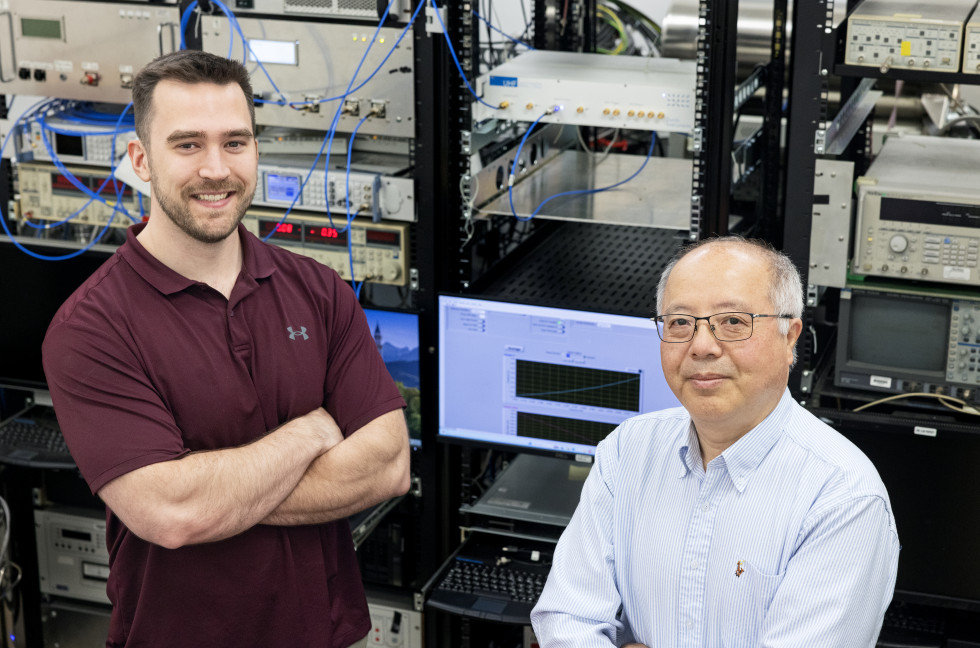
“The ultimate goal is being able to harvest energy using the minimum amount of material,” said Xiangdong Wei, a Jefferson Lab physicist helping lead the study. “With the right alignment, a little bit of fuel can produce a much bigger fire, and you can use that energy for the next round of fusion.”
The multiyear, spin-polarized fusion (SPF) project just received its second round of funding from DOE’s Fusion Energy Sciences (FES) program following its 2023 launch. The interdisciplinary team includes researchers from the University of Virginia; DOE’s Oak Ridge National Laboratory; the University of California, Irvine; and the DIII-D National Fusion Facility, a DOE Office of Science user facility hosted by General Atomics.
The work centers on the DIII-D tokamak, a research device that uses magnetic fields to confine plasma within its donut-shaped volume. DIII-D is a proving ground for technologies critical to future magnetic confinement reactors, such as the International Thermonuclear Experimental Reactor (ITER) megaproject under construction in France with support from the U.S., the European Union and other global leaders.
“The SPF initiative supported by FES is a targeted investment to advance aspects of the DOE’s Fusion Science and Technology Roadmap,” said Matthew Lanctot, Acting Director of the Fusion Energy Research Division in the DOE Office of Science. “The activity aims to leverage the expertise in spin-polarized materials developed by the Nuclear Physics program to influence relevant aspects of the nuclear fusion reaction itself. If successful, theory predicts significant implications for fusion pilot plants.”
Fuel for the Fire
In the sun’s hot, dense core, hydrogen atoms smash together until they fuse. The reaction forges heavier elements, such as helium, and releases tremendous amounts of energy into the surrounding solar layers.
If harnessed on Earth, the process would provide a superabundant source of electricity. But despite recent breakthroughs in ignition and energy gain, fusion technology is still years away from a commercially viable scale.
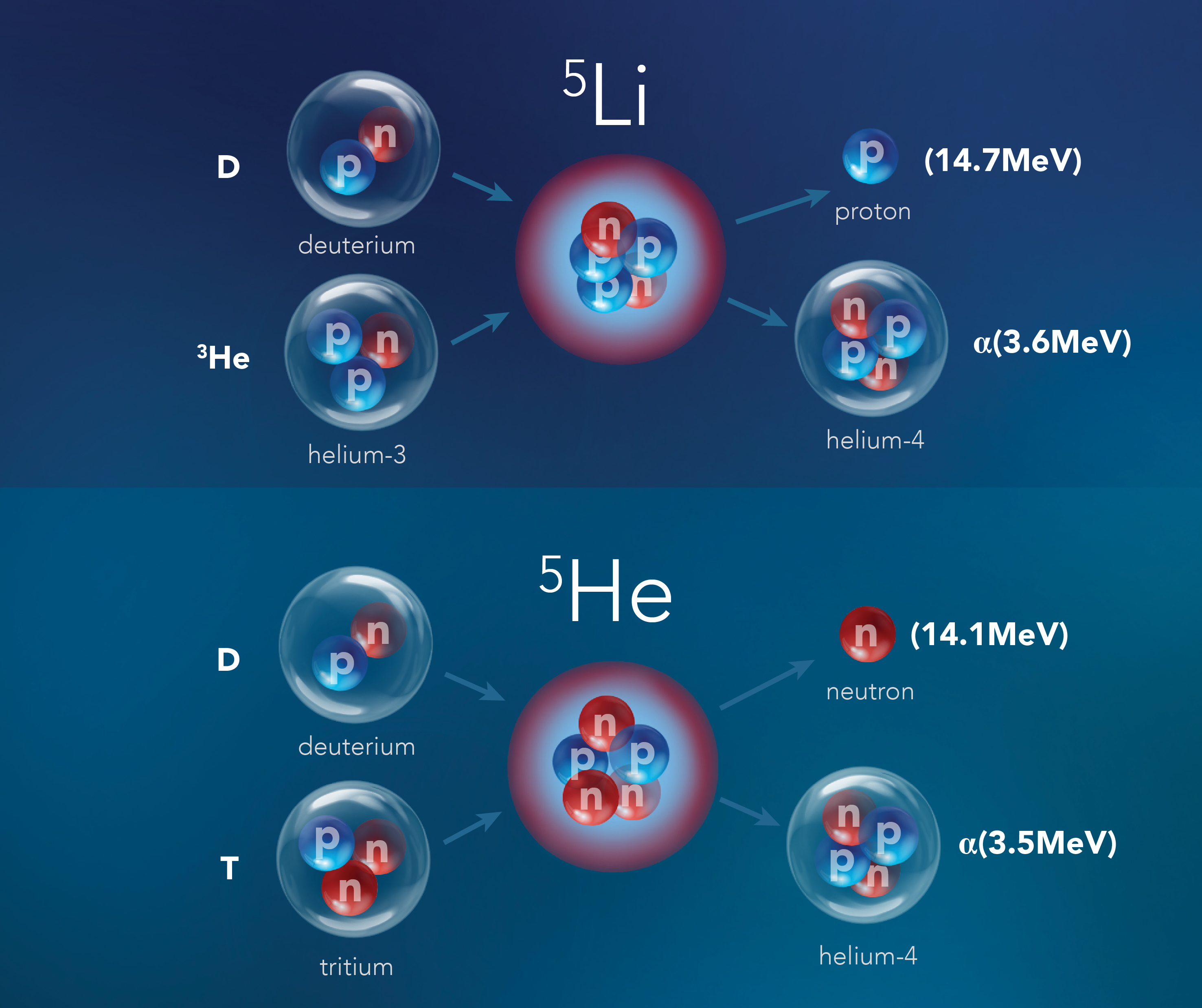
Modern experiments focus on two hydrogen isotopes as fuel: deuterium and tritium. Deuterium, also called heavy hydrogen, can be found by the boatload in the world’s oceans (as heavy water). Tritium, on the other hand, is short-lived (12.3 years half-life) and extremely rare on Earth. The world’s tritium inventory is generated as a byproduct of heavy-water-cooled fission reactors (on any given day, the global supply is about 20 kilograms).
The SPF project will use deuterium and helium-3, a helium isotope that has the same spin dynamics as tritium with nearly identical mass. Helium-3 is also more readily available for research. It was chosen as an alternative due to tritium’s scarcity, instability and associated hazards.
“But you can make tritium using a neutron-plus-lithium reaction,” said Phillip Dobrenz, a Jefferson Lab staff engineer working on the SPF project. “So, there’s virtually no fuel supply limit with fusion as it stands.”
Spin Some, Fuse Some
Like a whirling gyroscope, subatomic particles exhibit a behavior called spin. It can be manipulated when particles are exposed to a powerful magnet and temperatures colder than deep space. In these conditions, the particles tend to line up their spin parallel to the magnetic field. When most of the particles spin in the same direction, they are said to be polarized.
The SPF project will test whether the isotopes’ polarization can survive long enough, as theory predicts, in a magnetically confined, 100-million-degree plasma. If so, it promises to increase the likelihood of a fusion reaction by 50%, boosting the energy output of the system by 70-80%.
“Say you’ve got all these atoms swirling around in the plasma,” Dobrenz said. “By polarizing them, you make the so-called ‘surface area’ of each atom larger so that they have more likelihood of hitting one another and creating fusion. You can get more reactions per unit time, with a lower density.”
Phase I of the SPF project involved acquiring the isotopes and designing equipment that can polarize, store and inject them into the DIII-D tokamak. Phase II, which takes place over the next two years, provides funding for the procurement, prototyping and construction of the devices. The final phase, slated to begin in 2027, will deploy the system on DIII-D and measure the fusion byproducts to see if the polarization survives.
“This experiment can drive the design decisions of future reactors,” Wei said, “but no one will make those design changes based on a technology that is not verified.”
Fuel Supply
Jefferson Lab and the University of Virginia (UVA) are supplying the fusion fuels.
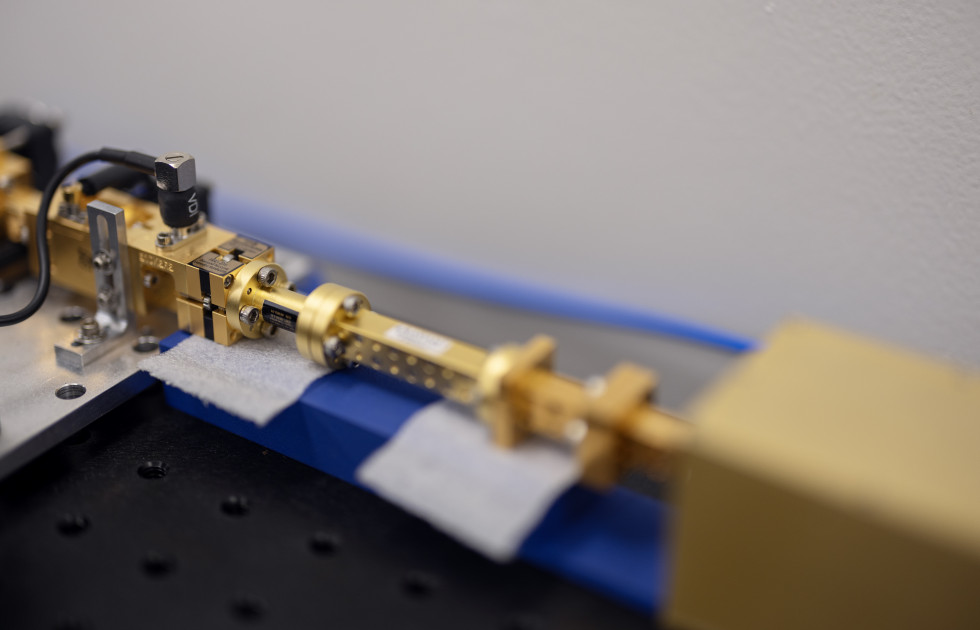
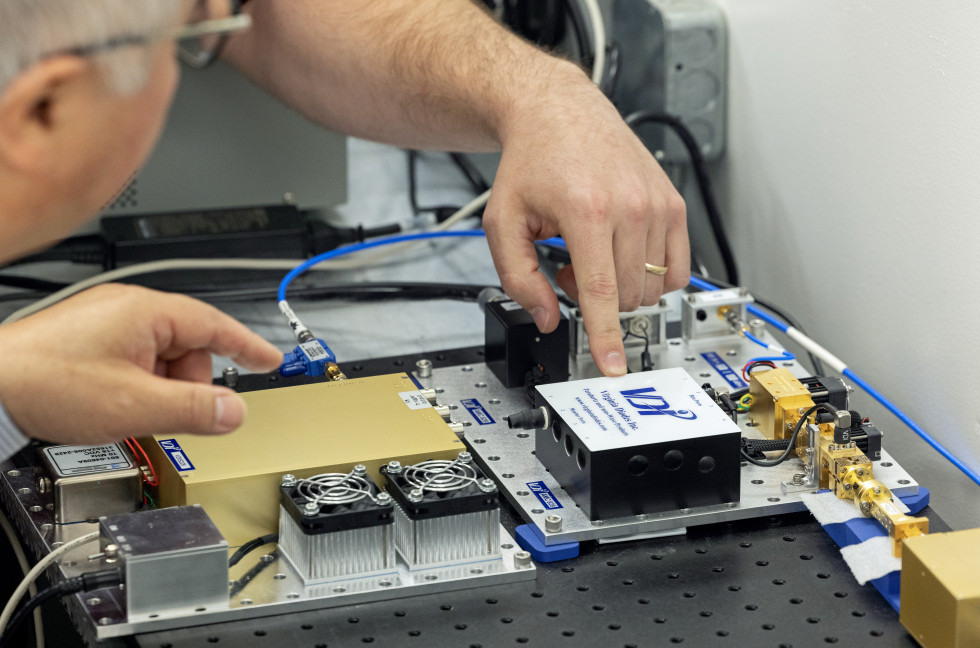
The helium-3 will be prepared at UVA under the leadership of Associate Professor G. Wilson Miller. To polarize the isotope, the team is building a device inspired by technology originally developed for magnetic resonance imaging (MRI). UVA also will build a permeator for filling polymer capsules with the polarized gas.
To prepare deuterium, Jefferson Lab is building off its expertise in developing polarized targets for nuclear physics. Wei has a deep background in this field, dating back to some of his earliest research on polarized targets for inertial confinement fusion experiments in the early 1990s.
“When the idea for polarized fuel first came about, the technology was not quite ready,” Wei said. “But in the past few decades, nuclear physicists have been optimizing polarized targets. Now, we’re able to start applying that technology to a different field.”
During Phase I, Wei’s team purchased deuterium in the form of lithium deuteride (LiD), which is staged at Oak Ridge and will be formed into pellets. LiD is a stable isotopic compound that is solid at room temperature, making it relatively easy to store and transport. Polarizing it, however, is a bit of a challenge.
“Lithium deuteride as a pure material is basically nonpolarizable,” Wei said. “First, you need to break down its perfect crystal structure by firing an electron beam at it. Once you have a little bit of imperfection, called a paramagnetic center, you can apply the high magnetic field and lower the temperature.”
Jefferson Lab has several electron beam sources to irradiate the LiD. Initial runs will take place on the Continuous Electron Beam Accelerator Facility (CEBAF), a DOE Office of Science user facility built to explore the nature of matter. To keep the pellets cold during the process, the lab is fabricating a specialized cryostat.
Phase II includes building the LiD polarizer. The device is a dilution refrigerator equipped with a superconducting magnet, a pellet handler for loading and dispensing LiD, a microwave emitter to transfer polarization from electrons to deuterons, and a system to monitor polarization.
Final Steps
The polarized LiD pellets will be transferred to a pellet injector, which will use compressed gas to send the pellets to the DIII-D tokamak at high speeds. Cryogenics and magnetic coils will maintain the particles’ polarized spin during the milliseconds-long transport. The device is being built at Oak Ridge under the leadership of Staff Scientist Larry Baylor.
A UC-Irvine team led Physics Professor William Heidbrink is working with General Atomics to develop detectors that can sense and measure fusion products. Once all the pieces are installed on DIII-D, it will provide a definitive test of fuel polarization’s survival in a 100-million-kelvin plasma.
“If successful, this experiment could set off a surge of attempts to make it commercially available,” Dobrenz said. “The project’s success would sprout a research field within the fusion industry.”
[Credit: Jefferson Lab]