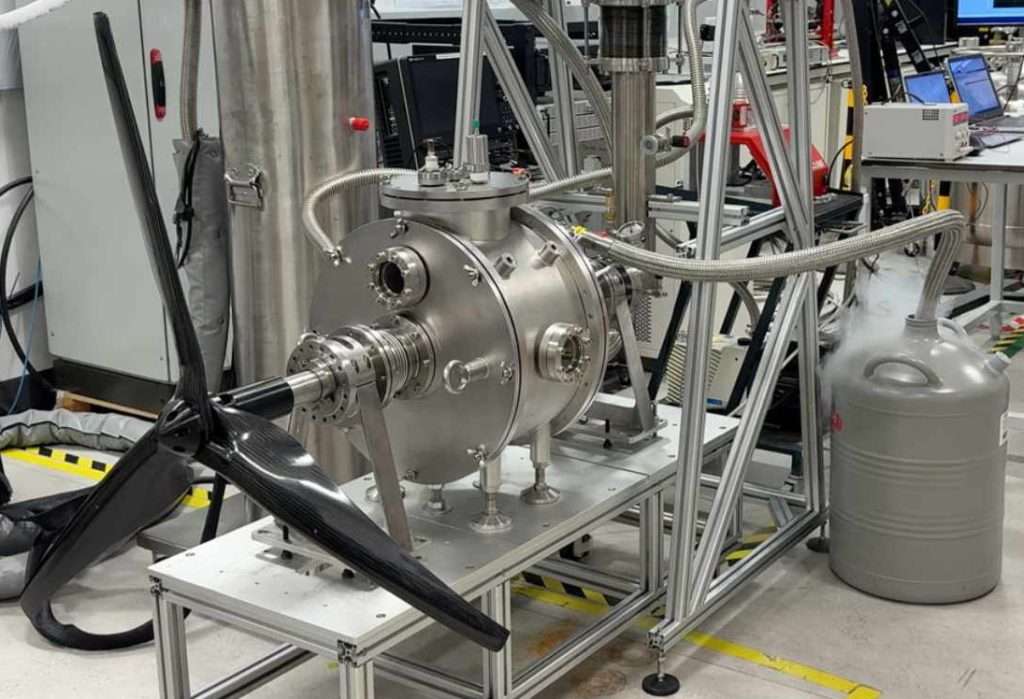
Scottish researchers have demonstrated a 100kW superconducting motor that could pave the way for future electric aircraft. The prototype, created in the Applied Superconductivity Laboratory (ASL) of the University of Strathclyde in Glasgow, is one of the first attempts in the world to develop a fully superconducting axial-flux motor for aviation.
The motor uses high-temperature superconductors (HTSs) to carry large electrical currents with almost no resistance when cooled to cryogenic temperatures of 20 Kelvin (K) or –253°C. It could allow aircraft motors to achieve much higher power densities than conventional electrical machines – a key requirement for future hydrogen-electric and fully electric aircraft.
Electric propulsion could dramatically reduce the environmental impact of flying. The challenge is to develop power systems that produce sufficient energy without being too heavy.
“Superconducting technology offers a route to much lighter and more efficient propulsion systems, but it also brings major engineering challenges in cryogenic cooling, protection and system integration,” explains Professor Min Zhang, who leads the ASL.
“This demonstrator shows that fully superconducting aviation motors are no longer just a theoretical concept,” she adds. “By integrating superconducting windings, brushless excitation and cryogenic operation, we have created a platform that can help to inform the next generation of megawatt-class propulsion systems.”
“High temperature” superconductor materials still operate at cryogenic temperatures. For example, rare-earth barium copper oxide tape becomes superconducting at around 20-77K. This is significantly warmer than traditional superconductors, which typically require cooling to around 4K (–269°C) using liquid helium.
The multidisciplinary, international Strathclyde team – comprising chemists, physicists, electrical engineers and mechanical engineers – has developed its motor from fundamental research through to a technology demonstrator, bringing together superconductor physics, cryogenic engineering, electromagnetic modelling and mechanical system integration. The motor combines low AC loss superconducting windings, novel brushless excitation and rotational cryogenic operation, in an integrated platform.
The proof-of-concept demonstrator is part of the Zero Emissions for Sustainable Transport 1 (Zest1) project led by Airbus and funded by the UK’s Aerospace Technology Institute (ATI).
The Strathclyde team says that its motor is an important step towards the development of future megawatt-class superconducting machines, which would be needed for larger commercial aircraft.
Aerospace companies are increasingly exploring cryogenic propulsion systems using liquid hydrogen. Because liquid hydrogen must already be stored at very low temperatures, researchers say it could create opportunities to combine fuel storage, cryogenic cooling and superconducting electrical systems on board future aircraft.
Strathclyde University has a high-temperature superconducting (HTS) facility in its Advanced Net Zero Innovation Centre, which forms part of the Superconducting Machines & Systems Catalyst. It provides capabilities in HTS material characterization, coil winding and mechanical testing under cryogenic conditions.
[Credit: Drives & Controls]