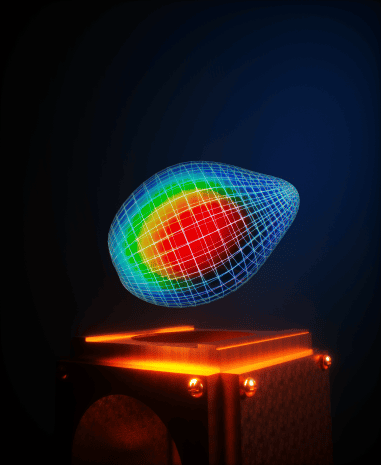
Scientists at Aalto University in Finland have built the world’s first cyclic heat engine, operating inside a superconducting circuit and using a minuscule amount of heat from a quantum refrigerator to convert it into useful work. The research could help save thousands of euros when quantum computers with thousands of qubits are built in the near future.
Finland’s Quantum Technology Strategy aims to build a quantum computer with a thousand logical qubits by 2035. A quantum computer at this scale will require hundreds of thousands of physical qubits, connected to one another via millions of microwave cables. Each of these cables costs a thousand euros, as per today’s prices, pushing up the cost of such a quantum computer.
Scientists at Aalto University were also concerned about the noise this infrastructure introduces into the quantum system setup and wondered whether an alternative approach could be used.

The answer to this problem is building autonomous devices at the quantum scale, which can completely eliminate those cables. However, to build an autonomous device at this scale, scientists had to build a quantum heat engine first.
Quantum Heat Engine
Heat engines were critical in bringing about the Industrial Revolution. From cars to airplanes, ships to power generation plants, heat engines are everywhere. They convert heat into useful energy that can be applied to do work.
While we have built bigger and bigger engines in the past, physicists are now fascinated by the idea that classical thermodynamics can be achieved at quantum scales as well. A team led by Mikko Möttönen, a professor of quantum technology at Aalto University in Finland, has now achieved this feat using a transmon qubit, resonator, and a quantum refrigerator.
“In our experiment, we built a nanofabricated heat engine using superconducting circuits and operated it in a cryostat near absolute zero,” explained Tuomas Uusnäkki, who was involved in building the device. The team created the Otto cycle, the same thermodynamic process that powers car engines inside the superconducting circuit.
Toward Autonomous Devices
To know whether the heat engine can do measurable work, the team transferred the qubit to the quantum-circuit refrigerator and controlled the flow of heat at a quantum scale. Unlike other heat engines, the quantum heat engine uses the quantum refrigerator for both heat and cold. This makes the system simple yet versatile.
“Our quantum-circuit refrigerator can be tuned to both heat and cool the qubit on demand. Using carefully timed control pulses, we drove the engine in an Otto cycle and monitored the qubit state as the engine ran,” added Uusnäkki.
The achievement of building a quantum heat engine sets the stage to build an entire autonomous heat engine that can perform jobs like reading qubits without using microwave pulses from temperatures near absolute zero to room temperature.
While saving thousands of euros in microwave cable costs, an autonomous heat engine will also help reduce the complexity of building quantum computers in the future.
The research findings were published in the journal Nature.
[Credit: Ameya Paleja, Interesting Engineering]