by Quan Sheng Shu
An Era-Defining Engineer and Mentor
My close friend and mentor, Dr. Ronald W. Fast, passed away on June 13, 2024. Born on April 2, 1934, Ron was widely recognized as one of the leading cryogenic and superconducting magnet engineers of his generation. As head of the Cryogenic Department in the Research Division at Fermilab, he played a pivotal role in the design and construction of the superconducting solenoid magnets for the Collider Detector at Fermilab (CDF and D0). These massive magnets provided the uniform magnetic fields needed to bend and track charged particles emerging from high energy proton–antiproton collisions—work that helped define an era of American particle physics. Figure 1 shows Ron working on the collider detector at Fermilab.

Beyond his technical achievements, Ron served the scientific community with immense dedication. He spent more than a decade on the Cryogenic Engineering Conference (CEC) Board of Directors and served as a longtime editor for Advances in Cryogenic Engineering. His profound contributions were ultimately recognized with the Samuel C. Collins Award, honoring his engineering accomplishments, his leadership, and his lasting influence on the fields of cryogenics and superconductivity.
A First Meeting and a Life-Changing Invitation
I first met Ron in 1983 at the CEC/ICMC conference at the Four Seasons Hotel in Colorado Springs. At the time, I was a visiting scholar at the National Bureau of Standards (NBS) in Boulder. Dr. Reed, the division director at NBS, introduced us. To ensure a strong first impression, Reed noted to Ron that I had translated Cryogenic Engineering—the seminal book by the deceased former director of NBS, R. Scott—into Chinese and published it in 1977.
Ron and I quickly found ourselves deep in conversation, and he passionately introduced me to new developments in cryostat designs for large superconducting magnets in the US. On the final day of the conference, he surprised me with an invitation to join him at Fermilab as a visiting scientist. I accepted with enthusiasm. Yet from the moment we met, he treated me as an equal partner in curiosity, engineering, and friendship. His passing leaves a profound, quiet space both in the cryogenic community and in my own life.
Pioneering Research: Bringing MLI to Megaprojects
I arrived at Fermilab in December 1984, and our research and experiments began in earnest. While we shared a broad interest in large cryostat design and magnet operations, my most influential work under his mentorship centered on multilayer insulation (MLI) for large, sophisticated superconducting magnets—including those envisioned for the Superconducting Super Collider (SSC).
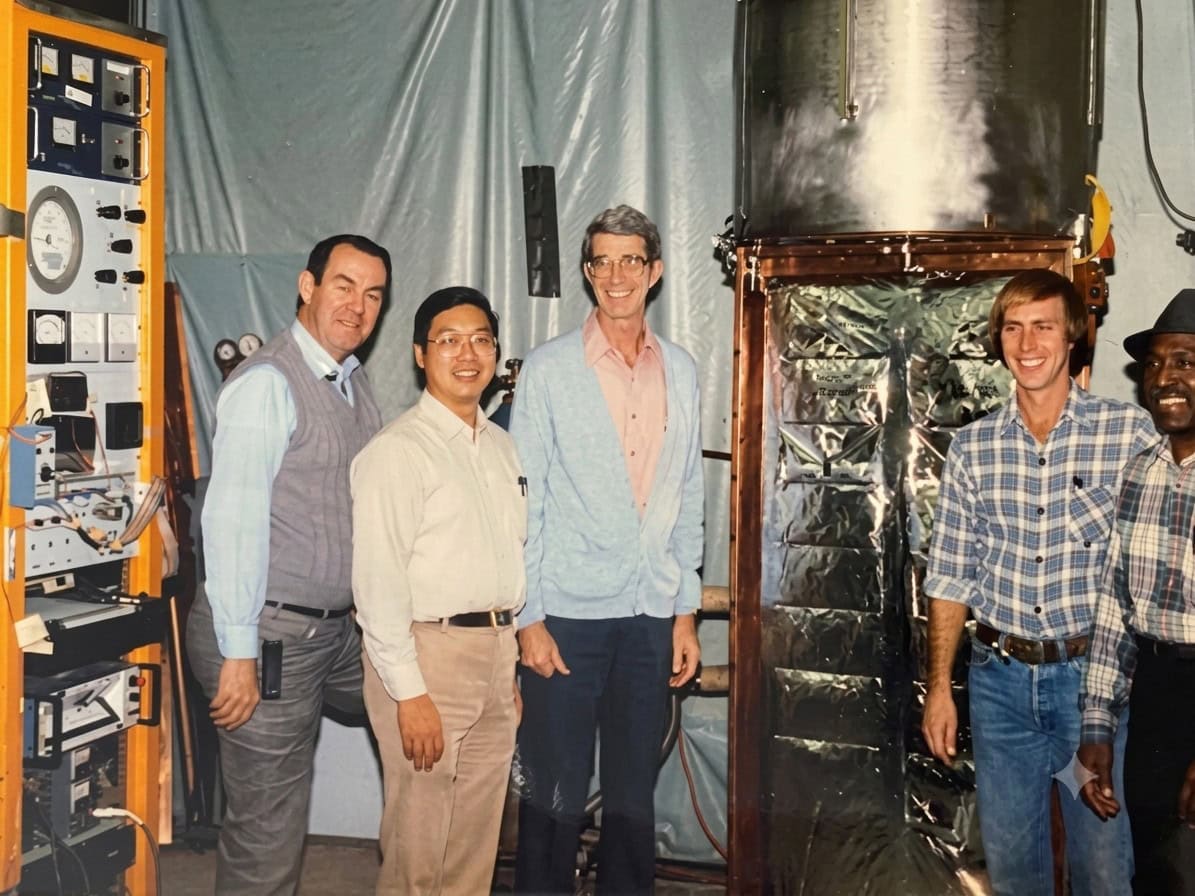
Together, we explored how crinkled (embossed) layers, perforations for outgassing, and geometric imperfections (such as cracks and slots) fundamentally altered heat transfer behavior. Our studies helped shift MLI from a laboratory curiosity to a practical, robust engineering tool for megaprojects like the Tevatron, the SSC, and later, the Large Hadron Collider (LHC). Figure 2 shows our experimental studies on MLI blankets (cracks and slots). The four pillars of our collaborative work continue to guide accelerator, aerospace, and medical cryostat design today: real world deficiency diagnostics; substrate versus tape optimization; enhanced black hole theory and apparent thermal conductivity modeling; and a long citation lineage that remains foundational to the field.
A Deepening Fellowship Beyond the Lab
During those intense years of research, Ron’s dedication often transcended normal working hours. One winter night in Chicago remains unforgettable. A 15 inch snowfall had completely blocked the parking lots around the test lab. Undeterred, Ron insisted we work together past 10 p.m. to check on our MLI tests and analyze the latest data. His commitment—both to science and to our partnership—was unwavering, even in the harshest conditions.

Our professional partnership soon blossomed into a deep, lifelong friendship. On weekends, we rode bicycles along the Fox River in Batavia (Figure 3). At times, Ron would take me out on his 13 meter yacht, navigating the river waters out into Lake Michigan. Over those waters, we talked about family, childhood memories, and our hopes for the future.
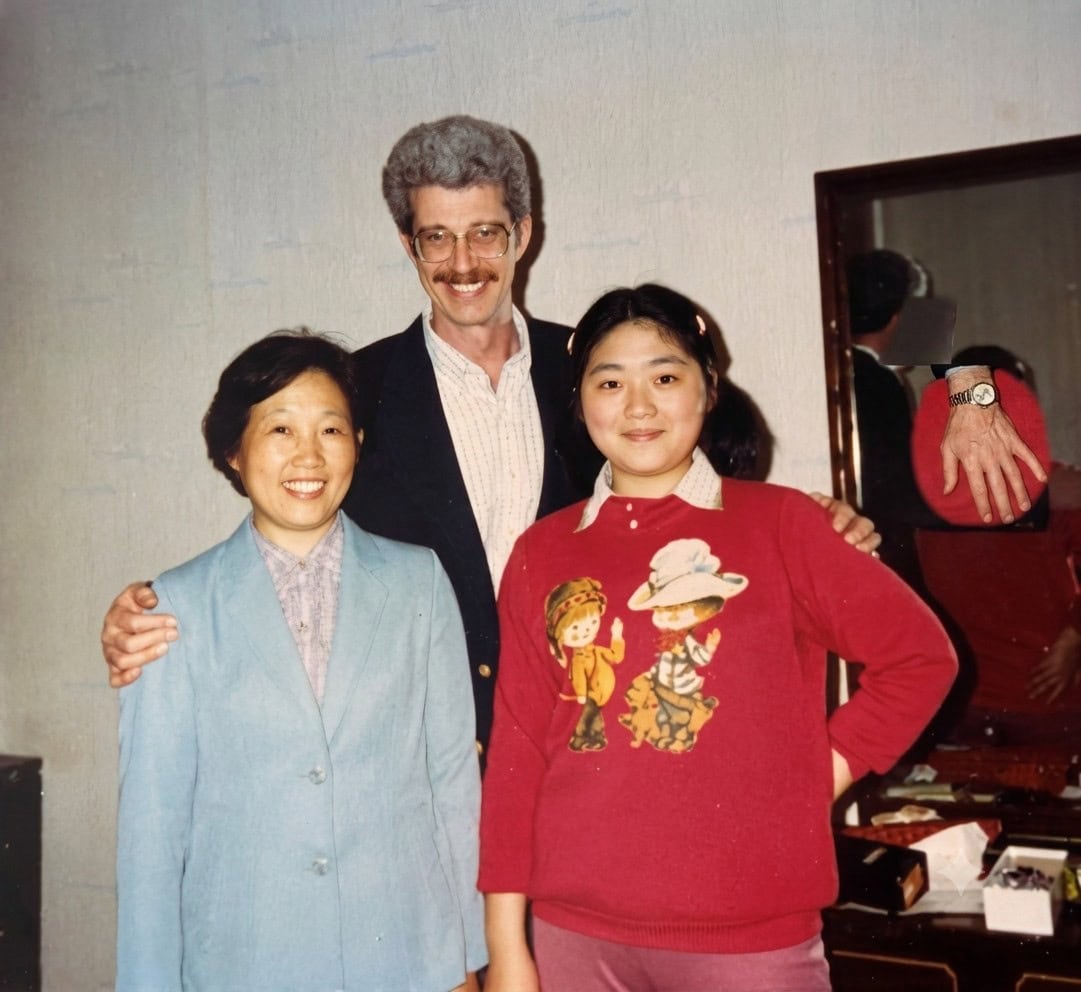
Even after my career took me to Cornell University and later to the SSC Laboratory, we stayed close. Ron traveled to China to visit my family, meeting my wife and daughter at Zhejiang University (Figure 4), and he continually offered me invaluable technical, professional, and personal guidance.
Shared Visions at the SSC and Editorial Leadership
In the early 1990s, I worked at the Superconducting Super Collider Laboratory as the cryogenic instrument section leader, and later as the technical head of the cryostat and interconnect group. During those years, our technical exchanges deepened as my responsibilities grew and Ron advanced the SSC detector design. We frequently compared design notes, insulation strategies, and integration challenges, sharpening each other’s thinking and strengthening the engineering foundation of the project. As a core leader of the conceptual design team, Ron coauthored the blueprint for a truly monumental SSC detector solenoid—an 8 meter diameter, 16 meter long magnetic field volume. His visits to my family home in DeSoto, TX, during this period remain cherished memories.
When I was appointed Chief Editor of the Cryogenic Engineering Conference in 1997, Ron generously shared his decades of editorial experience with me. He offered practical advice, historical perspective, and warm encouragement—never in a superior tone, but always as a supportive colleague eager to see me succeed. His guidance during that transition shaped my editorial approach.
An Enduring Legacy
After we both retired, our connection remained strong. Ron encouraged me—sometimes gently, sometimes firmly—to write a book on cryogenic technology for superconducting applications, ensuring our shared knowledge would be preserved. Meanwhile, he devoted himself wholeheartedly to church and community service, living out the same quiet generosity in his personal life that he always showed in his professional career. Dr. Ron Fast was a gifted engineer, a generous mentor, and a fiercely loyal friend. His legacy lives on in the pioneering machines he helped build, the students he inspired, and the colleagues—like me—whose lives were permanently touched by his kindness and wisdom.