ADVERTISEMENT

HiLumi LHC: cryogenics equipment arrives underground

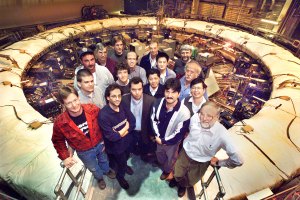
By Corinne Pralavorio The vertiginous descent of equipment into the depths of the accelerator tunnels is always a captivating event. The stars of the show over the last few weeks have been the two gleaming cold boxes that have arrived in the new service tunnels of the High-Luminosity LHC (HiLumi...

Pelican Wire Designs for Cryogenic and Extreme Energy Systems

As renewable energy, electrification and advanced research technologies continue to expand, the demands placed on wire and cable systems are evolving just as rapidly. Higher power densities, tighter system integration and increasingly extreme operating environments are pushing manufacturers beyond traditional commodity wire solutions. Caleb Lemmons, Business Development Manager at Pelican...
Structure model of the newly discovered substance with extraordinary properties. Credit: Maximilian Stremel, Markus Suta, Ingo Widmann, Hubert Huppertz

From Cryogenic to Red-Hot: Optical temperature sensing from 77 K to 873 K

by University of Innsbruck An international collaboration involving researchers from the University of Innsbruck has developed a novel luminescent material that enables particularly robust and precise optical temperature sensing across an exceptionally broad temperature range. Optical luminescence thermometry has been gaining increasing attention, as it allows contactless temperature measurement even under...
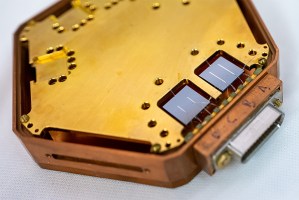
Researchers at QuTech, working on a Fujitsu-funded project, have developed the first cryogenic control chip able to directly control both electron and nuclear spins in diamond-based qubits.

Scalable Diamond Quantum Computing with Cryogenic Chip Integration

NV centers are among the most promising qubit platforms, combining fast electron-spin control with exceptionally stable nuclear-spin memories. However, until now, these systems have depended on room-temperature electronics connected by long cables to the cryogenic environment: a setup that considerably hinders scalability and reliability. The new cryo-CMOS controller solves this...
Superconductors are essential to the wholesale overhaul of systems needed to implement the energy transformation. Image: Reuters/Ina Fassbender

What Happens When Industry Demands the Impossible? Superconductors Step In

Energy transformation is not simply a fuel switch – it’s a redesign of the systems that underpin economic growth and national energy security. Electricity demand is rising sharply, driven by the electrification of end uses and the rising demand from data centres and AI. At the same time, power systems...

ADVERTISEMENT

Dewar

A dewar is a type of cryostat named after Sir James Dewar, the researcher who first developed the concept of a vacuum insulated container with silvered walls to reflect thermal radiation. Dewar was the first to liquefy hydrogen, and he created the device to store his discovery. The thermos bottle...

Stirling and Gifford-McMahon Cryocoolers

Stirling and Gifford-McMahon (GM) cryocoolers are two of the most commonly used cryocoolers in cryogenics. Both devices have a significant industrial base and operate at a wide range of temperatures and capacities. The thermodynamic cycles for both of these cryocoolers are quite similar. The Stirling cycle consists of a compressor,...

Liquefied Natural Gas (LNG)

A significant commercial application of cryogenics is the liquefaction, transport and storage of natural gas. Liquefied Natural Gas (LNG) is generally 95 percent methane with a few percent ethane and much lower concentrations of propane and butane. LNG liquefies at 111.6 K. Unlike many applications of cryogenics, the motivation for...

Wind Tunnels

Dr. Robert Kilgore The development of the cryogenic wind tunnel is one of many significant breakthroughs in both cryogenics and wind-tunnel technology made during the past millennium. Interest in the development of high-speed commercial and military aircraft resulted in a review of problems of flow simulation in transonic wind tunnels...

History of Cryogenics

From the Fall 1999 issue of Cold Facts magazine Millennium Breakthroughs A variety of CSA members give different perspectives on the past millennium: What were the most significant breakthroughs in cryogenics during the past millennium? Prof. R.G. Scurlock, Kryos Technology, scurlock@soton.ac.uk (“Breakthrough” = way through obstacles — Oxford English Dictionary)...

Cryobiology

Andreas Sputtek Past President Society for Cryobiology sputtek@uke.uni-hamburg.de or http://www.sputtek.de/. The word cryobiology (from the Greek words “cryo” = cold, “bios” = life, and “logos” = science) literally signifies the science of life at low temperatures. In practice, this field comprises the study of any biological material or system (e.g.,...

Cryogenic Insulation

James E. Fesmire Cryogenics Test Laboratory NASA Kennedy Space Center james.e.fesmire@nasa.gov Introduction In today’s world, the use of cryogenics and low-temperature refrigeration is taking a more and more significant role. From the food industry, transportation, energy, and medical applications to the Space Shuttle, cryogenic liquids must be stored, handled, and...