ADVERTISEMENT

A Basic Science Breakthrough

A Yale-led team has found the strongest evidence yet of a novel type of superconducting material, a fundamental science breakthrough that may open the door to coaxing superconductivity — the flow of electric current without a loss of energy — in a new way. The discovery also lends tangible support...

Leon Cooper Dies at 94

Leon Cooper, who has died aged 94, helped to solve a problem that had stumped many of the greatest minds in twentieth-century physics. With his colleagues John Bardeen and Robert Schrieffer, he deciphered the dance of electrons that causes superconductivity, or the sudden drop in electrical resistance experienced by certain materials,...

Korean Scientists Achieve Unprecedented Real-Time Capture of Quantum Information

A research team led by Professor Jaedong Lee from the Department of Chemical Physics at DGIST (President Kunwoo Lee) has unveiled a groundbreaking quantum state and an innovative mechanism for extracting and manipulating quantum information through exciton and Floquet states. Collaborating with Professor Noejung Park from UNIST’s Department of Physics (President Chongrae...

Standex Bolsters Scientific Refrigeration With $6.2m CBS Cryogenic Deal

Standex International Corporation (SXI) has acquired Michigan-based advanced cryogenic equipment manufacturer Custom Biogenic Systems (CBS) for around $6.2m cash. Under terms of the deal, CBS will become part of SXI’s scientific business segment. CBS expertise includes the manufacturing of unique isothermal freezers with dry liquid nitrogen technology for the pharmaceutical and...

Danaher Cryo Releases Optimized Rodeo Control System

To complement its family of sub-Kelvin cryostats, Danaher Cryogenics announces the release of its new Rodeo Control System. In an elegant, compact package, the Rodeo Control System gives the user great functionality, including system configuration and control, data collection and graphing, and system status. The Rodeo system is composed of...

ADVERTISEMENT

Dewar

A dewar is a type of cryostat named after Sir James Dewar, the researcher who first developed the concept of a vacuum insulated container with silvered walls to reflect thermal radiation. Dewar was the first to liquefy hydrogen, and he created the device to store his discovery. The thermos bottle...

Stirling and Gifford-McMahon Cryocoolers

Stirling and Gifford-McMahon (GM) cryocoolers are two of the most commonly used cryocoolers in cryogenics. Both devices have a significant industrial base and operate at a wide range of temperatures and capacities. The thermodynamic cycles for both of these cryocoolers are quite similar. The Stirling cycle consists of a compressor,...

Liquefied Natural Gas (LNG)

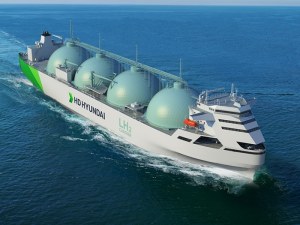
A significant commercial application of cryogenics is the liquefaction, transport and storage of natural gas. Liquefied Natural Gas (LNG) is generally 95 percent methane with a few percent ethane and much lower concentrations of propane and butane. LNG liquefies at 111.6 K. Unlike many applications of cryogenics, the motivation for...

Magnetic Levitation

From http://www.superconductors.org. Magnetic-levitation is an application where superconductors perform extremely well. Transport vehicles such as trains can be made to “float” on strong superconducting magnets, virtually eliminating friction between the train and its tracks. Not only would conventional electromagnets waste much of the electrical energy as heat, they would have...

Superconductivity

From Superpower website. History of Superconductivity Superconductivity was discovered in 1911 by the Dutch physicist, Heike Kammerlingh Onnes when he was able to liquefy helium by cooling it to 4 Kelvin, or -452°F. This enabled him to cool other materials close to absolute zero and investigate their electrical properties. He...

Medical Applications of Cryogenics

Neutron Therapy Cryogenics is at the heart of nuclear accelerators. Accelerators such as Fermilab’s Tevatron make neutron therapy for cancer possible. From Fermilab Today 4/20/09: Fermilab currently offers neutron therapy. But staff at Fermilab designed and built the proton accelerator used by the nation’s first hospital-based treatment center to use...

Nuclear Physics

Al Zeller National Superconducting Cyclotron Lab (NSCL) at Michigan State University zeller@nscl.msu.edu Cryogenics has a long history in nuclear physics. The technology has its origins in the use of cold traps for maintaining a vacuum, which is required to prevent beam loss and for generating high voltages used in acceleration....

What is the temperature range of cryogenics?

Could you please tell me what is the temperature range of cryogenics? In other words, is -100°F considered cryogenic, or does it start lower? Could I expect to see some extended life in D2 stamping dies? What would the recipe be to achieve the desired results using cryogenics?