ADVERTISEMENT

MIT’s Superconducting Magnets are Ready for Fusion

Harnessing nuclear fusion, the process by which lighter atoms combine into heavier ones, has been a dream of researchers for generations: in theory, it could produce electricity without emitting greenhouse gases and, unlike nuclear fission, generate very little radioactive waste. But making fusion work requires compressing hydrogen plasma fuel at...

Shuttle, Family Inspire NASA’s Cryogenic Technology Manager

Jeremy Kenny squinted his eyes as he looked toward the brilliant light. Then came the deafening sound waves that vibrated his body. This was the moment he’d dreamed about since childhood. It was Nov. 16, 2009, at NASA’s Kennedy Space Center in Florida, and Kenny and his wife were watching space...

Bluefors Launches Helium Recovery Solution for Single Unit NMR Systems

Bluefors has introduced its latest advancement: the Cryomech HeRL02-RM. This cutting-edge helium reliquefier, specifically engineered for helium recovery from individual nuclear magnetic resonance (NMR) units, marks a significant stride in helium conservation and management. The Cryomech HeRL02-RM establishes a closed-loop, zero-boiloff system for NMR magnets, ensuring optimal helium utilization. Boiled-off helium...

The LSST Camera Set to Unveil the Cosmos

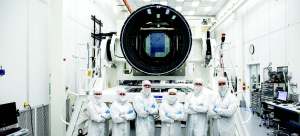
The completion of the Legacy Survey of Space and Time (LSST) Camera, after two decades of collaborative work involving scientists and engineers at the Department of Energy’s SLAC National Accelerator Laboratory and international partners, signifies a significant milestone in the construction of the Vera C. Rubin Observatory in Chile. The...

Scientists Uncover a Hidden Electronic State

Research often unfolds as a multistage process. The solution to one question can spark several more, inspiring scientists to reach further and look at the larger problem from several different perspectives. Such projects can often be the catalyst for collaborations that leverage the expertise and capabilities of different teams and...

ADVERTISEMENT

Dewar

A dewar is a type of cryostat named after Sir James Dewar, the researcher who first developed the concept of a vacuum insulated container with silvered walls to reflect thermal radiation. Dewar was the first to liquefy hydrogen, and he created the device to store his discovery. The thermos bottle...

Stirling and Gifford-McMahon Cryocoolers

Stirling and Gifford-McMahon (GM) cryocoolers are two of the most commonly used cryocoolers in cryogenics. Both devices have a significant industrial base and operate at a wide range of temperatures and capacities. The thermodynamic cycles for both of these cryocoolers are quite similar. The Stirling cycle consists of a compressor,...

Liquefied Natural Gas (LNG)

A significant commercial application of cryogenics is the liquefaction, transport and storage of natural gas. Liquefied Natural Gas (LNG) is generally 95 percent methane with a few percent ethane and much lower concentrations of propane and butane. LNG liquefies at 111.6 K. Unlike many applications of cryogenics, the motivation for...

Magnets

From “Superconductivity: Present and Future Applications” by the Coalition for the Commercial Application of Superconductors. Particle physics uses accelerators to recreate the conditions of the early universe in an attempt to piece together the complex puzzle of how we got to where we are today. These huge machines are used...

Energy Storage

From “Superconductivity: Present and Future Applications” by the Coalition for the Commercial Application of Superconductors. With power lines increasingly congested and prone to instability, strategic injection of brief bursts of real power can play a crucial role in maintaining grid reliability. Small-scale Superconducting Magnetic Energy Storage (SMES) systems, based on...

Astronomy

ASTRONOMY IN SPACE by Peter V. Mason, retired,  Jet Propulsion Laboratory, and Visiting Associate, California Institute of Technology. Pmason@alumni.caltech.edu In thinking about the reasons to perform astronomy in space, we first consider the effect of the earth’s atmosphere.  On a scale of decreasing energy, gamma rays, cosmic rays, X-rays and...

Cryocoolers

What is a Cryocooler? A mechanism that can extract heat from an object (cooler) and by doing so draw its temperature down below approximately 150 Kelvin (cryo). — (Courtesy Dr. Willy Gully) What is the difference between a Cryocooler and a Cryostat? A cryostat is any device designed to maintain...

Need help with calculating flow rate

I have to maintain a certain mass (some tons) at 100 K by circulating in it GHe (through apposite channels). How can I calculate the flow rate needed? I suppose that the delta T (T inlet and T outlet) and the heat load on the mass are necessary. Knowing the...