ADVERTISEMENT

Cryogenics at FAIR: Adaptability is Key

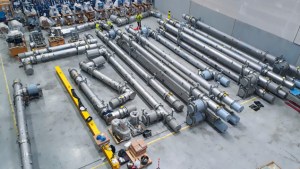
The Facility for Antiproton and Ion Research (FAIR) in Darmstadt, Germany, represents an ambitious reimagining of the GSI Helmholtz Center for Heavy Ion Research, one of Europe’s leading accelerator research laboratories. When it comes online for initial user experiments in 2027, FAIR will provide scientists from around the world with...

Green Hydrogen Facility May Be Coming to NY

A new green facility may be coming to Massena, NY. Air Products, an industrial gas supply company, has proposed a green hydrogen facility in Massena, according to a press release from C&S Engineers. This facility would produce liquid hydrogen by electrolysis to be used as a renewable fuel source. Project...

Superconductivity Breakthrough: First Direct Visualization of a Zero-Field Pair Density Wave

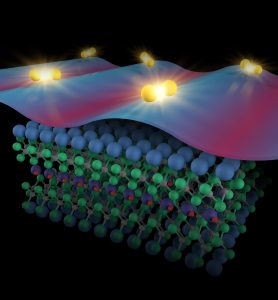
In the field of superconductivity—the phenomenon in which electrons can flow through a material with essentially zero resistance—the “holy grail” of discovery is a superconductor that can perform under everyday temperatures and pressures. Such a material could revolutionize modern life. But currently, even the “high-temperature” (high-Tc) superconductors that have been...

New Superconductor Could Lead to Quantum Computing Breakthrough

Superconductivity is the property of zero electrical resistance at ultralow temperatures and was discovered in 1911 by the Dutch physicist Kamerling-Ohnes. It plays a crucial role in many industries and technologies, ranging from quantum computing to energy. “Superconductors are amazing materials which have many strange and unusual properties,” explained Joe Carroll,...

Cryogenic SRAM IP Demonstrator Taped Out

sureCore’s cryogenic SRAM is a building block for any digital sub-system, that is capable of operating from 77K (-196° C) down to the near absolute zero temperatures needed by Quantum Computers (QCs).  Standard cell and IO cell libraries have been re-characterized for operation at cryogenic temperatures, thereby enabling an industry...

ADVERTISEMENT

Two-Phase Flows

Two-phase flows are those flows in which there is a mixture of two physical states (solid, liquid or vapor). In cryogenic applications, such flows are almost always a mixture of a cryogenic liquid along with its corresponding vapor. A mixture of liquid helium and helium vapor would be a typical...

Supercritical Fluids

A supercritical fluid is defined as a substance whose temperature and pressure exceed those of its critical point. Every pure substance has a critical point that is defined in thermodynamic space by a critical temperature and a corresponding critical pressure. For example, the critical point for helium has a critical...

Brayton Cycle

The Brayton cycle is one of the many thermodynamic cycles used to generate cooling at cryogenic temperatures. Strictly speaking, when referring to cooling we should call this the reverse Brayton cycle as the original Brayton cycle describes the process of power generation or propulsion via a gas turbine. In many...

Magnets

From “Superconductivity: Present and Future Applications” by the Coalition for the Commercial Application of Superconductors. Particle physics uses accelerators to recreate the conditions of the early universe in an attempt to piece together the complex puzzle of how we got to where we are today. These huge machines are used...

Energy Storage

From “Superconductivity: Present and Future Applications” by the Coalition for the Commercial Application of Superconductors. With power lines increasingly congested and prone to instability, strategic injection of brief bursts of real power can play a crucial role in maintaining grid reliability. Small-scale Superconducting Magnetic Energy Storage (SMES) systems, based on...

Astronomy

ASTRONOMY IN SPACE by Peter V. Mason, retired,  Jet Propulsion Laboratory, and Visiting Associate, California Institute of Technology. Pmason@alumni.caltech.edu In thinking about the reasons to perform astronomy in space, we first consider the effect of the earth’s atmosphere.  On a scale of decreasing energy, gamma rays, cosmic rays, X-rays and...

Cryocoolers

What is a Cryocooler? A mechanism that can extract heat from an object (cooler) and by doing so draw its temperature down below approximately 150 Kelvin (cryo). — (Courtesy Dr. Willy Gully) What is the difference between a Cryocooler and a Cryostat? A cryostat is any device designed to maintain...

An Issue of Pressure and Flow Rate in a Supply Tank

Please help solve this problem: A supply tank requires a vaporizer to generate sufficient pressure to pump stored fluid up into a vehicle or tank. The available head is limited as the tank level falls and it is important to minimize the system pressure drop to maintain the desired flow...

Using MLI on VJ Line Joints or Cryo Storage Tanks

When installing Multi Layer Insulation (MLI) blankets on VJ line joints or cryo storage tanks should they be wrapped and tied down tight or loose? These are usually pre-cut to size. Also should they have an access hole at the point of where the molecular sieve is installed to help...