ADVERTISEMENT

Sunlight ‘Leak’ Impacting NASA’s NICER Telescope, Science Continues

On Tuesday, May 22, NASA’s NICER (Neutron Star Interior Composition Explorer), an X-ray telescope on the International Space Station, developed a “light leak,” in which unwanted sunlight enters the instrument. While analyzing incoming data since then, the team identified an impact to daytime observations. Nighttime observations seem to be unaffected. The team...

Nanoscale Ultra-Fast Microscopy is Now in Your Hands

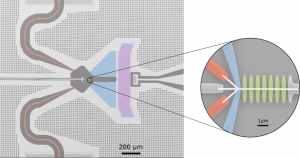
Semiconductors are foundational components of modern energy, communication, and myriad other technologies. Research on tailoring the underlying nanostructure of semiconductors for optimizing device performance has been ongoing for decades. Now, in a study recently published in Scientific Reports, researchers from the University of Tsukuba and collaborating partner UNISOKU Co., LTD.,...

Tiny Quantum Electronic Vortexes in Superconductors Can Circulate in Ways Not Seen Before

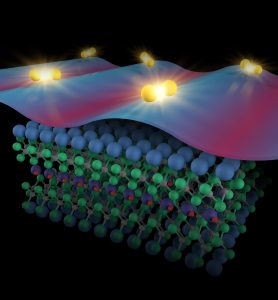
Within superconductors there are little tornadoes of electrons known as quantum vortices that can occur, vortices that have important implications in superconducting applications such as quantum sensors. Now a new kind of superconducting vortex has been found, according to an international team of researchers.[1] Egor Babaev, professor at KTH Royal Institute...

Early Universe Crackled with Bursts of Star Formation, Webb Shows

Among the most fundamental questions in astronomy: how did the first stars and galaxies form? NASA’s James Webb Space Telescope is already providing new insights into this question. One of the largest programs in Webb’s first year of science is the JWST Advanced Deep Extragalactic Survey, or JADES, which will...

RFID Tagging Technology Streamlines Cryogenic Sample Management

Ziath, an Azenta Life Sciences company, announced a revolution in cryogenic sample management – the Ri-Track Mirage 2D barcoded tube whole rack reader. Traditionally, identifying the identity of frost-covered racks of 2D barcoded tubes taken from low temperature storage has been a time-consuming and error-prone process. Drawing upon proprietary Radio Frequency...

ADVERTISEMENT

Dewar

A dewar is a type of cryostat named after Sir James Dewar, the researcher who first developed the concept of a vacuum insulated container with silvered walls to reflect thermal radiation. Dewar was the first to liquefy hydrogen, and he created the device to store his discovery. The thermos bottle...

Stirling and Gifford-McMahon Cryocoolers

Stirling and Gifford-McMahon (GM) cryocoolers are two of the most commonly used cryocoolers in cryogenics. Both devices have a significant industrial base and operate at a wide range of temperatures and capacities. The thermodynamic cycles for both of these cryocoolers are quite similar. The Stirling cycle consists of a compressor,...

Liquefied Natural Gas (LNG)

A significant commercial application of cryogenics is the liquefaction, transport and storage of natural gas. Liquefied Natural Gas (LNG) is generally 95 percent methane with a few percent ethane and much lower concentrations of propane and butane. LNG liquefies at 111.6 K. Unlike many applications of cryogenics, the motivation for...

Magnets

From “Superconductivity: Present and Future Applications” by the Coalition for the Commercial Application of Superconductors. Particle physics uses accelerators to recreate the conditions of the early universe in an attempt to piece together the complex puzzle of how we got to where we are today. These huge machines are used...

Energy Storage

From “Superconductivity: Present and Future Applications” by the Coalition for the Commercial Application of Superconductors. With power lines increasingly congested and prone to instability, strategic injection of brief bursts of real power can play a crucial role in maintaining grid reliability. Small-scale Superconducting Magnetic Energy Storage (SMES) systems, based on...

Astronomy

ASTRONOMY IN SPACE by Peter V. Mason, retired,  Jet Propulsion Laboratory, and Visiting Associate, California Institute of Technology. Pmason@alumni.caltech.edu In thinking about the reasons to perform astronomy in space, we first consider the effect of the earth’s atmosphere.  On a scale of decreasing energy, gamma rays, cosmic rays, X-rays and...

Cryocoolers

What is a Cryocooler? A mechanism that can extract heat from an object (cooler) and by doing so draw its temperature down below approximately 150 Kelvin (cryo). — (Courtesy Dr. Willy Gully) What is the difference between a Cryocooler and a Cryostat? A cryostat is any device designed to maintain...