ADVERTISEMENT

New Instrument Measures Supercurrent Flow with Quantum Benefits

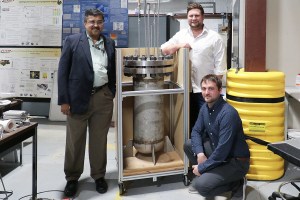
Jigang Wang offered a quick walk-around of a new sort of microscope that can help researchers understand, and ultimately develop, the inner workings of quantum computing. Wang, an Iowa State University professor of physics and astronomy who’s also affiliated with the U.S. Department of Energy’s Ames National Laboratory, described how the instrument works in extreme...

Cryomech Celebrates 60 Years of Cryo-Innovations

Cryomech was founded in 1963 by William E. “Bill” Gifford. Gifford was a professor at Syracuse University from 1961 to 1978 and (in collaboration with Dr. Howard O. McMahon) invented the Gifford-McMahon (GM) cycle cryo­cooler in 1957. This invention made research at very low temperatures much more accessible to the...

The “New” Space Mission–Cryogenic Bearings

Since the late 1990s, advancements in communication technology and the advent of GPS expanded the desire for companies and governments to invest in satellite technologies that operate in higher orbit. Today, companies like SpaceX, Blue Origin, Virgin Orbit, Relativity Space and ULA are developing cost-effective, reusable launch systems.  Manufacturers understand...

Why the LNG Retrofit Revolution Has Cryospain at Work Across Land and Sea

What is it about liquefied natural gas (LNG) for transport that has Cryospain’s teams hard at work across continents and oceans, on existing and brand-new vehicles and all over the world? Within the context of the global challenge of slashing emissions, LNG as fuel is taking a more and more...

What’s the Matter? STAR Cryoelectronics Builds Superconducting Quantum Sensors for X-ray Analysis and Dark Matter Searches

STAR Cryoelectronics, founded in 1999, is a leading worldwide supplier of advanced ultrasensitive quantum sensors and X-ray detectors based on superconductors and related control and readout electronics. The company also offers custom thin-film foundry services for superconductor electronics applications, cryogen-free, adiabatic demagnetization refrigerator (ADR) cryostats, and high-resolution spectrometers based on...

ADVERTISEMENT

Mixed Refrigerant Cycles

Most cryogenic refrigeration systems, both large scale systems and cryocoolers, use helium as a working fluid. There are a number of advantages to helium, not the least of which is that helium remains a fluid down to the lowest achievable temperatures. In order to freeze helium, pressures of over 20...

Fountain Pumps and He II Phase Separators

Helium II (He II), the second liquid phase of the 4He isotope described in this column in Cold Facts Spring 2010 (http://2csa.us/he2), can be modeled as consisting of two interpenetrating fluids. One, the superfluid component, has zero viscosity and entropy and the other, the normal fluid component, has nonzero viscosity...

Turboexpanders

A vital technology in the refrigerators and liquefiers described in Cold Facts Volume 31 Number 3 is that of turboexpanders. These devices are rotating machines in which the process fluid (e.g., helium) does work against the turboexpander while moving from high pressure to a lower pressure and thus is cooled....

Magnets

From “Superconductivity: Present and Future Applications” by the Coalition for the Commercial Application of Superconductors. Particle physics uses accelerators to recreate the conditions of the early universe in an attempt to piece together the complex puzzle of how we got to where we are today. These huge machines are used...

Energy Storage

From “Superconductivity: Present and Future Applications” by the Coalition for the Commercial Application of Superconductors. With power lines increasingly congested and prone to instability, strategic injection of brief bursts of real power can play a crucial role in maintaining grid reliability. Small-scale Superconducting Magnetic Energy Storage (SMES) systems, based on...

Astronomy

ASTRONOMY IN SPACE by Peter V. Mason, retired,  Jet Propulsion Laboratory, and Visiting Associate, California Institute of Technology. Pmason@alumni.caltech.edu In thinking about the reasons to perform astronomy in space, we first consider the effect of the earth’s atmosphere.  On a scale of decreasing energy, gamma rays, cosmic rays, X-rays and...

Cryocoolers

What is a Cryocooler? A mechanism that can extract heat from an object (cooler) and by doing so draw its temperature down below approximately 150 Kelvin (cryo). — (Courtesy Dr. Willy Gully) What is the difference between a Cryocooler and a Cryostat? A cryostat is any device designed to maintain...

An Issue of Pressure and Flow Rate in a Supply Tank

Please help solve this problem: A supply tank requires a vaporizer to generate sufficient pressure to pump stored fluid up into a vehicle or tank. The available head is limited as the tank level falls and it is important to minimize the system pressure drop to maintain the desired flow...

Using MLI on VJ Line Joints or Cryo Storage Tanks

When installing Multi Layer Insulation (MLI) blankets on VJ line joints or cryo storage tanks should they be wrapped and tied down tight or loose? These are usually pre-cut to size. Also should they have an access hole at the point of where the molecular sieve is installed to help...