ADVERTISEMENT

Paragraf is Changing the Game with Cryogenic Hall Sensors

Due to limitations in size and power dissipation, many prevalent measurement methods are incompatible with low temperature applications. Hall effect sensors have emerged as the superior option because of their compact size and low-power requirement. Until now, conventional Hall sensors have themselves been limited by material capabilities and the quantum...

CryoEdge Solves an Ancient Problem with a Cutting-Edge Solution

Ever since the Stone Age, people have searched for the most effective ways to cut and shape materials for best use. This quest has most recently resulted in revolutionary breakthroughs and developments like lasers, plasma beams, and water jets as cutting instruments. Despite these advances, the overwhelming majority of cutting...

How to Avoid a Tank Collapse

The industrial gas industry produces the elemental components of “air” (nitrogen, oxygen, and argon) that are used in other industries as part of their processes. Once separated from air, each element exists as an extremely cold cryogenic temperature liquid. Typical liquid temperatures are −185° C. Large, field-erected tanks are used...

Hydrogen Liquefaction System Developed from Stirling Cryogenerators

Stirling cryogenerators have been widely used since the 1960s and 1970s for the production of LH2 at various institutes and research laboratories all over the world. In materials sciences, small-scale production was used to study the properties and behavior of LH2 and its effect on materials. In scientific devices, Stirling...

Liftoff! NASA’s Artemis I Mega Rocket Launches Orion to Moon

Following a successful launch of NASA’s Space Launch System (SLS), the most powerful rocket in the world, the agency’s Orion spacecraft is on its way to the Moon as part of the Artemis program. Carrying an uncrewed Orion, SLS lifted off for its flight test debut at 1:47 a.m. EST...

FRIB Experiment Pushes Elements to the Limit

A new study led by the Department of Energy’s Lawrence Berkeley National Laboratory (Berkeley Lab) has measured how long it takes for several kinds of exotic nuclei to decay. The paper, published today in Physical Review Letters, marks the first experimental result from the Facility for Rare Isotope Beams (FRIB), a...

ADVERTISEMENT

Dewar

A dewar is a type of cryostat named after Sir James Dewar, the researcher who first developed the concept of a vacuum insulated container with silvered walls to reflect thermal radiation. Dewar was the first to liquefy hydrogen, and he created the device to store his discovery. The thermos bottle...

Stirling and Gifford-McMahon Cryocoolers

Stirling and Gifford-McMahon (GM) cryocoolers are two of the most commonly used cryocoolers in cryogenics. Both devices have a significant industrial base and operate at a wide range of temperatures and capacities. The thermodynamic cycles for both of these cryocoolers are quite similar. The Stirling cycle consists of a compressor,...

Liquefied Natural Gas (LNG)

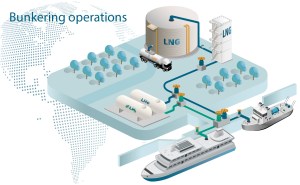
A significant commercial application of cryogenics is the liquefaction, transport and storage of natural gas. Liquefied Natural Gas (LNG) is generally 95 percent methane with a few percent ethane and much lower concentrations of propane and butane. LNG liquefies at 111.6 K. Unlike many applications of cryogenics, the motivation for...

Magnetic Levitation

From http://www.superconductors.org. Magnetic-levitation is an application where superconductors perform extremely well. Transport vehicles such as trains can be made to “float” on strong superconducting magnets, virtually eliminating friction between the train and its tracks. Not only would conventional electromagnets waste much of the electrical energy as heat, they would have...

Superconductivity

From Superpower website. History of Superconductivity Superconductivity was discovered in 1911 by the Dutch physicist, Heike Kammerlingh Onnes when he was able to liquefy helium by cooling it to 4 Kelvin, or -452°F. This enabled him to cool other materials close to absolute zero and investigate their electrical properties. He...

Medical Applications of Cryogenics

Neutron Therapy Cryogenics is at the heart of nuclear accelerators. Accelerators such as Fermilab’s Tevatron make neutron therapy for cancer possible. From Fermilab Today 4/20/09: Fermilab currently offers neutron therapy. But staff at Fermilab designed and built the proton accelerator used by the nation’s first hospital-based treatment center to use...

Nuclear Physics

Al Zeller National Superconducting Cyclotron Lab (NSCL) at Michigan State University zeller@nscl.msu.edu Cryogenics has a long history in nuclear physics. The technology has its origins in the use of cold traps for maintaining a vacuum, which is required to prevent beam loss and for generating high voltages used in acceleration....

Could an Amateur Construct a Liquid Air Plant?

I am a newly retired experimental physicist. Is it feasible for an “amateur” to construct a liquid air plant? Do you have detailed descriptions of older (presumably simpler) liquid air plants, or references that might be of assistance?