ADVERTISEMENT

A Quarter-Century Industry Experience Brings About New Company

After 25 years in the high-tech cryogenics field, while employed at Cryogenic Technical Services (CTS) and High Precision Devices (HPD) and working with some of the best scientific minds in the world, Charlie Danaher started Danaher Cryogenics in early 2022 to respond to the ever-increasing demand for elegant, collaborative solutions...

Are We Alone in the Cosmos? Space Dynamics Lab to Help Answer the Question

Utah State University’s Space Dynamics Laboratory (USU SDL) announced in May 2022 that it has delivered a critical subsystem to NASA’s Jet Propulsion Laboratory (JPL) for integration onto the Nancy Grace Roman Space Telescope. The Cryogenic Thermal Subsystem for the Roman Coronagraph Instrument was delivered to JPL at SDL’s facilities...

Turboexpanders Are Key Components to the Energy Transition

With the energy sector looking to decarbonize, the transition away from hydrocarbons is underway, with hydrogen taking center stage in many of the industry’s roadmaps. Georgia-based Chart Industries (NYSE: GTLS) has responded to this interest by bolstering its offering of products and technologies that enable the industry to move away...

Test Chamber for NASA’s New Cosmic Mapmaker Makes Dramatic Entrance

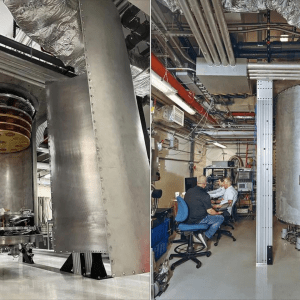
After three years of design and construction, a monthlong boat ride across the Pacific Ocean, and a lift from a 30-ton crane, the customized test chamber for NASA’s upcoming SPHEREx mission has finally reached its destination at Caltech’s Cahill Center for Astronomy and Astrophysics in Pasadena. Set to launch no...

ADVERTISEMENT

Dewar

A dewar is a type of cryostat named after Sir James Dewar, the researcher who first developed the concept of a vacuum insulated container with silvered walls to reflect thermal radiation. Dewar was the first to liquefy hydrogen, and he created the device to store his discovery. The thermos bottle...

Stirling and Gifford-McMahon Cryocoolers

Stirling and Gifford-McMahon (GM) cryocoolers are two of the most commonly used cryocoolers in cryogenics. Both devices have a significant industrial base and operate at a wide range of temperatures and capacities. The thermodynamic cycles for both of these cryocoolers are quite similar. The Stirling cycle consists of a compressor,...

Liquefied Natural Gas (LNG)

A significant commercial application of cryogenics is the liquefaction, transport and storage of natural gas. Liquefied Natural Gas (LNG) is generally 95 percent methane with a few percent ethane and much lower concentrations of propane and butane. LNG liquefies at 111.6 K. Unlike many applications of cryogenics, the motivation for...

Magnetic Levitation

From http://www.superconductors.org. Magnetic-levitation is an application where superconductors perform extremely well. Transport vehicles such as trains can be made to “float” on strong superconducting magnets, virtually eliminating friction between the train and its tracks. Not only would conventional electromagnets waste much of the electrical energy as heat, they would have...

Superconductivity

From Superpower website. History of Superconductivity Superconductivity was discovered in 1911 by the Dutch physicist, Heike Kammerlingh Onnes when he was able to liquefy helium by cooling it to 4 Kelvin, or -452°F. This enabled him to cool other materials close to absolute zero and investigate their electrical properties. He...

Medical Applications of Cryogenics

Neutron Therapy Cryogenics is at the heart of nuclear accelerators. Accelerators such as Fermilab’s Tevatron make neutron therapy for cancer possible. From Fermilab Today 4/20/09: Fermilab currently offers neutron therapy. But staff at Fermilab designed and built the proton accelerator used by the nation’s first hospital-based treatment center to use...

Nuclear Physics

Al Zeller National Superconducting Cyclotron Lab (NSCL) at Michigan State University zeller@nscl.msu.edu Cryogenics has a long history in nuclear physics. The technology has its origins in the use of cold traps for maintaining a vacuum, which is required to prevent beam loss and for generating high voltages used in acceleration....

Could an Amateur Construct a Liquid Air Plant?

I am a newly retired experimental physicist. Is it feasible for an “amateur” to construct a liquid air plant? Do you have detailed descriptions of older (presumably simpler) liquid air plants, or references that might be of assistance?