ADVERTISEMENT

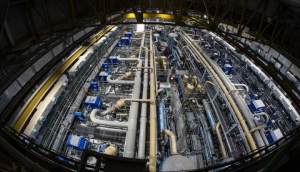
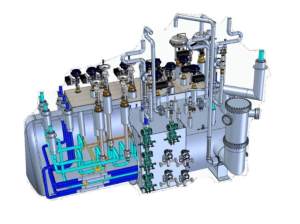
Demaco Produces ESS Hydrogen Distribution System

Hydrogen is the most abundant chemical element in the universe and the most important feedstock for life. In Greek, the word “hydrogen” is composed of the terms “hydro” and “genes,” which means water generator. In 1766, the English chemist Henry Cavendish distinguished hydrogen from other flammable gases and identified its properties,...


Ability Engineering Technology Introduces Ultra Precise Cryo Valve to Public

Ability Engineering Technology (AET), an Illinois-based manufacturer of equipment used in cryogenic process applications, has announced the introduction of a standard product line of Cryogenic Valves. According to Matt Resler, Sales Director at AET, “Our cryogenic valves have been successfully used for more than 30 years by our DOE clients, and...

Space Cryogenic Workshop Recap

During a year filled with uncertainty, many were worried about the effects of the pandemic on CSA’s biennial Space Cryogenics Workshop (SCW). After much consideration and effort, we are pleased to report the successful execution of our first – and hopefully only – virtual SCW. Hosted virtually on the Remo®...

Fermilab Sees Record Performance from Next-Generation Accelerator Componen

For several years, three US Department of Energy national labs have worked together to further improve state-of-the-art particle accelerator technology. First tests of a prototype built at Fermi National Accelerator Laboratory (Fermilab, CSA CSM) show the effort has paid off, with a new component setting records. The technology under development...

ITER Takes First Steps Toward Cryoplant Commissioning

Every week since the beginning of November, a tube trailer filled with approximately 4,600 cubic meters (750 kg) of compressed gaseous helium delivers its load to the ITER cryoplant in the south of France. At a later stage, the deliveries will become more massive, as helium is delivered in liquid...

Jefferson Lab Accelerator Gets a Fresh Pair of Eyes

A newly invented detector is allowing physicists at the US Department of Energy’s Thomas Jefferson National Accelerator Facility (CSA CSM) to “see” neutrons like never before. Fresh insight from these devices has improved operation of the lab’s powerful electron accelerator, which is used in nuclear physics studies of the atom’s...

ADVERTISEMENT

Helium II

Helium II (He II) refers to the second liquid phase of the most abundant helium isotope (4He). Helium II is also referred to as superfluid helium. Helium II occurs once the temperature of the liquid helium drops below 2.17K. The phase transition between the first liquid phase of Helium (referred...

Air Separation and Liquefaction

by Nils Tellier, PE, President, EPSIM Corporation (CSA CSM) nils@epsim.us All illustrations courtesy EPSIM Corporation Background History of Air Separation and Liquefaction This section builds on a rich history of methods to develop deep refrigeration and cryogenic liquefaction during the 19th Century. You are encouraged to read Cryo Central’s History...

Bose-Einstein Condensate

A Bose-Einstein condensate, first proposed in 1925 by Albert Einstein based on work done by Satyendra Nath Bose (the same Bose from whom the term boson is derived), is a super-cold state of matter in which almost all of the individual atoms have “condensed” down to the lowest possible quantum...

Cold Technology for Pest Control

While it does not reach temperatures cold enough to be called cryogenic, carbon dioxide snow is at the heart of a new way of dealing with unwanted pests. It utilizes a quick freezing process that takes advantage of the properties of carbon dioxide snow and has a number of benefits...

Cryogenic Finishing

The following 3 articles discuss the uses and procedures of various type of cryogenic finishing. 1) By Robin A. Rhodes, Cryogenic Institute of New England, Inc. rrhodes@nitrofreeze.com Cryogenic Deflashing is employed to remove undesired residual mold flash that remains on molded parts after they are removed or ejected from the...