ADVERTISEMENT

Next-Generation Oilless Cryogenic ORC Turbine Generator

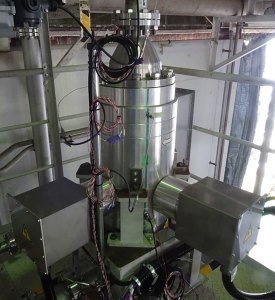
Mitsubishi Heavy Industries, Ltd. (MHI) and Mitsubishi Heavy Industries Marine Machinery and Equipment Co., Ltd. (MHI-MME), a wholly owned operating company of MHI based in Nagasaki, have successfully conducted demonstration testing of 100 kW class cryogenic ORC (Organic Rankine Cycle) power generation using the world’s first “next-generation oilless cryogenic turbine...
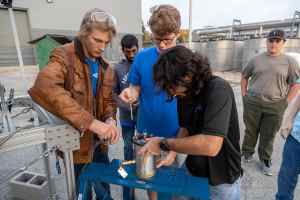
Students Design Experimental Fuel System To Power Liquid-Propellant Rocket Engines

Aerospace Engineering students Alex Clay and Samir Ahmed have spent the past four years at Embry-Riddle Aeronautical University manufacturing complex liquid-propellant rocket engines. Now, as they near graduation, there is one last thing they’d like to do: Prepare for ignition. Along with fellow members of the university’s Experimental Rocket Propulsion Laboratory...

The Next Generation in Cryogenics and Superconductivity

CSA’s annual Young Professionals introduces outstanding engineers, scientists, and technicians (under 40) who are making fascinating contributions to the cryogenics and superconductivity industries. Debuted in the summer of 2006, this spotlight shines on future leaders who show the promise of making a difference in their fields.  We are proud to...

Chase Coolers and Their Long History in CMB Science

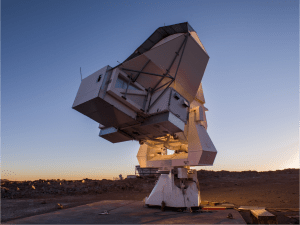
Making advances in science requires the proper tools. Often those tools must be developed by scientists themselves. That’s the story of most science missions studying Cosmic Microwave Background radiation (CMB). Sub-Kelvin coolers developed by Chase Research Cryogenics (CSA CSM) have played a strategic role in many of these missions. Let’s...

Launching a Groundbreaking Mobile Liquid Hydrogen System

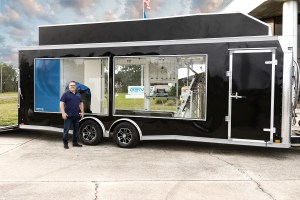
GenH2, an industry leader in hydrogen infrastructure solutions, announced the launch of its groundbreaking LS20 mobile liquid hydrogen system, an end-to-end liquefaction and storage system. The innovative, mobile liquefaction unit offers a space-optimized, fully integrated liquid hydrogen solution to be used in a range of applications from transportation to energy...

Liquid Helium Ballast Refrigeration

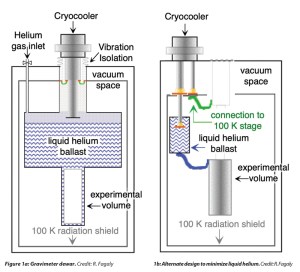
The Need for Vibration-Free Cryogenics The measurement of local gravitational fields requires continuous, high precision and extremely stable measurements. In 1968, the development of the superconducting gravity meter (SG)[1] vastly improved the state of the art. In contrast to mechanical quartz or metal springs, SGs use a superconducting sphere levitated in...

ADVERTISEMENT

Stability

Stability refers to the ability of a device employing superconductors to remain in its superconducting state after part of the superconductor transitions back to its normal conducting state due to a disturbance. While the concept can apply to many superconducting devices—transmission lines, generators, motors, etc.—it is most commonly considered in...

Cable-in-Conduit Conductors

Cable-in-Conduit Conductors (CICC) are a common form of superconducting cable used in large-scale applications. There are several varieties of CICCs, but they all consist of many small, stabilized superconducting wires contained within a conduit through which a coolant (typically supercritical He II) flows. Figure 1 shows the cross section of...

Bayonet Coupling

A bayonet coupling is a demountable joint that allows for quick and easy connection and disconnection of cryogenic components, including transfer lines, cryostats, liquefiers and refrigerators. Bayonets provide a number of advantages, chief among them the ability to connect and disconnect the bayonets while components they connect are still at...

Magnets

From “Superconductivity: Present and Future Applications” by the Coalition for the Commercial Application of Superconductors. Particle physics uses accelerators to recreate the conditions of the early universe in an attempt to piece together the complex puzzle of how we got to where we are today. These huge machines are used...

Energy Storage

From “Superconductivity: Present and Future Applications” by the Coalition for the Commercial Application of Superconductors. With power lines increasingly congested and prone to instability, strategic injection of brief bursts of real power can play a crucial role in maintaining grid reliability. Small-scale Superconducting Magnetic Energy Storage (SMES) systems, based on...

Astronomy

ASTRONOMY IN SPACE by Peter V. Mason, retired,  Jet Propulsion Laboratory, and Visiting Associate, California Institute of Technology. Pmason@alumni.caltech.edu In thinking about the reasons to perform astronomy in space, we first consider the effect of the earth’s atmosphere.  On a scale of decreasing energy, gamma rays, cosmic rays, X-rays and...

Cryocoolers

What is a Cryocooler? A mechanism that can extract heat from an object (cooler) and by doing so draw its temperature down below approximately 150 Kelvin (cryo). — (Courtesy Dr. Willy Gully) What is the difference between a Cryocooler and a Cryostat? A cryostat is any device designed to maintain...

An Issue of Pressure and Flow Rate in a Supply Tank

Please help solve this problem: A supply tank requires a vaporizer to generate sufficient pressure to pump stored fluid up into a vehicle or tank. The available head is limited as the tank level falls and it is important to minimize the system pressure drop to maintain the desired flow...

Using MLI on VJ Line Joints or Cryo Storage Tanks

When installing Multi Layer Insulation (MLI) blankets on VJ line joints or cryo storage tanks should they be wrapped and tied down tight or loose? These are usually pre-cut to size. Also should they have an access hole at the point of where the molecular sieve is installed to help...