

ADVERTISEMENT

Space Cryogenic Workshop Recap

During a year filled with uncertainty, many were worried about the effects of the pandemic on CSA’s biennial Space Cryogenics Workshop (SCW). After much consideration and effort, we are pleased to report the successful execution of our first – and hopefully only – virtual SCW. Hosted virtually on the Remo®...
Fermilab Sees Record Performance from Next-Generation Accelerator Componen

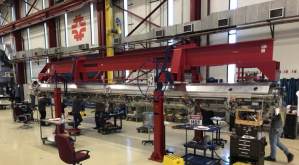
For several years, three US Department of Energy national labs have worked together to further improve state-of-the-art particle accelerator technology. First tests of a prototype built at Fermi National Accelerator Laboratory (Fermilab, CSA CSM) show the effort has paid off, with a new component setting records. The technology under development...

ITER Takes First Steps Toward Cryoplant Commissioning

Every week since the beginning of November, a tube trailer filled with approximately 4,600 cubic meters (750 kg) of compressed gaseous helium delivers its load to the ITER cryoplant in the south of France. At a later stage, the deliveries will become more massive, as helium is delivered in liquid...

Jefferson Lab Accelerator Gets a Fresh Pair of Eyes

A newly invented detector is allowing physicists at the US Department of Energy’s Thomas Jefferson National Accelerator Facility (CSA CSM) to “see” neutrons like never before. Fresh insight from these devices has improved operation of the lab’s powerful electron accelerator, which is used in nuclear physics studies of the atom’s...

ADVERTISEMENT

Dewar

A dewar is a type of cryostat named after Sir James Dewar, the researcher who first developed the concept of a vacuum insulated container with silvered walls to reflect thermal radiation. Dewar was the first to liquefy hydrogen, and he created the device to store his discovery. The thermos bottle...

Stirling and Gifford-McMahon Cryocoolers

Stirling and Gifford-McMahon (GM) cryocoolers are two of the most commonly used cryocoolers in cryogenics. Both devices have a significant industrial base and operate at a wide range of temperatures and capacities. The thermodynamic cycles for both of these cryocoolers are quite similar. The Stirling cycle consists of a compressor,...

Liquefied Natural Gas (LNG)

A significant commercial application of cryogenics is the liquefaction, transport and storage of natural gas. Liquefied Natural Gas (LNG) is generally 95 percent methane with a few percent ethane and much lower concentrations of propane and butane. LNG liquefies at 111.6 K. Unlike many applications of cryogenics, the motivation for...

Primary Standards

Elie K. Track Hypres, Inc. elie@hypres.com http://www.hypres.com/ Primary standards involve the exact definition and realization of units of measurement for various quantities, time, length, mass, voltage, resistance, current, etc. International agreements based on the latest scientific knowledge define those units, and their realizations vary depending on the unit itself. For...

Shrink Fitting

Robin A. Rhodes Cryogenic Institute of New England, Inc. rrhodes@nitrofreeze.com Shrink fitting, (or “compression fitting” as it is sometimes called), is a method used to insert a pin or bushing into a housing or other assembly requiring an extremely tight tolerance fit. It can be used as an alternative to...

Telecommunications

From the Winter 2004 issue of Cold Facts magazine The recent M-Calc IV — 4th Industry Assessment workshop discussing military and commercial applications for low-cost cryocoolers, held in November in San Diego, highlighted progress being made in cryogenics as applied in telecommunications. The reliability and long lifetime of projects now...

Wind Tunnels

Dr. Robert Kilgore The development of the cryogenic wind tunnel is one of many significant breakthroughs in both cryogenics and wind-tunnel technology made during the past millennium. Interest in the development of high-speed commercial and military aircraft resulted in a review of problems of flow simulation in transonic wind tunnels...

Cryogenic thermophysical property data

I am in search of information regarding cryogenic thermophysical property data, specifically, Thermal Conductivity, Thermal Expansion, Stiffness and Modulus, in the 20K range. My list of materials include: Ti-6AL-4V (ELI), Al 6061-T651, and Invar (36%, plus any other composition which might have data available). Other materials which would be helpful...



