Antarctic research productivity relies on consistent access to energy. Increased availability of cheaper and cleaner energy could enhance the research capacity at Antarctic stations and expand the frequency of research flights using aircraft such as the Basler BT-67 (a modified DC3) to map climate change impacts on glaciers. The Australian Antarctic Division (AAD) resupplies its three Antarctic stations biannually with special Antarctic blend diesel using the icebreaker RSV Nuyina from Hobart, Tasmania. The ambition of achieving net-zero Antarctic station emissions by 2040 presents an opportunity to harness the abundant wind energy, particularly at Mawson Station, for onsite green hydrogen production, enabling greater energy independence. Renewable liquid hydrogen (LH2) could provide clean, dispatchable fuel suitable for aerial-based research and station operations, addressing both the reliance on diesel and the intermittency of renewable resources such as wind and solar. Investigating the potential use of LH2 in a resource constrained environment like Antarctica could provide valuable insights for developing LH2 supply chains in other remote and extreme locations worldwide.
Hydrogen produced by electrolysis has already been used in Antarctic research activities, including filling weather balloons at Australian research stations and demonstrating fuel cell power at Argentina’s Esperanza Antarctic station.[1] However, the techno-economics of Antarctic hydrogen energy remain poorly understood due to the region’s uncertain location cost factors, logistical challenges and the need for redundancy in equipment and personnel. To assess the feasibility of scaling up green hydrogen energy use in Antarctica, the levelized cost of supplying green LH2 to Australia’s Mawson Station was estimated for both a low and high demand scenario. This was conducted through the comparison of the costs of importing versus producing green LH2 onsite using a techno-economic model developed in MATLAB. Understanding the economic viability of green hydrogen in Antarctica is a vital step towards decarbonizing human activity in the region.
Hydrogen Demand Scenarios
The low demand scenario was based on the hydrogen needed to match the distance covered by the Basler research plane using lightweight LH2 drones. This corresponded to a hydrogen demand of 13.6 kg/month using small-scale fixed-wing drones akin to the LH2-powered ScanEagle demonstrated by Insitu and Washington State University.[2] The high demand scenario was based on providing 25% of the electricity and heat of Australia’s Mawson Station and corresponded to a hydrogen demand of 1914 kg H2/month.
Supply Chain Analysis
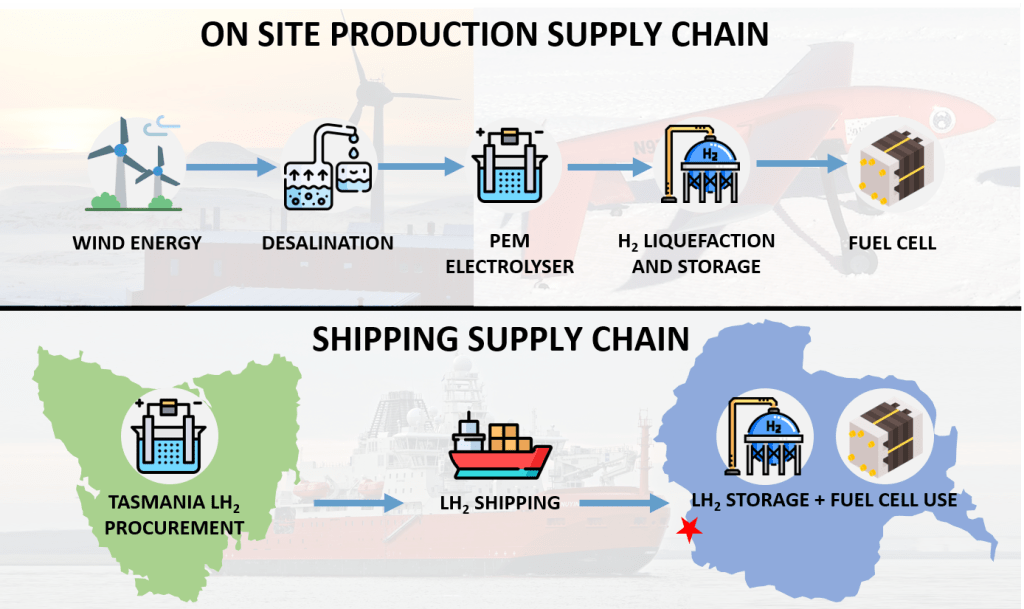
Onsite production and shipping LH2 supply chains were modelled based on the processes in Figure 1 to determine the levelized cost of energy (LCOE) breakdown for a 20-year project lifetime. The onsite production supply chain required additional processes for wind energy generation, seawater desalination, electrolysis and modular cryocooler based liquefaction. Comparatively, the shipping scenario involved procuring LH2 offsite in Tasmania, at $6.50 AUD/kg and transporting it to Mawson biannually, where it was stored in 40-ft ISO-containers.
Economic Analysis
The LCOE for both LH2 demand scenarios and supply chains is shown in
Figure 2. At low hydrogen demands, labor was found to account for the highest proportion of the LCOE for both shipping and production, whilst factors such as storage and electrolysis were less significant. Additional plant operators were required to ensure sufficient skills for maintenance and operation of LH2 equipment new to Antarctica. At higher demands, the cost of LH2 storage dominated the LCOE for both supply chains. Oversizing the storage capacity to account for boiloff losses and parallelizing expensive LH2 ISO-containers both contributed to levelized hydrogen costs over $57 AUD/kg. This emphasizes the R&D needs to lower the cost of hydrogen storage and distribution to meet use case price points. Potential paths to reducing the supply cost of LH2 to remote areas could include minimizing boiloff losses arising from passive heat leak and tank transfers such as through reliquefication or utilization of boiloff gas and increasing the manufacturing scale of LH2 storage ISO containers.
Further analysis indicated that onsite production became more cost-effective compared to offsite production and shipping as the demand for hydrogen increased, with a crossover point at a demand of
68 kg H2/month. It cannot be definitively concluded that onsite production is the best pathway as there are practicalities that must be considered given the sensitivity of the location, such as the logistics of shipping equipment, weatherization of systems, labor requirements and safety considerations. Redundancy, location factors and the small scale of use all contributed to levelized costs of LH2 of approximately $500 AUD/kg at 100 kg/month decreasing down to approximately $50 AUD/kg above a scale of
2000 kg/month.
While LH2 may have a significantly higher cost than conventional energy sources, the potential value of Antarctic LH2 cannot be assessed through a simple cost comparison to diesel alone. Lightweight LH2 fueled drones could extend the range of research flights without producing emissions in one of our most fragile natural environments and is a use case that has no direct comparison to diesel. Beyond cost considerations, demonstrating hydrogen’s viability in Antarctica could establish the region as a model of energy sustainability in remote and extreme environments, while also helping to preserve its priceless ecosystems.
The authors would like to acknowledge the support of Dr. Thomas Hughes, Liam Turner and James Wang from the Civil Engineering Department at Monash University, David Waterhouse at the Australian Antarctic Division, Dr. Felicity McCormack from the School of Earth, Atmosphere and Environment at Monash University and the Securing Antarctic’s Environmental Future (SAEF) ARC special research initiative in completing this work.
References:
[1] Aprea, J. (2012). “Two years experience in hydrogen production and use in Hope Bay, Antarctica”. International Journal of Hydrogen Energy, p. 37.
[2] Washington State University. (2022). “University, industry collaboration allows liquid hydrogen-powered UAS to take flight. Retrieved from https://news.wsu.edu, July 2024.