By Rachael Floyd, Director of Product Management for Cryogenic Systems, Lake Shore Cryotronics
The Rising Price of Helium
Helium is a nonrenewable resource that is increasingly difficult to obtain reliably. Once released into the atmosphere, it is irretrievable. Limited availability and few sources of production are driving helium prices upward. Add in growing demand for helium in semiconductor manufacturing, magnetic resonance imaging, data storage and low temperature research, and the result is clear: helium prices have doubled since 2021.[¹]
Currently, prices for liquid helium range from $30/liter for large quantity purchases to $60/liter for small quantity purchases. Consider an example of a cryostat that requires 1 liter to cool down to base temperature and 1 liter per hour to maintain it. If the cryostat is used for six hours a day, four days a week, the weekly cost for research using the best available helium pricing is:
$30/L × (1 L + 1 L/hr × 6 hr/day) × 4 days/week = $840/week
For a month, that adds up to $3,360—a painful fixed cost. If the price per liter is $60, the monthly cost doubles to $6,720.
Options for Reducing Helium Consumption
Fortunately, there are strategies to manage helium expenditures. One option is a helium reclamation system, which captures and recycles used helium gas. However, these systems typically come with significant capital and infrastructure costs. For smaller labs, startups and teaching institutions, reclamation systems are often out of reach.
A second option is a closed-cycle refrigerator cryostat. The cold head is connected to the cryostat to form an integrated assembly. Unlike continuous flow cryostats, these do not require helium during operation. Disadvantages include higher initial cost, increased vibration due to the cold head being directly coupled to the cryostat, challenges in achieving ultrahigh vacuum, and a larger, heavier assembly that is less maneuverable.
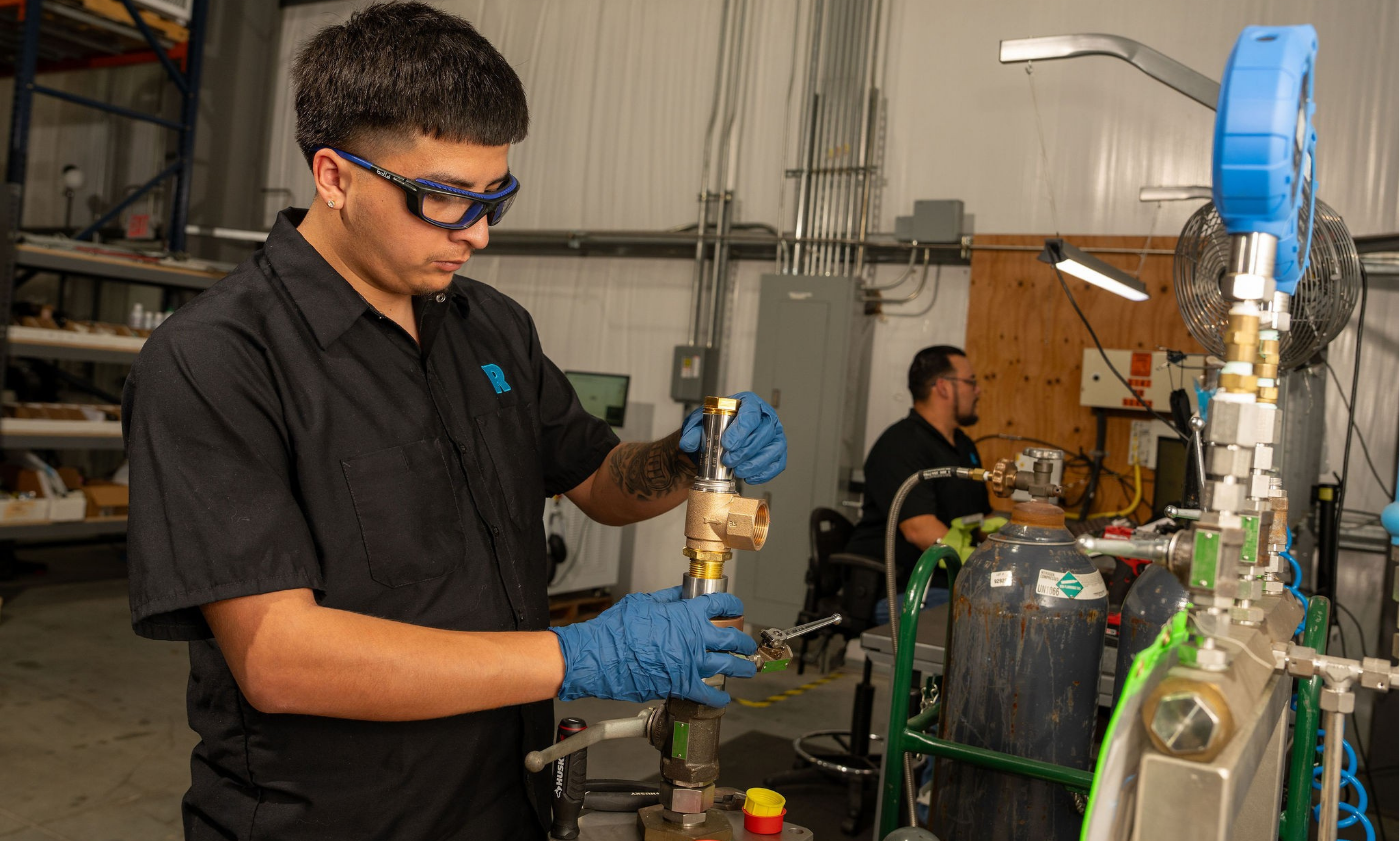
A third option is a system that uses recirculating gas cooling technology, allowing researchers to operate a continuous flow cryostat as a closed-loop system. Rather than consuming and venting helium, a recirculating gas system uses a fixed amount of helium circulated through a closed loop, cooling the sample chamber without helium loss. One example is the Infinite Helium recirculating gas cooler from Lake Shore Cryotronics (see Figure 1).
[Figure 1. Infinite Helium automated recirculating gas cooler (courtesy of Lake Shore Cryotronics).]
How a Recirculating Gas Cooling System Works
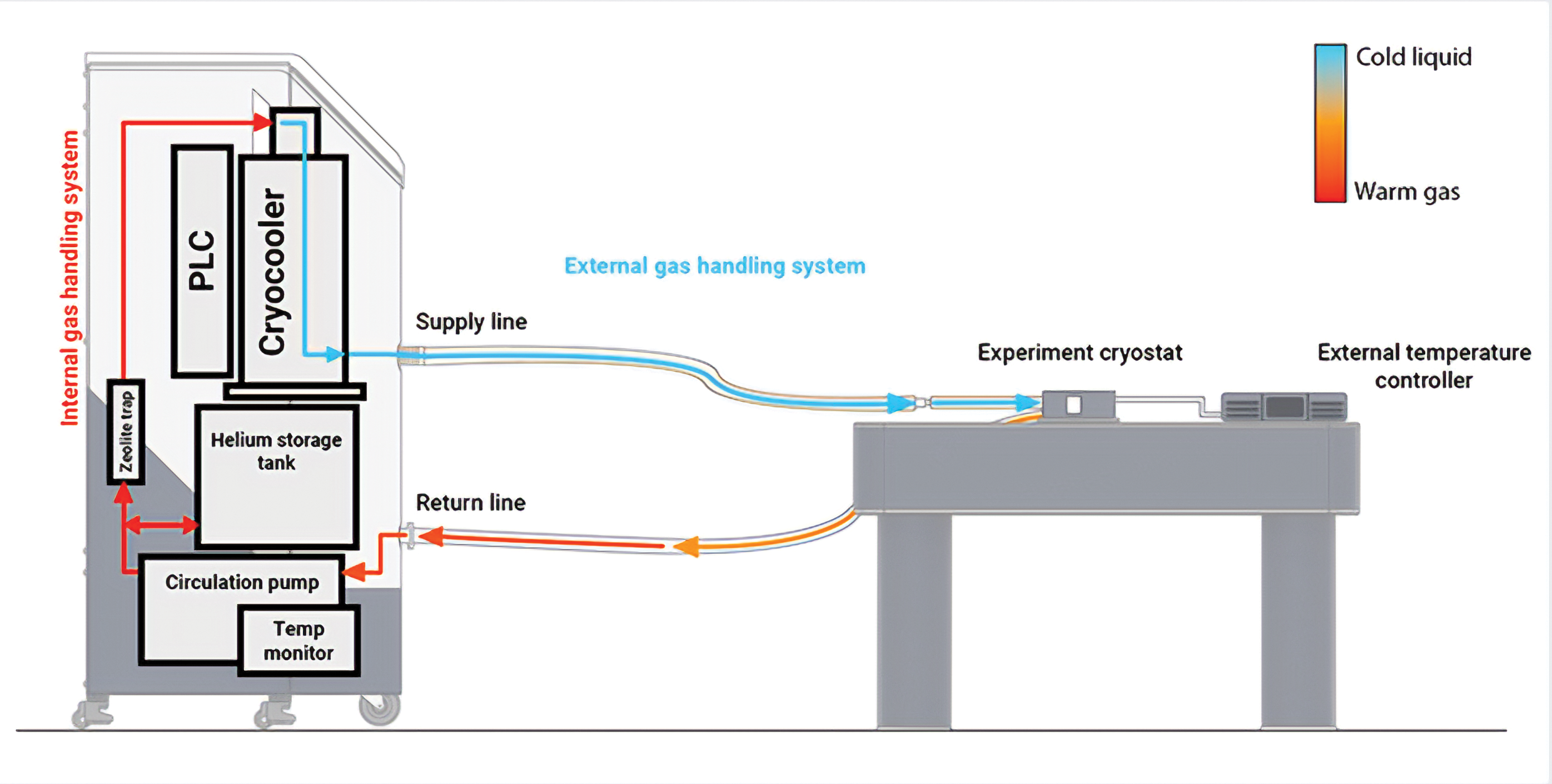
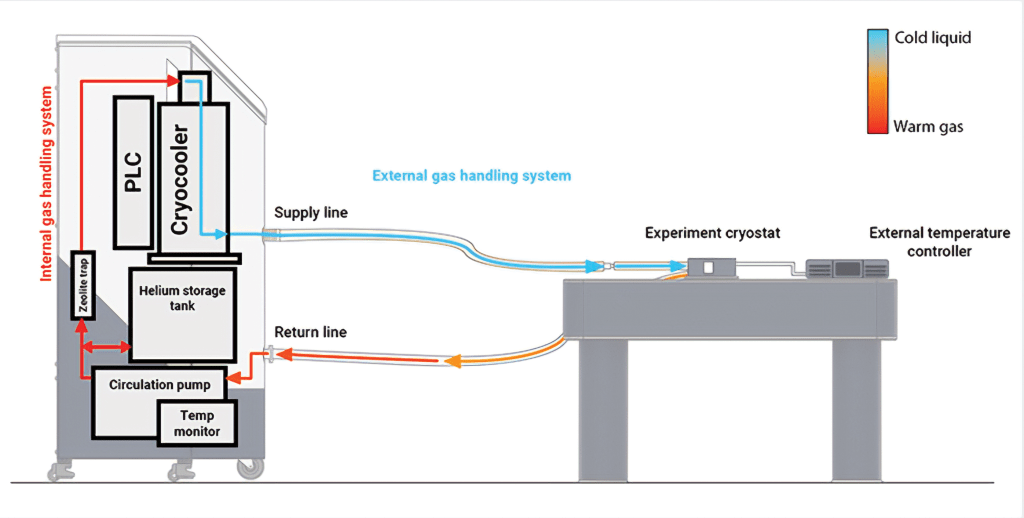
Figure 2 shows a system using the Infinite Helium recirculating gas cooler. In this setup, a continuous flow cryostat on an optical table receives liquid helium from a cryocooler. A flexible, vacuum-insulated transfer line connects the cryocooler to the cryostat. Helium cools the cryostat and then evaporates. A circulation pump draws the warmed gas back into the system through a return line and feeds it into the cryocooler. The cryocooler reliquefies the gas and returns it to the cryostat, completing the loop.
When idle, the system compresses and stores helium gas in a holding tank. The Infinite Helium system incorporates programmable logic controller (PLC) technology for automated operation.
[Figure 2. Block diagram of the Infinite Helium recirculating gas cooler.]
Research Efficiently, Safely and Cost-Effectively with Infinite Helium
In addition to significant helium cost savings, the Infinite Helium system offers numerous benefits:
- Automated operation – No more time wasted manually adjusting valves. Infinite Helium determines optimal settings for cooldown and base temperature maintenance.
- Greater setup flexibility – The cryostat can be oriented in any position to accommodate detection and measurement equipment.
- Compatibility with existing cryostats – The system works with many current continuous flow cryostats, reducing the need for new hardware or experimental redesign.
- Low vibration – Vibration isolation and physical distance from the cryostat allow sensitive research like microscopy to proceed undisturbed.
- Long-term continuous operation – The system can run for up to six months, enabling uninterrupted experimentation and eliminating mid-project maintenance.
- Enhanced thermal stability – Through controlled cooldown cycles, temperature setpoints and gas flow management, the system ensures a stable experimental environment with minimal thermal drift.
- Multi-lab utility – Designed with mobility in mind, Infinite Helium can be shared across labs, increasing ROI and supporting collaborative research.
- Enhanced safety – Built-in monitoring prevents fault conditions and reduces operator error that could cause downtime or equipment damage.
- Ease of use – Minimal training is required. For example, initiating cooldown is as simple as pressing one button on the touchscreen panel.
References
[1] A. Nordrum. “The era of cheap helium is over—and that’s already causing problems.” MIT Technology Review, Febuary 25, 2024. https://www.technologyreview.com/2024/02/25/1088930/global-helium-market-semiconductors/