By Wesley Johnson and Dan Hauser
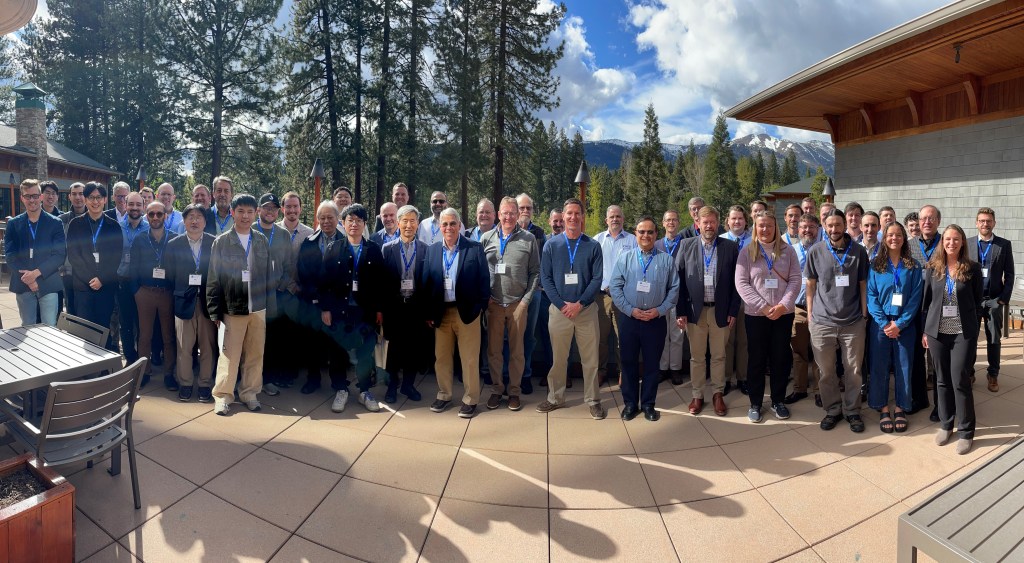
The 31st Space Cryogenics Workshop (SCW) was held at the Hyatt Regency Lake Tahoe in Incline Village, Nevada, from May 13 to 15, 2025, chaired by Wesley Johnson and Daniel Hauser. More than 60 scientists and engineers from around the world convened to discuss space applications for cryogenics, renew acquaintances and connect with new practitioners in the field. As is typical, the workshop was held the week before the Cryogenic Engineering Conference.
The technical program featured 35 papers and posters presented in a single-track format across eight oral and two poster sessions. Day one included mission overviews of the Black Hole Explorer, Titan Submarine and LOXSat; a session on multiple analysis methodologies and the verification of computational fluid dynamics and nodal codes for long-duration storage and pressure control of in-space propellants; a session on cryogenic chilldown testing and analysis; a session on heat transfer coefficient testing for boiling and subcooling cryogenic fluids; and an overview of sunshield developments. The first day’s poster session highlighted hydrogen heat pipes and the on-orbit performance of the XRISM dewar.
The second day was equally broad, featuring sessions on more experimental works, cryocoolers under lifetime testing, analytical modeling of aerospace cryogenic fluid systems and cryogenic long-duration propellant storage missions. A cryogenic propellant transfer test conducted aboard SpaceX’s Starship vehicle was also presented, detailing the transfer of cryogenic liquid oxygen between tanks under low-gravity conditions. Also included were presentations on the Cryogenic Active Cooling for Human Exploration (CACHE) acquisition and liquid hydrogen boiloff loss recovery systems. The second day’s poster session included presentations on a Turbo-Brayton cryocooler, a sub-kelvin adiabatic demagnetization refrigerator and a feasibility study of a mechanical cooler system for LiteBIRD. It was interesting to observe the combination of component testing and analysis as they fit into the bigger picture of several planned and proposed missions.
The SCW awards banquet was held at the Chateau, where attendees enjoyed mountain scenery and social interaction. The best paper award for the 2025 workshop was presented to Jinwook Kim, Kyoung Joong Kim, Junhyuk Bae and Sangkwon Jeong, of the Korea Advanced Institute of Science and Technology, for their paper entitled “Experimental and Numerical Investigation of Cryogenic No-Vent Fill (NVF) Process Using Adsorption on Activated Carbon.” The T.H.K. Frederking Space Cryogenics Workshop Student Scholarship was awarded to Ziyang Hang, a Ph.D. student at the University of Wisconsin. Michael Meyer, recently retired from NASA, and Wei Dai, of the Chinese Academy of Sciences, were recognized as Fellows of the Cryogenic Society of America for their contributions to space cryogenics and their demonstration of professional excellence and service.
The papers from the SCW have been submitted to Cryogenics for publication in a special edition. The authors thank the Diamond sponsors (OPW Clean Energy Solutions and Omega Flex), Gold sponsor (Alloy Valves and Control), Silver sponsors (Spaceline Technologies and Quest Thermal Group), and the session chairs and presenters for their patience with last-minute changes. The 31st Space Cryogenics Workshop once again demonstrated the vibrant and collaborative nature of the space cryogenics community. Attendees left with new insights, strengthened professional connections and a renewed sense of purpose for advancing cryogenic technologies in future space missions.